

Car Insurance Quote by Phone: A Step-by-Step Guide
Learn how to get an accurate car insurance quote by phone, what to prepare, what questions to expect, and how agents and shoppers handle the call
You're probably calling because the easy path already failed. The online form didn't know what to do with the teen driver, the short lapse, the financed SUV, or the older car you barely drive but still want covered right. That's exactly when a car insurance quote by phone stops being old-school and starts being useful.
A phone quote works best when your situation has moving parts. You can correct bad assumptions in real time, pin down which discounts are real, and keep one carrier from making itself look cheaper by stripping coverage. If you handle the call the right way, you don't just get a price. You get a cleaner comparison and fewer surprises when it's time to bind.
Why a Car Insurance Quote by Phone Still Wins for Complex Drivers
If you have one car, one driver, a clean record, and no questions, online quoting is fine. If you've got a lapse, a newly licensed driver, business-use miles, multiple vehicles, or you're trying to bundle home and auto, get on the phone.
Phone quoting still matters because shoppers don't buy insurance in one neat digital session. McKinsey found that more than 80% of shoppers used direct channels to gather information, 70% ultimately quoted direct, and over 75% spoke with a person, either an agent or a call center during the process, according to its auto insurance shopping research. That tells you something simple. People still need human help when the quote gets messy.
Who should call instead of click
A phone call is usually the smarter move if you fall into any of these buckets:
- Multi-car households: One driver may need broad coverage while another needs a cheaper setup.
- Non-standard history: Lapses, tickets, accidents, prior claims, or reinstatements often need explanation.
- Usage complications: Commutes, mixed personal and business use, rideshare questions, or delivery driving can break simple web forms.
- Bundle shoppers: Homeowners and renters often need someone to test whether the bundle savings outweigh a better standalone auto rate.
- Discount confusion: Good student, paperless, paid-in-full, loyalty, telematics, and vehicle-safety discounts don't always stack the way people expect.
Practical rule: If you expect to explain anything during the quote, call.
What the phone does better
A good agent can adjust assumptions while you're still on the line. They can tell you when a vehicle should be rated as pleasure use instead of commute, when a listed household member needs to be included, and when a deductible change is moving the premium more than any supposed discount.
The phone is also where complex comparison shopping gets sharper. You can hold the quote to your exact coverage target and force clarity before the number lands in your inbox. That's how you use a car insurance quote by phone strategically, not as a fallback.
What to Prepare Before You Dial for a Car Insurance Quote
Most bad phone quotes don't go bad because the agent is incompetent. They go bad because the caller is guessing. If you want a quote that holds up, gather the details first and keep them in front of you.
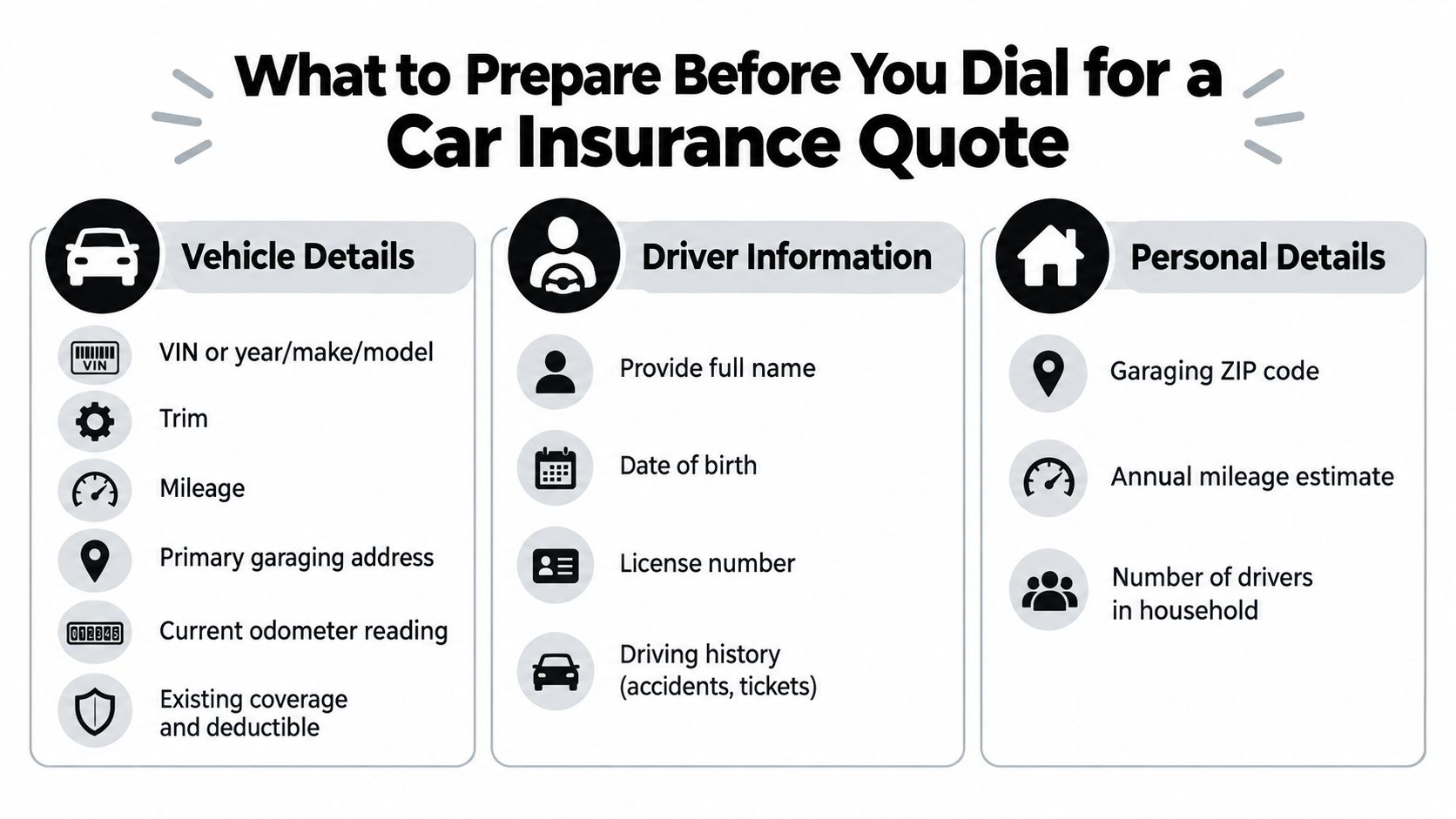
J.D. Power reported that shoppers receive an average of 3.5 quotes, the highest level in the study's history, in its 2026 U.S. Insurance Shopping Study press release. That means speed matters. If you fumble for details, you slow the call, increase rerates, and make it easier to compare the wrong numbers.
Vehicle details to gather
Start with each car on the policy. Don't rely on memory if you can avoid it.
- VIN or exact vehicle description: Year, make, model, and trim.
- Mileage facts: Current odometer reading and your best annual mileage estimate.
- Garaging location: The primary address where the car sleeps most nights.
- Ownership status: Owned outright, financed, or leased.
- Current physical damage setup: Existing coverage and deductible if you already carry collision or other protection.
- Special equipment: Anti-theft devices and meaningful safety equipment are worth mentioning.
Driver and household details to gather
Calls get stuck. The rep can't rate a policy accurately if the driver list is fuzzy.
- Legal names and dates of birth: Every household driver, not just the ones you want to insure.
- License details: License number and state for each rated driver.
- Driving history notes: Accidents, tickets, claims, and any lapse in prior insurance.
- Occupation and daily use: Work status, commute pattern, and whether anyone uses a car for business tasks.
- Policy context: Current insurer, renewal date, and whether you also have home or renters coverage to bundle.
Keep your current declarations page open during the call. It's the fastest way to stop coverage errors before they start.
Two things that save the call
A practical phone quote usually starts with identity and garaging address, then moves into vehicle details, current limits, prior coverage, driving history, and bundle signals before the rep gives a preliminary number, as outlined in the J.D. Power methodology note linked above. The more complete those inputs are, the less likely you are to get hit with quote drift later.
Last, give yourself a quiet window. Ten focused minutes with no speakerphone chaos beats a longer call filled with repeated questions and wrong entries.
What the Agent Will Actually Ask You on the Call
The agent usually starts with the part that drives the rating fastest: where the car is kept and how it's used. That means garaging ZIP, whether the vehicle is owned or leased, and whether it's personal use, commuting, or something more complicated. If your answer is vague, the rest of the quote gets shaky.
Then the rep goes driver by driver. They'll ask who lives in the household, who has access to the vehicles, and who should be listed. Expect questions about license status, prior insurance, accidents, violations, and how long each driver has been continuously insured.
The sequence that actually moves the quote
Here's the normal rhythm of a solid call:
- Location and use first: Garaging address, ownership, commute, business use, rideshare, or delivery use.
- Driver profile next: Names, license details, driving history, prior carrier, lapse history.
- Vehicle specifics after that: VIN, trim, annual miles, where the car is parked, and whether it sits in a garage, driveway, or on the street.
- Coverage choices last: Liability limits, deductibles, uninsured motorist, roadside, rental, and bundling options.
That order matters because the rating engine can't produce a useful quote if the fundamentals are wrong.
What's negotiable and what isn't
The ZIP code isn't negotiable. The VIN isn't negotiable. The household drivers aren't negotiable if they need to be listed. What can move is the structure of the policy. You can often change deductibles, remove add-ons you don't need, or test whether telematics makes sense.
If an agent jumps to price before confirming use, drivers, and prior coverage, treat that quote as a draft, not a decision.
If you want to understand how strong intake questions improve the whole process, review these lead qualification questions for inbound calls. The same discipline applies to insurance. Clean intake produces cleaner quotes.
When the rep finally gives you a number, ask one direct question: “Which inputs had the biggest effect on this price?” A competent agent will tell you.
Keeping Coverage Comparisons Apples-to-Apples by Phone
If you don't lock the coverage structure before the second call, you're not comparing insurers. You're comparing different policies with different packaging.
Shoppers now collect more quotes than they used to, and phone calls with agents can take real time, especially when one person is shopping several carriers in a single conversation, as noted in the earlier shopping discussion and in neutral call-timing guidance from Tesco Insurance contact guidance. That's exactly why you need a script.
Lock these fields before every call
Use the same wording every time. Don't say “whatever's standard.” That's how agents downgrade the quote.
| Field | Locked Value | Why It Matters |
|---|---|---|
| Liability limits | Your chosen target | Lower limits can make one carrier look falsely cheaper |
| Collision deductible | Same amount on every quote | Deductible changes distort premium comparison |
| Comprehensive deductible | Same amount on every quote | Same reason as collision |
| Drivers listed | Identical household driver list | Missing drivers can trigger rerates later |
| Vehicle usage | Same description each call | Commute versus pleasure use changes rating |
| Annual mileage | Same estimate each call | Mileage assumptions can shift price |
| UM/UIM coverage | Same election each call | Quiet reductions make quotes look cheaper |
| Roadside and rental | Either included everywhere or nowhere | Add-ons create false price gaps |
The script that keeps the call honest
Say this up front: “Please quote the same drivers, same vehicles, same limits, same deductibles, and the same optional coverages I'm using with the other carriers.”
Then listen for the soft tricks. Some reps lower uninsured motorist coverage, strip roadside, or raise deductibles to get the headline premium down. Stop that immediately and reset the quote.
Use one simple spreadsheet with each carrier in its own column. Capture the premium, quote number, effective date, coverages, deductibles, and notes on any discount assumptions. Clean comparison beats memory every time.
Personal Data You Must Share and What You Can Hold Back
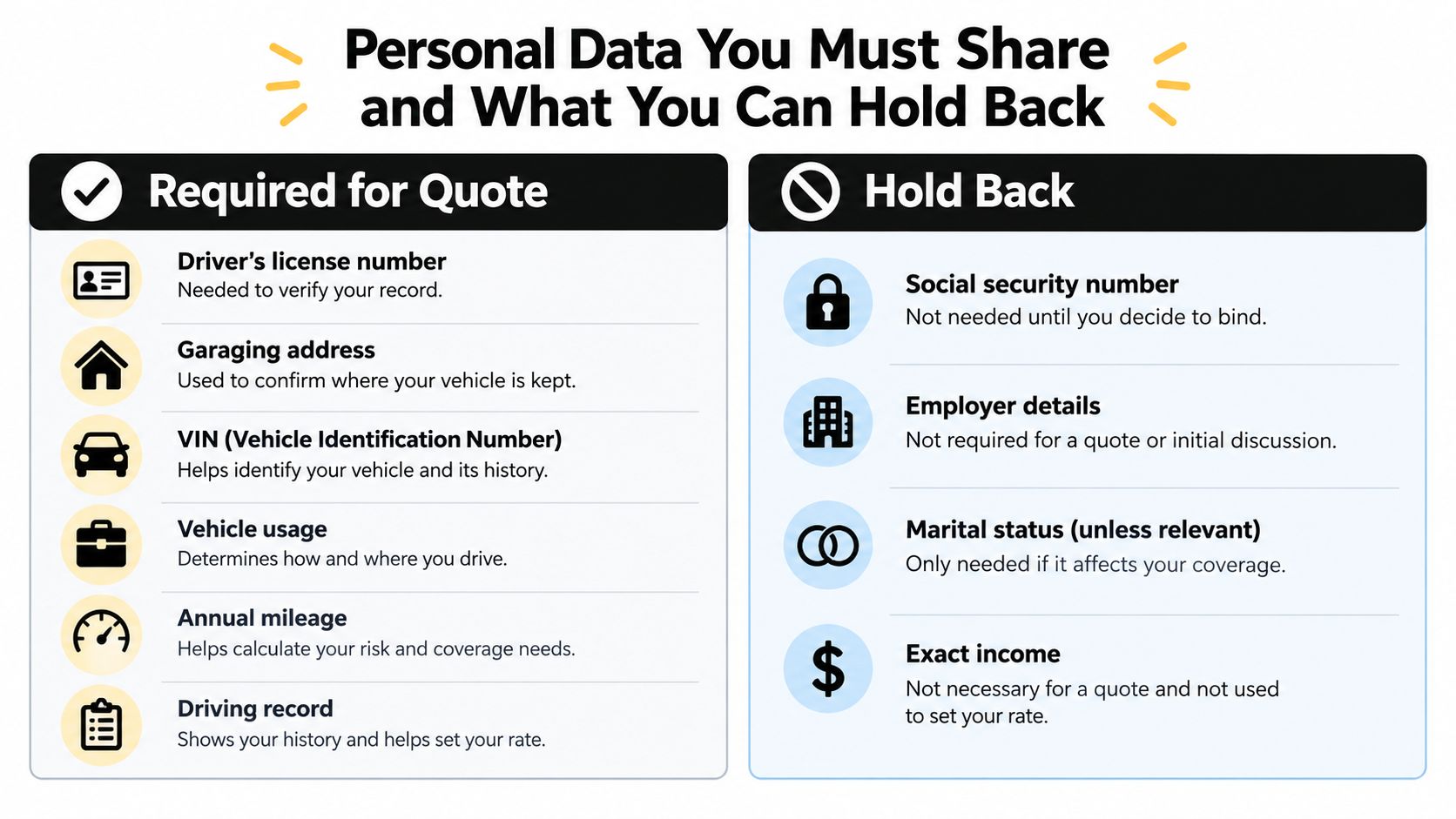
A lot of shoppers overshare because they think they have to. You don't. For a quote, give the data that improves rating accuracy. Hold back the data that signals you're ready to buy until you've chosen the policy.
Guidance aimed at consumers often asks for full name, address, driver's license number, Social Security number, VIN, mileage, and insurance history. Some carriers also ask financial or criminal-history questions during the quoting process, which is exactly why many callers feel exposed, as reflected in Allstate's auto insurance guidance. You should be selective.
Share this for an accurate quote
These items usually matter to the quote itself:
- Driver's license number: Helps verify the driving record.
- Garaging address: Rating depends heavily on where the vehicle is kept.
- VIN: Reduces vehicle-description errors.
- Vehicle usage: Personal, commute, business-related, rideshare, or delivery.
- Annual mileage: Impacts rating assumptions.
- Driving history: Prior accidents, violations, claims, and coverage gaps.
Hold this back until you're ready to bind
These details can wait unless the carrier has a clear reason tied to finalizing the policy:
- Social Security number
- Payment card or bank details
- Employer details beyond what's needed for occupation
- Extra personal data that doesn't change the quote
Tell the agent this plainly: “I'm shopping right now. I'll provide payment information and any bind-only details after I choose the policy.”
A legitimate rep should be able to separate quote-stage questions from bind-stage questions. If you want a broader framework for handling sensitive intake information, this guide on customer data security for phone-based workflows is worth reading.
How Insurance Agents Can Quote Faster With an AI Receptionist
Most agencies don't lose phone quotes because nobody wants the business. They lose them because the call came in at the wrong time, the producer was already tied up, or the office let a high-intent shopper hit voicemail.

That's expensive behavior in insurance because inbound calls tend to outperform forms in conversion. Foundry CRO's insurance benchmarks report that phone calls convert at 30% to 50% versus 10% to 20% for online forms, and that qualified exclusive inbound auto calls can push quote-to-bind rates higher than typical auto quoting benchmarks, according to its insurance advertising benchmarks. If the phone is where intent shows up, agencies need intake coverage, not more missed calls.
What an AI receptionist should actually do
An AI receptionist should not try to replace licensed advice. It should handle intake cleanly and get the agent to the useful part faster.
It should:
- Answer overflow and after-hours calls
- Collect quote basics like name, ZIP, vehicles, drivers, current carrier, and requested effective date
- Handle voice and text on the same workflow
- Book callbacks or appointments directly into the team calendar
- Send a usable summary before the agent returns the call
SkipCalls is a simple-to-set-up solution that works for any case, from customer support, lead qualification, appointment booking, and many more. It handles voice and text and does not require you to change your phone number to integrate into your workflow. It has many integrations with CRM and calendars.
That last part matters operationally. Businesses can usually keep their existing number through number porting, and some business phone setups let teams preserve workflows without changing the published line. CRM syncing, calendar booking, and lead capture from calls and texts are also standard capabilities in tools built for appointment-heavy businesses, as shown in this overview of CRM and calendar integrations in call handling tools.
For a closer look at how this model works in practice, watch this quick walkthrough.
If you're evaluating this setup for an agency, this overview of an AI phone receptionist for inbound call handling covers the core workflow.
After the Call - Verification, Follow-Up, and Binding
The call ending doesn't mean the quote is done. It means you've entered the part where small mistakes turn into premium changes, missing coverage, or bind delays.
Verify the quote in writing
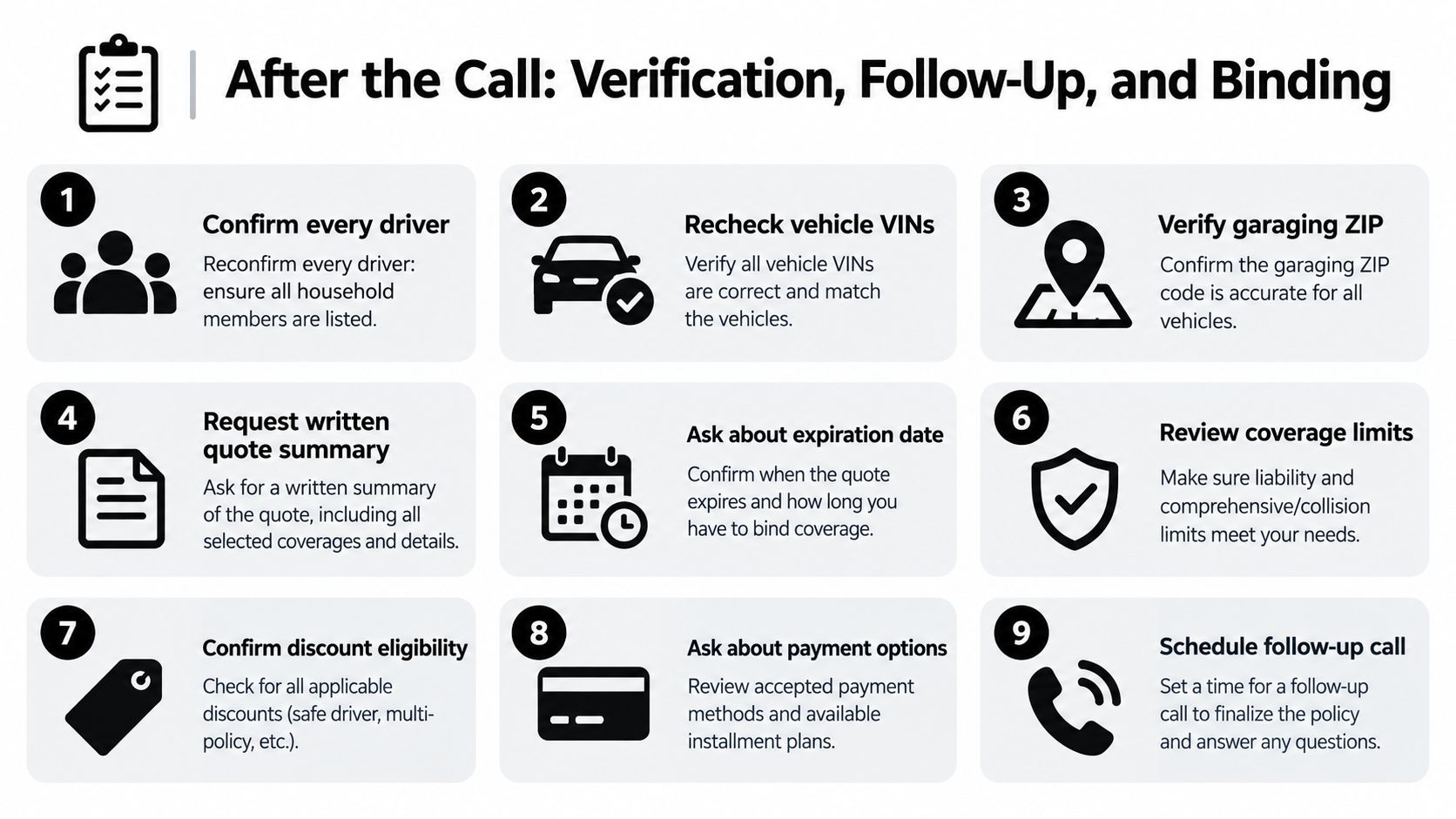
Before you pick a winner, get every serious quote summarized in writing. Email or text is fine. You want a record you can compare line by line.
Your post-call checklist should include:
- Reconfirm every driver: Make sure no one was added or omitted by mistake.
- Recheck VINs and garaging details: One wrong digit or wrong ZIP can trigger a rerate.
- Verify coverage limits and deductibles: Don't trust the verbal summary alone.
- Ask for the quote number and effective date: You need both for follow-up.
- Review discount assumptions: Bundle, telematics, paid-in-full, and loyalty details should be explicit.
Ask the agent how long the quote is expected to remain valid. Quote timing matters, especially if you're still collecting competing offers or waiting on household paperwork.
Handle follow-up like a buyer, not a browser
If anything was unclear on the first call, schedule a follow-up quickly. Don't leave the file half-finished and expect the number to hold forever. If you're comparing several agencies, a simple callback plan keeps the process organized. Agencies that want to work old leads or stale quote requests more systematically can borrow ideas from this local service database reactivation guide, especially around structured follow-up and re-engagement.
If you plan to keep your own record of the conversation, make sure you understand the legal and practical side of that first. This guide on how to record a business conversation responsibly is a good place to start.
Get the quote in writing before you bind. If the written version doesn't match the call, the written version is the real one.
What to confirm before binding
When you're ready to move, switch from shopping mode to execution mode.
- Payment method: Confirm the first payment process and timing.
- Start date and time: Don't assume midnight. Confirm it.
- Declarations page accuracy: Read it. Don't just file it.
- Lienholder information: Required if the vehicle is financed.
- Proof of insurance delivery: Ask how you'll receive it and when.
After binding, save the quote or declarations PDF, store the agent's contact details, and review the policy again at renewal or after any major life change. That habit catches more errors than people think.
If your agency depends on phone quotes, missed calls are lost revenue and messy follow-up is wasted time. SkipCalls gives insurance teams an AI receptionist that answers calls and texts, captures quote details, and books callbacks so agents can spend more time quoting and less time chasing incomplete leads.

