
10 Creative SMS Messages for Local Businesses
Explore 10 creative SMS messages for appointments, follow-ups, promotions, reviews, and lead nurturing that local service businesses can use today.
A customer is waiting at the front desk while a new lead calls. Another prospect has just sent a text, and nobody knows whether the caller received a response. By the end of the afternoon, the team has served customers, but several promising conversations still have no clear next step.
The strongest creative SMS messages aren't clever for the sake of being clever. They're short, specific, conversational, and connected to a workflow such as booking, qualification, follow-up, reactivation, or review collection. SMS campaigns can reach around 96.6% deliverability, and benchmark click rates for well-performing campaigns range from roughly 8.9% to 14.5%, so the opportunity is immediate, but so is the cost of sending unclear messages. TrueDialog's SMS benchmarks explain why speed and a direct action matter.
Below are 10 practical templates for local businesses, from appointment confirmations and missed-call recovery to nurturing, referrals, and feedback. They work especially well when voice calls, texts, CRM records, and calendars share the same workflow. SkipCalls handles voice and text, captures and qualifies leads, books appointments, and connects CRM and calendar workflows without requiring you to change your existing business number. You can also see how Bonna Beauty manages SMS around booking and customer communication.
1. Appointment Confirmation with Service Details
A confirmation text should remove uncertainty, not just announce that an appointment exists. The customer needs the service, date, time, location, and the easiest way to confirm or change the booking.
Practical rule: Put the appointment details before the explanation. Customers should understand the commitment from the first line.
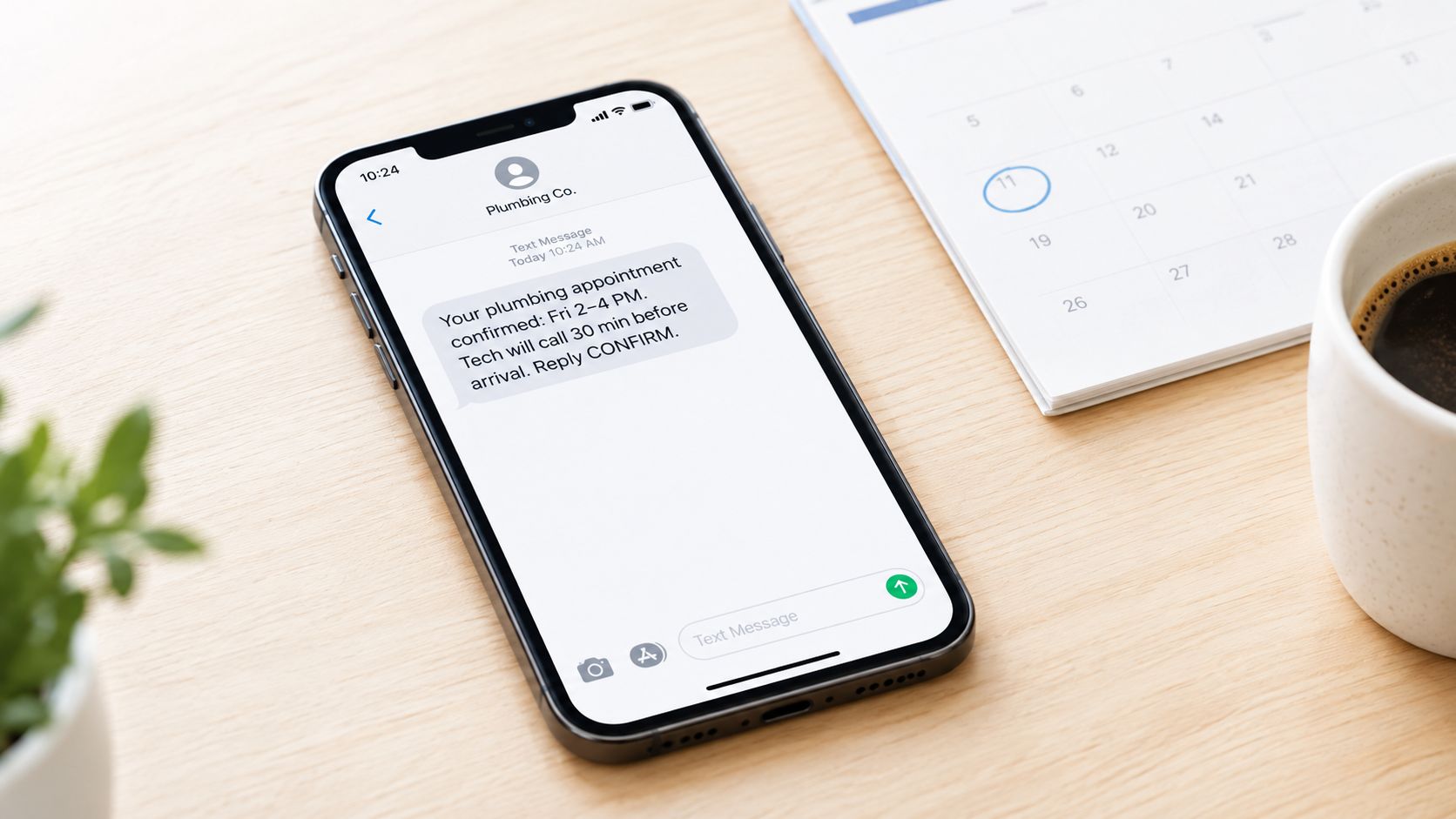
For a plumbing company, try:
Your plumbing appointment is confirmed for Friday, 2-4 PM. Our technician will call 30 min before arrival. Address: 123 Main St. Reply CONFIRM.
A beauty salon could write:
Your haircut with Maria is set for Saturday at 10:00 AM. Please arrive 10 min early. Reply CHANGE to cancel or reschedule.
For a real estate showing:
Your home showing is Tuesday at 3:00 PM at 456 Oak Ave. Sarah will meet you at the front door. Reply YES to confirm.
Keep the message compact enough for a single SMS where practical, and remove anything the customer doesn't need. A single action, such as CONFIRM, CHANGE, or CANCEL, is easier to process than several competing links. The confirmation should also state the business name if the sending number isn't immediately recognizable.
SkipCalls can send confirmation texts after a call or text conversation creates a booking. Its calendar connections help keep the scheduled time and customer record aligned, while this appointment confirmation guide provides another practical reference for the workflow. A confirmation 24 hours before the appointment and another two hours before can support attendance, provided the timing matches the customer's consent and communication expectations.
2. Limited-Time Offer and Flash Sale Alert
Promotional texts work best when the offer is concrete and the recipient already has a reason to care. A past inquiry, previous appointment, or stated interest gives the message context. A random discount sent to everyone often feels like noise.
A home services company might send:
⏰ TODAY ONLY: $50 off any AC tune-up. Book now and mention code COOL50. Expires tonight. Call or reply BOOK.
A beauty salon could use:
Flash Sale. 25% off spa packages this weekend. New clients get an extra $20 off. Book: [booking link] Use code SPA25.
For an insurance agency:
Limited time: Get a free insurance review. Book today and mention code FREE200. Offer expires Friday.
Real estate messaging should make the access valuable rather than overstating scarcity:
🔥 NEW LISTING: A luxury home just launched. Virtual tour available for 48 hours. Reply TOUR for access before the public listing.
The trade-off is urgency versus trust. “Today only” can prompt action when it reflects a genuine deadline, but repeated artificial countdowns train customers to ignore future offers. Use a trackable code, keep the action singular, and send the message during the business hours when someone can answer replies or calls.
For customers who don't respond, a final reminder shortly before the actual deadline can work, but it shouldn't become a second full sales pitch. State the offer, the deadline, and the action again. SMS adoption is already mainstream, with 75.3% of businesses using SMS marketing in 2026, up from 66% a year earlier, while 65.4% plan to increase texting spend further, according to G2's SMS marketing statistics. That crowded environment makes relevance more useful than louder copy.
3. Lead Qualification and Interest Assessment
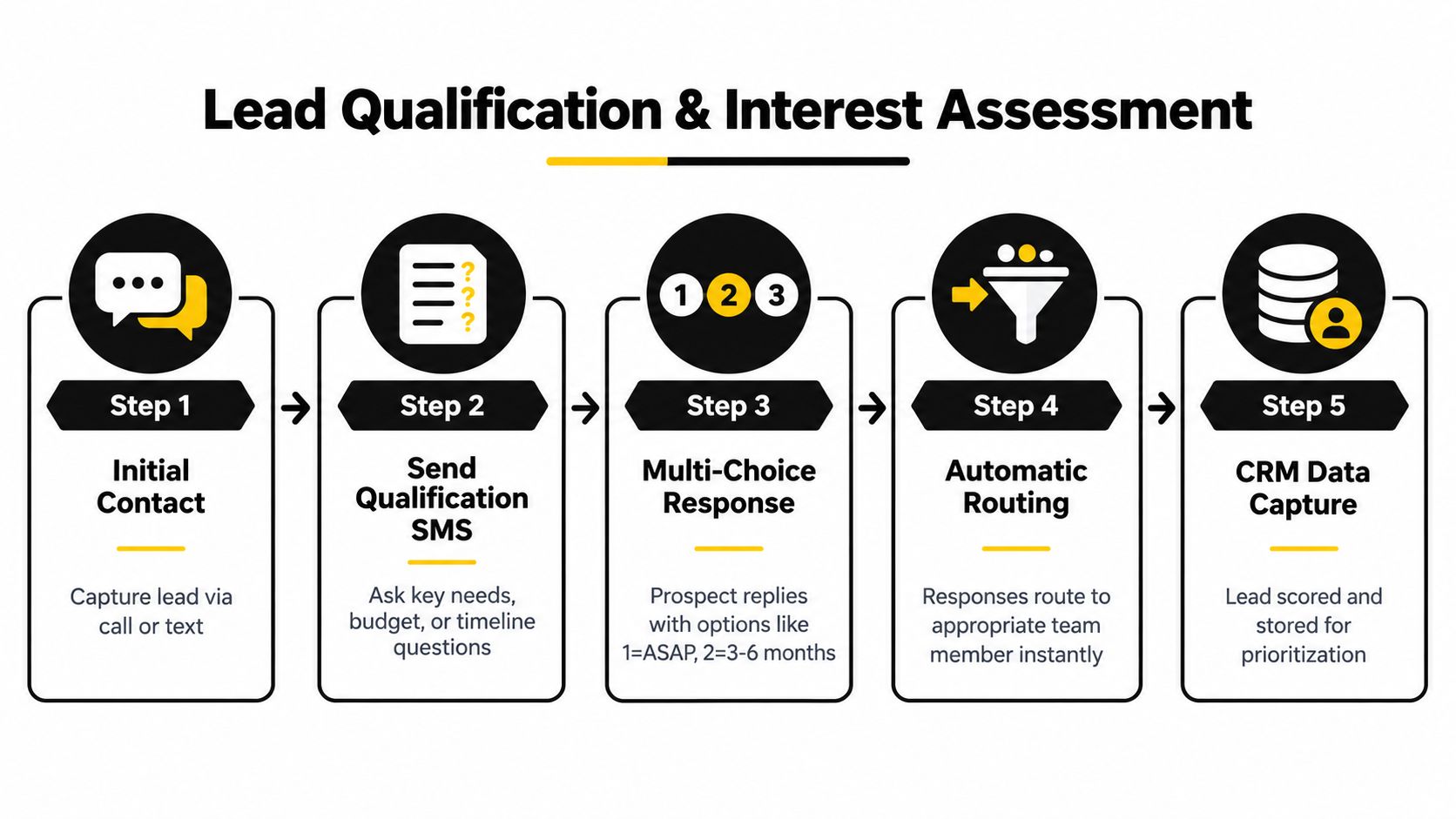
A new inquiry rarely needs a long questionnaire by text. It needs one useful answer that tells the team what to do next. Ask one question, offer a small set of clear responses, and use the reply to route the conversation.
A real estate agent can start with:
Great. What's your buying timeline? Reply 1 for ASAP, 2 for 3-6 months, or 3 for browsing.
An insurance agency might ask:
Thanks for reaching out. What coverage do you need? Reply 1 for auto, 2 for home, or 3 for both.
A law firm can make routing easier:
Need legal help? Reply 1 for business, 2 for personal injury, or 3 for real estate. We'll connect you with the right attorney.
For home services:
Ready for an estimate? Reply 1 for HVAC, 2 for plumbing, 3 for electrical, or 4 for multiple services. Add your preferred date.
Avoid asking for the service, budget, address, and availability in the same text. A customer who has just made contact may answer one simple question, then disengage from a form disguised as a conversation.
Build the next response around the answer
Once the lead replies, send a response that proves the answer was useful. A buyer who selects “ASAP” might receive available showing times. A homeowner who selects HVAC might receive a request for the property address or a callback choice. Store the response against the lead record so the next employee doesn't repeat the same question.
SkipCalls supports voice and text workflows for lead qualification, and its configured automation can use a trigger, message purpose, timing, and consent or transactional basis before sending a follow-up. The practical framework in these lead qualification questions is useful when deciding which question belongs first.
A short video can reinforce the same process for teams training staff or configuring automated replies.
4. Follow-Up After Initial Contact
A lead often doesn't need another sales pitch after a call. They need evidence that the business listened and a simple next step. Mentioning a specific detail from the conversation makes the text feel like a continuation rather than a generic automation.
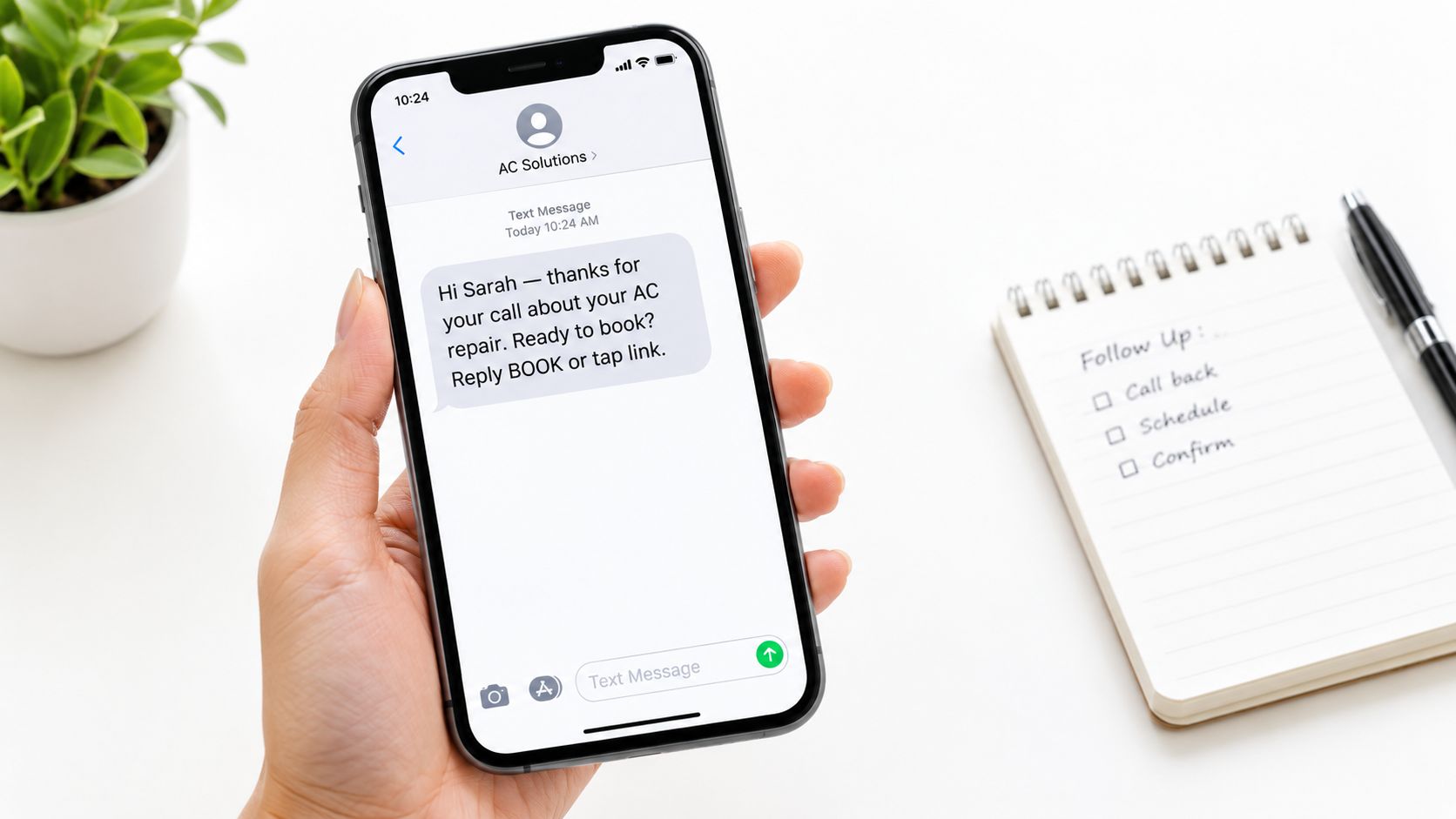
For an HVAC company:
Hi Sarah. Thanks for calling about your AC repair today. Schedule by Friday for a free diagnostic. Ready to book? [booking link] or reply CALL ME.
A real estate agent could write:
Hi John. Great talking about 123 Main St today. I'm sending three comps and the inspection report. Would you like a walkthrough Saturday or Sunday?
A bridal salon might send:
Hey Maria. Thanks for asking about our bridal package. I'd love to show you the design portfolio. Reply BOOK for a consultation this week.
For a law firm:
Hi David. Following up on your business contract questions. I've prepared a cost estimate. Can we schedule 15 min tomorrow or Thursday?
The best follow-up refers to the actual call, meeting, or website interaction. It doesn't pretend that automation is personal, and it doesn't force the recipient to explain the entire situation again. Use the customer's first name, one relevant detail, and one action.
Send it while the conversation is still familiar. A booking link is appropriate when the next step is scheduling. A callback prompt is better when the issue needs discussion. SkipCalls can log incoming calls and trigger personalized SMS follow-ups, while its voice capability gives the customer an alternative when texting isn't enough. That combination is particularly useful for small teams that can't watch every inbox. RealtyAI's marketing automation overview offers additional context for follow-up workflows in real estate.
5. Urgency-Based Callback Request
A missed call is often a warm opportunity, not a lost one. The caller already tried to reach the business, so the text should acknowledge the attempt and offer a fast path to a real person.
For an HVAC company:
Hi. We can help with your heating issue. Which call time works? 1 for today, 3-5 PM, 2 for tomorrow morning, or 3 for tomorrow afternoon.
A real estate agent can offer:
Interested in that property? I have 15-min slots today at 6 PM, tomorrow at noon, or tomorrow at 3 PM. Reply 1, 2, or 3.
An insurance agency might write:
Let's discuss your coverage. Reply 1 for this evening, 2 for tomorrow morning, or 3 for tomorrow evening, and I'll call then.
For a law firm:
Ready to discuss your case? Reply 1 for this week or 2 for next week. Add your preferred day and I'll confirm.
Specific options beat “When are you free?” because the customer can answer without opening a calendar. Keep the choices realistic for the team. Offering a callback window that nobody can honor creates a second service failure.
“Reply 1, 2, or 3” is a better request than an open-ended scheduling question.
SkipCalls can send an automatic text after a missed call, continue the conversation from its own number, and notify the team when a hot lead needs attention. Its missed-call text-back workflow is designed for exactly this recovery moment. If there is no reply, one reminder after a reasonable interval can help. Don't keep sending messages to a person who has shown no interest or hasn't provided the necessary consent.
6. Educational Content and Value-Add Tip
A useful text can create demand without sounding like an advertisement. Lead with something the recipient can apply today, then connect the advice to your service only if the connection is natural.
An HVAC company could send:
Quick tip: Change your AC filter every 30 days. A clogged filter makes the system work harder. Need a tune-up? Reply CHECK.
A plumbing business might write:
Plumbing tip: Use cold water when running your garbage disposal. It helps move grease through the line. Need drain help? Reply DRAIN.
A real estate agent can offer:
Home-selling tip: Neutral paint can make rooms easier for buyers to picture as their own. Reply SELL for a preparation conversation.
A salon might send:
Hair tip: Apply deep conditioner to the ends, not the roots. Reply TREATMENT if you'd like help choosing a service.
An insurance agency could write:
Coverage tip: Marriage, children, or a new car can change what your policy needs to cover. Reply REVIEW for a conversation.
Avoid unsupported savings or improvement figures in educational copy unless your business has a defensible, relevant source. The value comes from specificity, not an impressive percentage. “Check your filter before the next heat wave” is more useful than a vague promise to reduce costs.
Rotate tips by season, service, and customer need. Track replies and bookings, not just whether a customer viewed the text. The tip that receives a question may be more valuable than the one that receives a quick click, because it opens a two-way conversation. SkipCalls can carry that conversation through text or voice and keep the resulting lead connected to the business workflow.
7. Referral Request with Incentive
Ask for a referral after the customer has had a clear opportunity to appreciate the service. The message should explain what to share, what the new customer receives, and how the existing customer receives credit.
For an HVAC company:
Love your experience? Refer a friend and you both get $25 off. Share code HVAC2024-SARAH. Mention it when they book.
A beauty salon could send:
💇 Share the glow. Your friend gets 20% off their first service, and you get a free blowout. Code: GLOW-MARIA123.
A real estate agent might write:
Know someone buying or selling? Refer them and receive a $500 gift card when they close. Code: REALTOR-JOHN.
For a home services company:
Refer a neighbor for plumbing or electrical work and get a $50 credit. Give them code REFER2024.
The incentive needs to be understandable at a glance. A unique code or referral link lets the team connect the new inquiry to the existing customer without relying on memory. It also gives the business a way to send a proper thank-you message when the referral becomes a customer.
Don't make the referral request sound like an obligation. “If you know someone who needs this service” is more respectful than implying that a satisfied customer owes the business a lead. Also check any industry restrictions before offering incentives, particularly in regulated professional services.
A monthly reminder can keep the program visible, but repeated requests will feel extractive if the customer hasn't had another positive interaction. A thank-you text should arrive after the referral is recorded, even if the reward depends on a later event. Recognition builds the relationship more effectively than a generic automated receipt.
8. Reactivation Campaign for Inactive Customers
Reactivation messages work when they acknowledge history without making the customer feel blamed. Start with a useful reason to return, and make the next step as easy as the original booking.
For a salon:
Hey Sarah. We enjoyed seeing you last time. Come back this month for 25% off any service. Book here: [booking link].
An HVAC company could send:
Hi John. Spring is a good time to schedule an AC check. Get $40 off your next maintenance visit through [date]. Schedule: [booking link].
A real estate agent might write:
Hi. New homes are available in the neighborhoods you liked. Would you like an updated preview? Reply SEE.
An insurance agency can use:
Hi David. Life changes can affect your coverage. We offer a policy review for returning customers. Reply REVIEW to schedule a 20-min call.
Segment customers by the last meaningful interaction, service type, and likely need. Someone who completed a seasonal maintenance service deserves a different message from someone who requested a quote but never booked. The more specific the reason for returning, the less the text resembles a mass discount.
Make silence informative
If the customer doesn't respond, don't immediately escalate the discount. A later message can ask whether their needs changed or whether they'd prefer not to receive reminders. That answer can improve segmentation and reduce unwanted contact.
SkipCalls can connect customer records, calls, texts, and calendar activity, helping a small team identify inactive leads and choose a suitable reactivation path. A second message after a week may be reasonable for an opted-in audience, but the sequence should stop when the customer opts out, asks not to be contacted, or no longer has a relevant service need.
9. Event or Promotion Announcement
An event message has two jobs, registration and logistics. Include the topic or offer, date, time, location, and RSVP action in the first message. Excitement helps, but vague details create unnecessary replies and administrative work.
A real estate agent could write:
🏡 Free home-selling workshop, “Price Your Home Right,” Saturday at 10 AM, 456 Oak Ave. Reply YES or call [business number] to RSVP.
A beauty salon might send:
✨ Spring Collection Trunk Show, Wednesday, 5-8 PM. First 20 guests receive 20% off. Reply ATTEND by Monday.
For an HVAC company:
❄️ Free AC check-ups this Saturday, 9 AM-3 PM. No appointment needed. Bring this text. Location: [address].
A law firm can announce:
Business Contracts 101, Thursday at 2 PM, virtual. Free for small business owners. Reply REGISTER for the Zoom link.
Use an initial announcement two weeks before the event when the audience needs time to plan, then send reminders closer to the date. Registrants should receive a confirmation with the final address or meeting link. An event-day message should answer the practical question, “What do I do now?”
SMS can coordinate with email, voice, and chat rather than replacing them. For example, a detailed email can explain the workshop while SMS handles the RSVP and reminder. This guide to multi-channel messaging is relevant when a local business wants one customer conversation to continue across several channels.
After the event, send a thank-you and ask for one specific piece of feedback. That closes the loop and gives the team a reason to continue the relationship without immediately sending another promotion.
10. Customer Feedback and Review Request
The best time to request feedback is soon after the service, while the experience is still clear. Start with a quick rating or direct review link. Don't force customers through a long survey before they can tell you whether the appointment went well.
For an HVAC company:
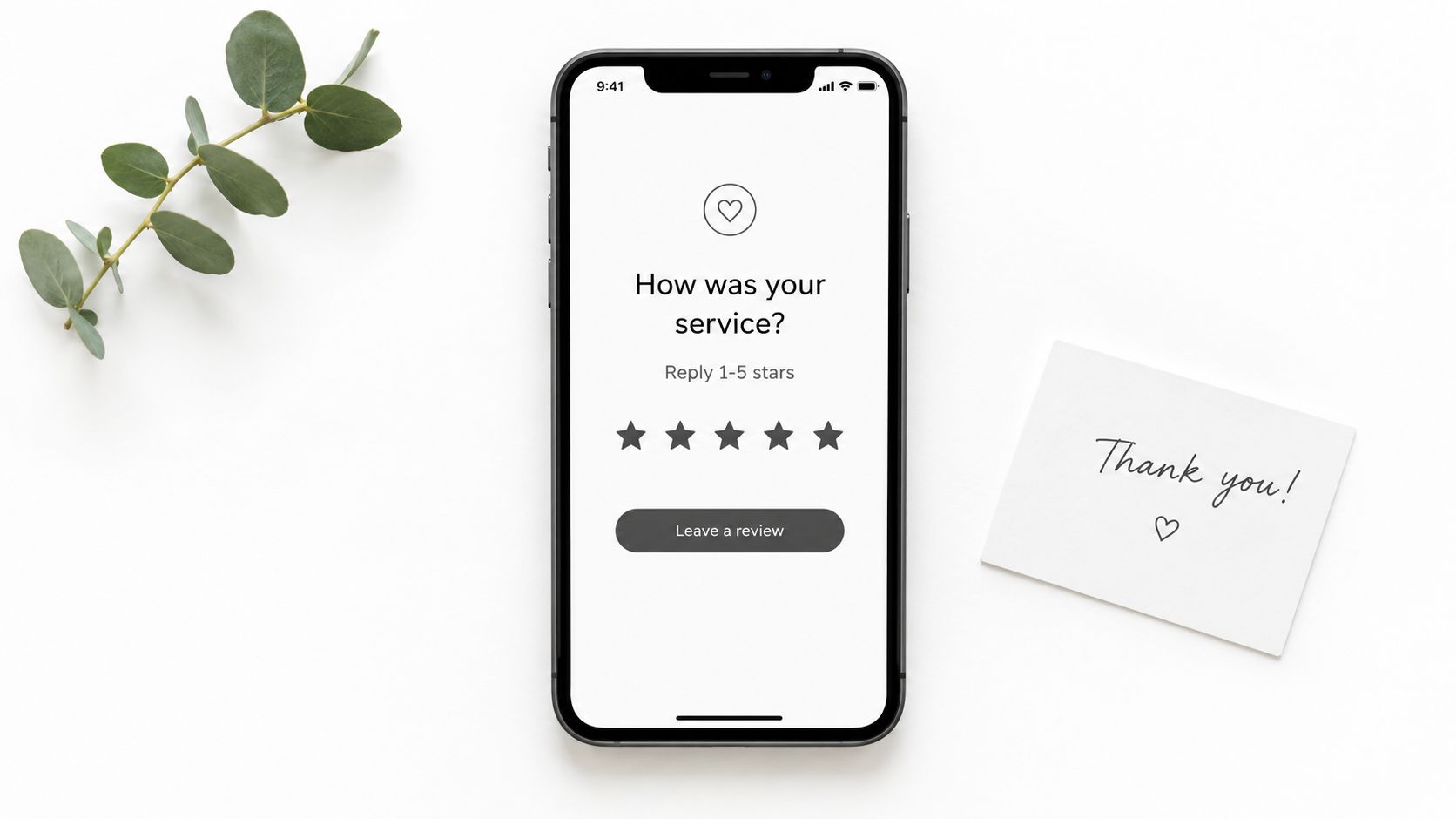
Thanks for choosing us for your AC service. How was your experience? Reply 1-5 stars. Google review: [review link]. Thank you.
A salon could send:
Thanks, Maria. Did you love your haircut? We'd appreciate a Google review: [review link]. Thank you for visiting.
A real estate agent might write:
Thanks for trusting us with your home search. Would you recommend us? Reply YES or NO. If yes, share a Google review: [review link].
A law firm can keep the language careful:
Thanks for choosing our firm. Please rate your experience and share feedback here: [review link]. We appreciate your trust.
Send the request within 24 hours of service completion when the customer has a clear memory of the interaction. A star response can alert the team to a problem, while a positive experience can lead directly to a public review. Keep private service details out of the message, especially for legal, insurance, or other sensitive matters.
Protect the relationship: Ask for honest feedback, don't promise a positive review, and make the opt-out path clear for future messages.
SkipCalls can trigger a feedback text after a completed service and record replies alongside the customer conversation. The team should respond to both praise and complaints. A thoughtful response to a problem may save the relationship, while ignoring a poor rating leaves the customer with no reason to return.
Comparison of 10 Creative SMS Message Types
| Template | Implementation Complexity | Resource Requirements | Expected Outcomes | Ideal Use Cases | Key Advantages |
|---|---|---|---|---|---|
| Appointment Confirmation with Service Details | Low, automated trigger & templating | Calendar integration, accurate booking data | Reduce no-shows; clearer customer prep | Service appointments (HVAC, plumbing, salons, healthcare) | Automated reminders; clearer logistics |
| Limited-Time Offer & Flash Sale Alert | Medium, promo codes & links setup | Promo codes, landing page, margin tracking | Immediate bookings; short-term conversion spike | Time-sensitive promotions, inventory clears | Urgency-driven response; trackable ROI |
| Lead Qualification & Interest Assessment | Medium, two-way flows & routing | CRM, scoring rules, predefined response options | Higher-quality leads; faster prioritization | Post-lead capture qualification (real estate, insurance) | Automates qualification; saves sales time |
| Follow-Up After Initial Contact | Low, personalized automated messages | Call logs, personalization tokens, calendar links | Higher conversion rates (notable uplift) | Post-call/meeting follow-ups for prospects | Keeps brand top-of-mind; boosts conversions |
| Urgency-Based Callback Request | Medium, scheduling + callback routing | Team availability, callback routing rules | Increased callback confirmations; faster contact | Missed calls, hot prospects needing quick reply | Respects schedule; flags hot leads |
| Educational Content & Value-Add Tip | Low, content creation cadence | Subject-matter content, links to resources | Improved trust; steady engagement over time | Authority building, off-peak touchpoints | Positions business as expert; lower unsub rates |
| Referral Request with Incentive | Medium, code tracking & reward fulfillment | Unique referral codes, tracking system, rewards | High-quality warm leads; lower CAC | Satisfied customers after service completion | Generates referrals; strengthens loyalty |
| Reactivation Campaign for Inactive Customers | Low, segmentation + targeted offer | Activity data, tailored incentive, timing rules | Re-engage lapsed customers; quick conversions | Lapsed or dormant customer lists | Cheaper than new acquisition; boosts LTV |
| Event or Promotion Announcement | Medium, RSVP capture & reminders | Event logistics, RSVP mechanism, reminders | Increased registrations; attendee data capture | Workshops, open houses, webinars, promos | Drives attendance; simplifies RSVPs |
| Customer Feedback & Review Request | Low, post-service automation | Review links, simple rating UI, optional incentive | More reviews; improved local reputation | Post-service follow-up to recent customers | Builds social proof; captures actionable feedback |
Build a Message Workflow, Not a Message Folder
Ten templates won't fix a disconnected customer journey. The value appears when each message responds to a real event and creates the next useful action. A missed call should trigger a text-back option. A qualified lead should move toward a callback or calendar slot. A completed appointment should lead to feedback, a referral request, or a relevant future service.
A simple lifecycle might look like this:
- Confirm the booking: Send the service, time, location, and change option.
- Recover the missed call: Offer a short callback window and alert the right team member.
- Qualify interest: Ask one question and store the answer against the lead.
- Follow up: Reference the original conversation and provide one next step.
- Nurture with value: Share a specific tip connected to the customer's situation.
- Reactivate past customers: Give returning customers a relevant reason to reconnect.
- Request referrals: Use a clear code or link and confirm the reward process.
- Collect feedback: Ask for a rating or review soon after service completion.
This approach also explains why creative SMS shouldn't be treated as copywriting decoration. SMS adoption is broad, with 84% of consumers having opted in to business texts in 2025, and businesses increasingly use texting for customer service as well as marketing, according to SimpleTexting's 2025 statistics. The useful creative decision is often operational: should the customer reply with a number, choose a time, confirm an appointment, or speak to a person?
Keep one clear action in each message. Check consent and timing before enabling automation, especially when a workflow changes from transactional updates to promotional content. Review the full customer record before sending a follow-up so a customer doesn't receive a reminder for a booking they've already canceled.
SkipCalls fits this model for small teams that need calls and texts in one workflow. It can answer business calls, capture customer details, qualify leads, book appointments, connect CRM and calendar records, and notify the team about hot leads by calling them. Businesses can also keep an existing phone number when moving to a different communications provider, a process known as number porting, as explained in this overview of number porting. SkipCalls' ability to work without requiring a new business number makes adoption easier for teams that already have a number customers recognize.
The goal isn't to collect a folder of polished messages. It's to connect the right message to the right customer moment, then make sure somebody or something can handle the reply. For more on writing concise conversion-focused copy across channels, see what email copywriting means in 2026, then adapt the same discipline to the tighter space of SMS.
Start by choosing one workflow with a visible business problem, such as missed calls or appointment no-shows. Write one message, define the trigger, connect the CRM or calendar record, test every reply path, and review the conversations with your team. Once that workflow is reliable, add the next message in the customer journey.
SkipCalls handles business calls and texts, captures and qualifies leads, books appointments, and connects CRM and calendar workflows without requiring you to change your existing phone number. Visit SkipCalls to connect these creative SMS messages to a practical workflow for your local business.


