

Law Firm Intake Specialist Role Explained Simply
What does a law firm intake specialist do? Learn duties, skills, SOPs and how to measure intake performance for your firm.
A prospective client calls after seeing your firm's advertisement. The attorney is in court, the receptionist is helping someone at the front desk, and the call goes to voicemail. The caller leaves a short message, contacts another firm, and may never hear back.
That moment looks administrative, but it's a revenue event. Marketing created the opportunity. Intake determines whether the opportunity becomes a qualified consultation, a signed engagement, or a lost lead. A law firm intake specialist exists to manage that handoff with speed, consistency, and judgment.
The problem is widespread. One industry benchmark reports that 35% of calls to small and midsized law firms go unanswered during business hours, while only 33% of firms respond to prospective-client email inquiries. The same benchmark says 26% of firms never respond to online lead forms (legal client intake statistics). When prospective clients contact multiple firms, even a short delay can give a competitor the first meaningful conversation.
The practical answer isn't telling the receptionist to “take better messages.” It's building a defined workflow with trained people, approved questions, reliable systems, and clear ownership. This guide explains what the role does, which skills matter, how to build an intake SOP, and how to measure the leaks that keep marketing spend from becoming new business. For a broader look at the process itself, see this guide to law firm client intake.
What a Law Firm Intake Specialist Actually Does
A law firm intake specialist is the firm's first qualified contact for a prospective client. The specialist responds to the inquiry, gathers the facts the firm needs, checks whether the matter appears to fit approved criteria, and moves the person toward the correct next step, usually a consultation or attorney review.
A receptionist primarily protects the flow of the office. They answer general calls, greet visitors, and direct messages. An intake specialist protects the flow of potential matters. That difference changes the questions, the systems, the training, and the performance measures.
Think of the role as air traffic control. Every inquiry arrives with a different level of urgency, a different practice area, and a different destination. The specialist doesn't decide the legal strategy or provide legal advice. Instead, they gather enough reliable information to route the lead safely and quickly.
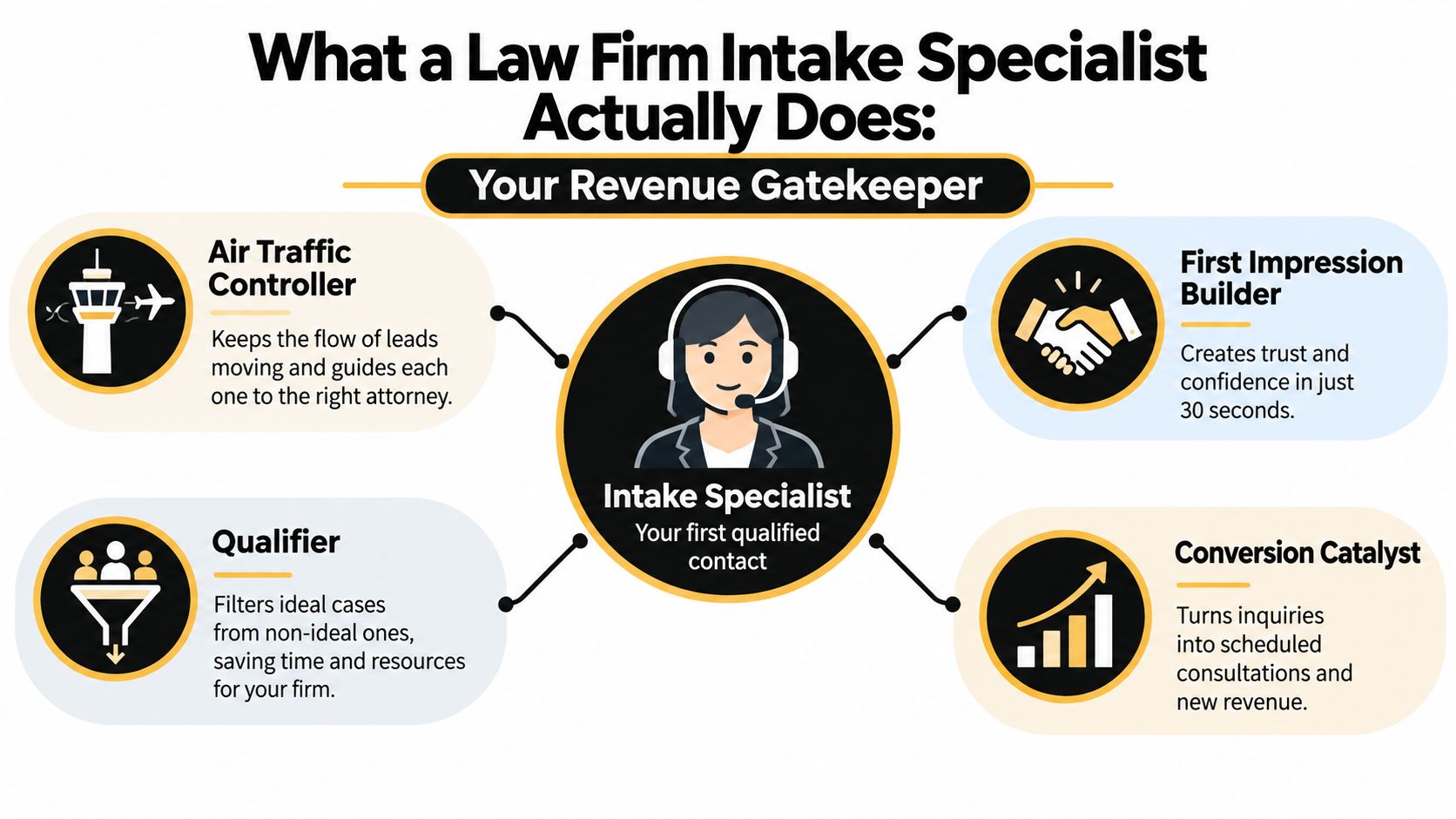
The role in four practical functions
- First contact: Create a calm, professional experience when the caller may be injured, frightened, angry, or confused.
- Information gatherer: Capture names, contact details, incident facts, deadlines, opposing parties, and other firm-approved fields.
- Qualifier: Apply the firm's criteria without improvising legal conclusions.
- Conversion coordinator: Arrange the consultation, transfer the lead, or assign the next follow-up task.
This role became more specialized as legal marketing moved online. A phone call, form submission, chat, or text can now be tied to a particular campaign and tracked through a CRM. That makes first response a measurable part of client acquisition rather than an informal front-desk task.
The role matters most in consumer-facing practices such as personal injury, family law, criminal defense, and other areas where phone and web inquiries generate new business. Firms that want to formalize the function can also review how to build a high-performing intake function with Ares, especially when defining ownership between reception, intake, and attorneys.
Core Responsibilities That Drive Client Conversion
The specialist's daily work follows a chain. If one link breaks, the attorney may never see the opportunity. Answering the call without recording the facts creates a weak handoff. Recording the facts without booking the consultation leaves the prospect responsible for doing the next step. Booking without confirmation creates avoidable no-shows.
Respond across every active channel
A modern intake desk may receive calls, emails, text messages, live chats, web forms, and referral-portal inquiries. The specialist must know which channels require a live response, which can receive an immediate acknowledgment, and which need escalation.
Speed is central. One 2025 study found a 13-minute median response time for law firm leads, with only 25% of firms responding within 5 minutes and 56% responding within 1 hour (PaperStreet's law firm intake survey). A separate Hennessey Digital study of 1,333 U.S. law-firm websites found a 13-minute median first outreach time, with 33% responding within 10 minutes or less and 56% within 1 hour (Hennessey Digital's 2025 response-time study).
A good specialist therefore treats a new form like a ringing phone, not like an email that can wait for an afternoon batch.
Triage urgency and fit
Qualification isn't interrogation. It's a structured conversation that helps the firm understand whether the inquiry matches its practice area, jurisdiction, timing, and case criteria.
For example, a family-law intake may need to identify whether a court date is approaching, whether children are involved, and whether the caller already has counsel. A personal-injury workflow may ask about the incident date, location, injuries, insurance, and potentially adverse parties. The specialist records the answers and escalates according to written rules. They don't promise an outcome or give legal advice.
Use a consistent question set, such as the one described in these lead qualification questions for law firms, then adapt the fields to the practice area.
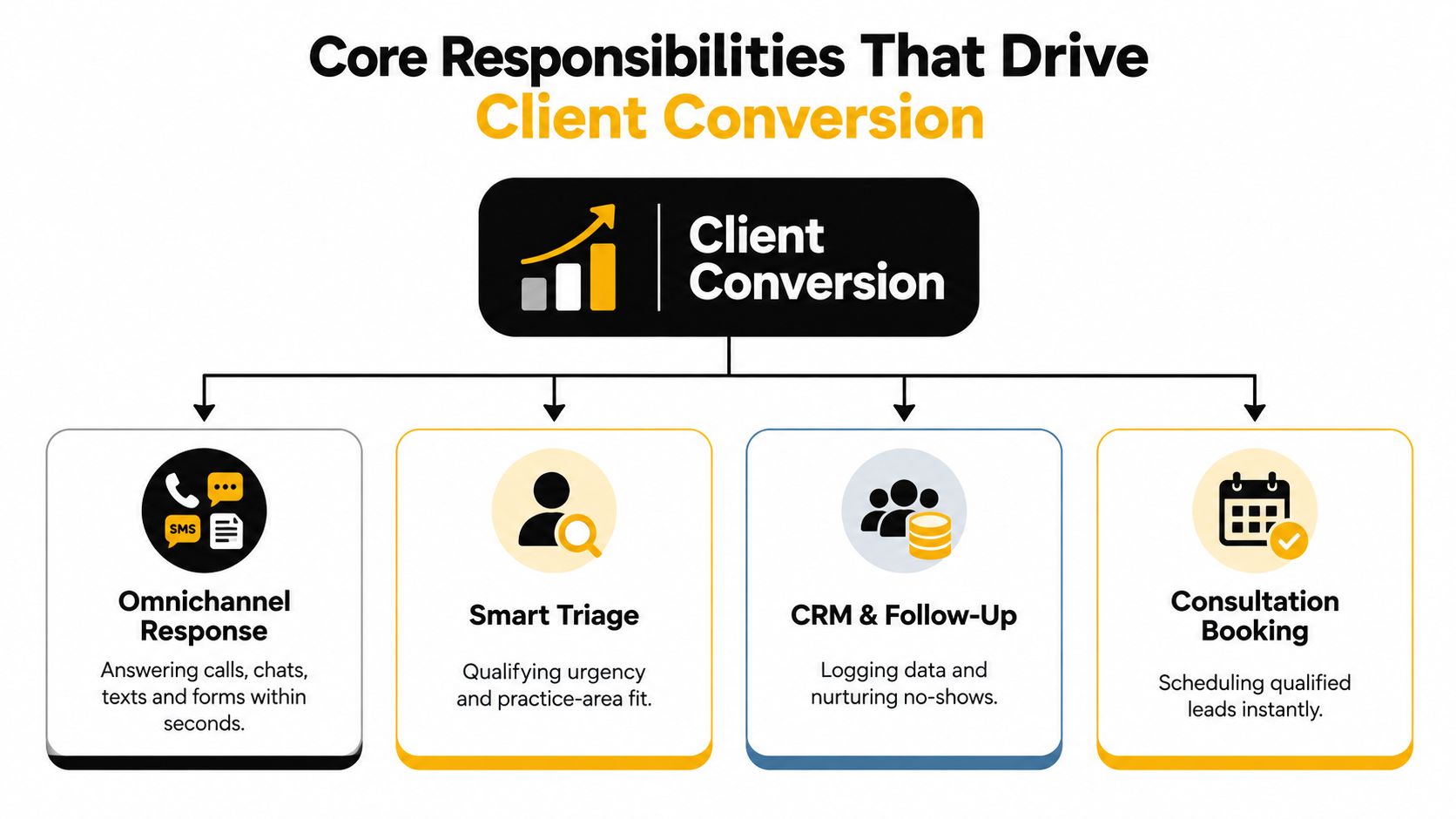
Document and route accurately
The CRM record should tell the next team member what happened without forcing the caller to repeat everything. Common systems include Clio, MyCase, and Lawmatics, alongside the firm's phone and calendar tools.
The record should show the channel, timestamp, contact details, matter type, qualification answers, urgency, conflict-check information, consent or communication preferences where required, and the next owner. A vague note such as “wants lawyer call” isn't an intake record. It's a reminder that someone still has to do the intake.
Book the next action
A qualified prospect should receive a clear next step while interest is active. The specialist can offer approved consultation times, place the appointment on the correct attorney's calendar, explain what the prospect should prepare, and send a confirmation.
The following video can help new team members visualize how intake conversations and handoffs fit together:
Essential Skills and Traits of Top Intake Specialists
The best intake specialists don't sound like salespeople reading a script. They sound prepared, attentive, and human while still collecting every required detail.
Empathy with boundaries
A caller may be describing an accident, a separation, an arrest, or a dispute with an employer. The specialist should acknowledge the person's concern without making promises.
Weak response: “That sounds like a case we can definitely win.”
Better response: “I'm sorry you're dealing with this. I'll gather the details the attorney needs, then explain the next step in the firm's review process.”
The second response builds trust without crossing into legal advice or guaranteeing an outcome.
Active listening and precise capture
Listening means more than waiting for the caller to stop speaking. The specialist notices dates, names, locations, deadlines, and contradictions, then confirms them politely.
Practical rule: If a detail could change routing, urgency, conflicts, or appointment preparation, repeat it back before ending the conversation.
A specialist who enters the wrong incident date or misses the opposing party can create downstream risk. Good notes use the caller's facts, not the specialist's assumptions.
Calm urgency
Fast work can still feel unhurried. The specialist should move the conversation forward with short transitions: “I'll ask a few questions so I can route this correctly,” or “I have the information needed to offer the next available consultation.”
This is especially valuable when several channels compete for attention. Calm urgency prevents two common failures, rushing the caller or letting a high-intent inquiry sit untouched.
Script fluency
A script should protect consistency, not erase personality. During training, ask candidates to follow a question path while responding naturally to an unexpected answer. Look for whether they return to the required fields without sounding dismissive.
Technology confidence
The role depends on more than a headset. Specialists need practical fluency with the phone system, CRM, calendar, message templates, and follow-up queue. They should know how to correct a data-entry error, mark an urgent matter, document an attempted callback, and verify that an appointment saved.
Building Reliable Intake SOPs From First Call to Booked Consultation
A strong SOP turns individual judgment into a repeatable operating system. It should tell every person, across every shift, what happens when a call is answered, missed, transferred, or received through a form.
Step one, answer or acknowledge immediately
During business hours, define a live-answer standard and a backup owner. One intake checklist advises firms to return missed calls within 5 minutes during business hours, leave a voicemail, send a follow-up text, and log the lead status in the CRM (law firm intake checklist).
For forms and chats, the workflow should create an instant acknowledgment and assign a human follow-up task. The message should set expectations without implying that an attorney has reviewed the matter.
Step two, follow the approved question path
Use practice-area-specific scripts. A general opening can establish the caller's name, contact details, reason for contacting the firm, location, incident or event date, urgency, opposing parties, and preferred communication channel. The exact questions should come from the firm's approved criteria.
Conflicts require special care. The specialist should collect the names the firm has instructed them to collect and route the information through the firm's conflict process. They shouldn't announce that representation is available before the firm completes its required review.
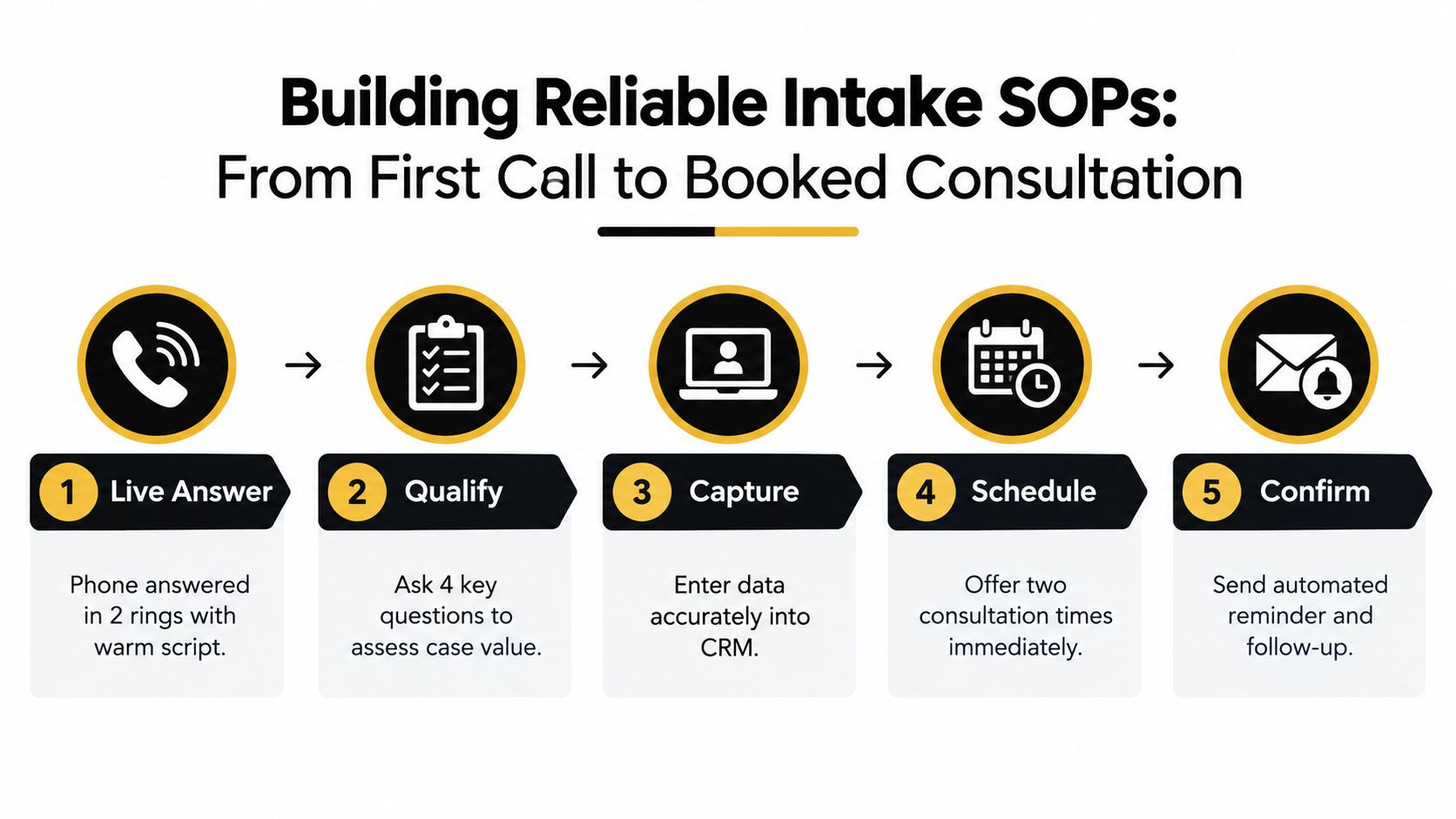
Step three, capture the record before moving on
Enter the information while the conversation is fresh. The record should include the lead source, channel, status, answers, documents promised or received, and the person responsible for the next action.
Missed-call automation can support this sequence. Industry guidance describes an initial SMS within 30 to 90 seconds, a staff callback within the promised window, and follow-up tasks after several hours or 24 hours if the prospect hasn't responded (legal missed-call follow-up automation guidance).
Step four, offer and schedule
Don't end with “someone will call you.” Offer the consultation process and approved appointment options. Once booked, verify the attorney, date, time zone, meeting method, and required preparation.
Step five, confirm and own the handoff
Send a confirmation, create reminders, and identify who handles cancellations, no-shows, and unanswered follow-ups. A handoff is complete only when another person or system owns the next step.
For consistent language at the first point of contact, firms can adapt a telephone answering script for law firms to match their practice-area rules and compliance review.
How to Measure Intake Performance and Stop Revenue Leaks
A busy intake desk can still underperform. Counting calls answered tells you about activity, not whether qualified prospects reach consultations and signed engagements. Managing partners need a small dashboard that follows the entire path from inquiry to outcome.
Measure the response window first
Track the time from form submission, missed call, or inbound message to the first meaningful response. Hennessey Digital's 2024 research found 28% of firms replied in under 5 minutes, 35% within 10 minutes, and 56% within 2 hours (legal intake response-time benchmark). These figures make sub-5-minute response a useful operational target for high-intent web leads, even if the firm sets different standards by channel.
Also separate live answers from callbacks. A callback after a voicemail isn't equivalent to a live conversation when the prospect is comparing firms.
Track the funnel, not isolated activity
A practical dashboard can include:
- Answer rate: Which calls reached a person, and which were abandoned or sent to voicemail?
- First-response time: How long did each form, text, chat, or missed call wait?
- Contact rate: How often did the firm reach the person after the initial inquiry?
- Qualification rate: How many inquiries matched the firm's approved criteria?
- Booking rate: How many qualified leads received a consultation?
- Show rate: How many booked prospects attended or completed the consultation?
- Signed-client conversion: How many consultations became engagements?
Compare results by source, practice area, day, shift, and channel. If paid-search leads receive fast replies but referral-portal leads wait, the problem may be assignment logic rather than staff effort. If bookings are strong but show rates are weak, the firm may need better confirmations or clearer preparation instructions.
A useful dashboard question: Where did the last qualified lead stop moving?
Tools that only count surface activity can be useful for orientation, but firms should distinguish those measurements of surface level AI tools from CRM outcomes tied to consultations and engagements.
Augmenting Intake With Virtual Reception and Smart Tools
There are three workable coverage models. In-house intake provides direct supervision and deep firm knowledge, but coverage depends on staffing, schedules, training, and workload. Outsourced human intake adds capacity and extended availability, but the vendor must follow the firm's scripts, security requirements, escalation rules, and CRM process. Hybrid intake combines staff judgment during complex conversations with automated or virtual support for overflow, missed calls, texts, and after-hours inquiries.
The after-hours issue deserves attention. One 2026 benchmark reports that 61% of inbound calls arrive outside 9-to-5, meaning a strictly daytime model can leave substantial demand uncovered (2026 legal staffing coverage benchmark). Availability alone isn't enough. A firm needs 24/7 qualification, which means the system must collect approved facts, identify urgent matters, recognize practice-area boundaries, apply conflict-aware routing, and book only according to firm rules.
SkipCalls is a simple-to-set-up solution that works for any case, from customer support, lead qualification, appointment booking, and many more. It handles voice and text and does not require you to change your phone number to integrate into your workflow. It has many integrations with CRM and calendars. Firms evaluating connected workflow tools can also review how to choose document automation software based on integration, ownership, and audit needs.
Before selecting a tool, confirm that it can:
- Follow your script: Required questions and prohibited statements should be configurable.
- Route intelligently: Urgent or high-value matters should reach the correct human owner.
- Write usable records: Summaries, transcripts, tags, and statuses should enter the right system.
- Book safely: Calendar rules, consultation types, time zones, and reminders must be explicit.
- Support review: Managers should be able to audit conversations and improve the SOP.
For more context on this operating model, review virtual receptionist services for lawyers. The right choice isn't human versus technology. It's whether the firm has designed a clear process in which each handles the work it can perform reliably.
SkipCalls handles voice and text inquiries, captures the details your firm requires, supports lead qualification and appointment booking, and connects with CRM and calendar tools without requiring a phone-number change. Visit SkipCalls to see how it can help your firm cover missed calls and after-hours intake while keeping the approved workflow in view.


