
California Call Recording Laws for Business Calls
California call recording laws require all-party consent on confidential calls. See penalties, sample notices, and a simple business checklist.

 Reviewed by Nikita Podelenko, Founder & Engineer of SkipCalls

Table of contents
It's 7:40 p.m. and the shop line forwards to a cell because the crew is still on a roof. A homeowner starts in on a leak, an address, and whether insurance might cover it. A beep plays, or maybe it doesn't. Plenty of owners treat that beep as california call recording laws handled. It isn't.
The useful question is narrower than the usual label that California is a two-party state. Ask whether the call is a confidential communication, and whether every person who joins later still consented. A tech who picks up after a transfer, or a spouse who leans into the speaker, may never have heard a word about recording.
This is general information for service businesses, not legal advice. Last checked: October 2026.
What California Requires and What a Violation Costs
Since the Invasion of Privacy Act took effect on January 1, 1968, California Penal Code section 632 has made it unlawful to intentionally record or eavesdrop on a confidential communication without the consent of every party. That covers a telephone call or another electronic device. The violation is the act of recording. Posting the audio later, or never using it, doesn't create the problem and doesn't erase it.
The same code is stricter than a one-party model. It can reach a company sitting outside California when a California person is on the recorded call. For a contractor, law firm, property manager, repair shop, or salon, the working habit is consent from every participant before capture when the talk may be confidential. A clear opening line such as "This call may be recorded" gives the other person a chance to stay or leave. Facts still matter, including whether the communication was confidential.
The statutes worth knowing
Criminal exposure under section 632 is a fine of up to $2,500 per violation, up to one year in county jail, imprisonment in state prison, or both a fine and imprisonment. Penal Code section 632.7 sets the maximum fine for recording certain telephone communications without all-party consent at $2,500, and it covers cell, cordless, and mixed cell-or-cordless and landline calls, which is how most customers phone a shop.
Civil exposure sits in a different section. Under Penal Code section 637.2, a person injured by a violation may seek the greater of $5,000 per violation or three times the actual damages. The caller doesn't have to prove actual damages, or even a threatened loss, before filing. The statute also allows a court action to stop or restrain the recording.
Sections 633 and 633.5 are not ordinary business exceptions. One preserves specified law-enforcement powers that existed before January 1, 1968. The other is a narrow path for a participant recording evidence reasonably tied to listed serious crimes, not a green light for intake, dispatch, or quality recording.
| Situation | Statute | Consent | Maximum exposure |
|---|---|---|---|
| Recording a confidential phone or electronic communication | Penal Code 632 | Every party | $2,500, up to 1 year in county jail, state prison, or both |
| Recording a cell, cordless, or cell-or-cordless mixed with landline call | Penal Code 632.7 | Every party | $2,500, up to 1 year in county jail, state prison, or both |
| Caller sues over an unlawful recording | Penal Code 637.2 | Not a consent rule | Greater of $5,000 per violation or 3 times actual damages |
| Specified law-enforcement recording | Penal Code 633 | Not a business exception | Powers that existed before January 1, 1968 |
| Participant records evidence of listed serious crimes | Penal Code 633.5 | Narrow participant exception | Not permission for routine customer-service recording |
How per violation adds up
Per violation means each unlawful recording can stand on its own. Ten customer calls recorded without consent are ten potential violations, not one shared $5,000 bill. A shop that records every answered call for a week is stacking exposure by the day, and the criminal and civil tracks can run side by side on the same calls. A busy Monday of missed-call returns can multiply exposure faster than one dramatic complaint.
Practical rule: Play a clear notice before capture starts, and get every participant's consent when the talk may be confidential.
A beep with no words fails that test. So does a notice buried after the caller has already given the address, the price range, and the problem. Put the words first, then record.
When a Customer Call Counts as Confidential
Calling California an all-party state is incomplete. Penal Code section 632 prohibits intentionally recording a confidential communication without consent from all parties, and the statute applies when participants reasonably expect the conversation to be private. That expectation is the test, and it changes mid-call. A conversation held after a clear announcement, a shout across a public counter, or a routine dispatch line each lands differently under the same statute.
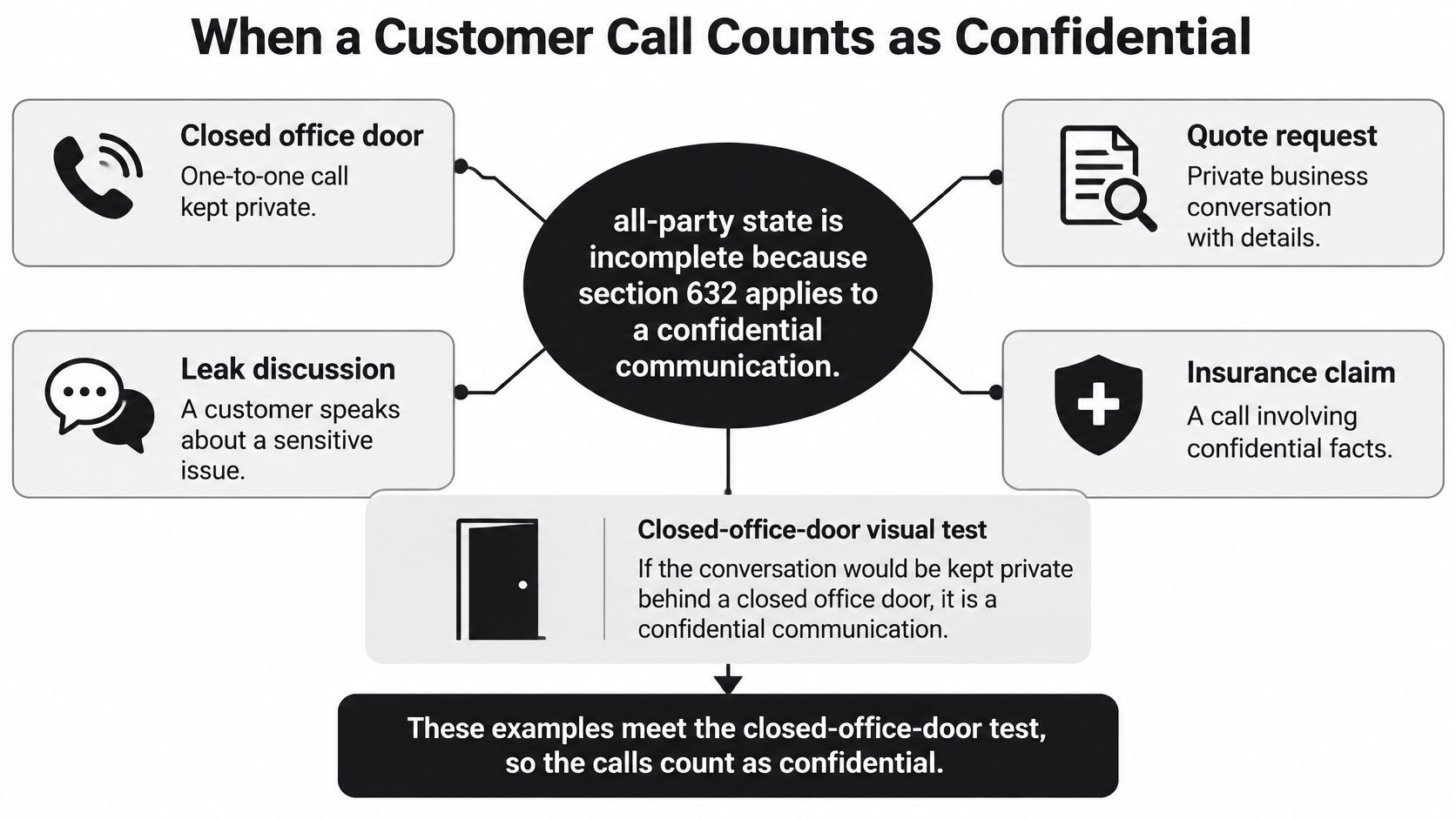
The closed office door test
Use a closed office door as the test. A one-to-one call about a leak, a quote, an insurance claim, a listing, or a legal intake happens behind a shut door. Only the people on the line are talking, personal or job details get shared, and no notice has played yet. Treat that as confidential.
A shout across a busy front counter is closer to talking where others can hear. So is a call where a recording notice already played and the caller kept going. A caller who chose speaker in a public place has also weakened the expectation.
Consent expires when the room changes. The first caller who heard the notice and stayed on the line agreed for herself. When a spouse picks up an extension, a technician joins, or a manager conferences in, that new person heard nothing. Replay the announcement every time a voice joins, not just at the start of the call.
- Private details: Address, price, claim facts, tenant issues, or intake notes on a normal line point toward confidentiality.
- Notice already played: A clear announcement followed by continued talk weakens the privacy expectation. It is not a reason to skip the announcement next time.
- A new voice: Refresh consent. The first caller's yes doesn't cover a spouse, a tech, or a coworker.
- Routine lines: A court might later call a dispatch call non-confidential, but betting on that ruling is a gamble. Play the notice anyway.
For a plumber, salon, realtor, property manager, or small firm, announce recording on every line you record. If you keep audio or call transcription for service businesses, the notice still comes before capture. This is general information, not legal advice. Last checked: October 2026.
Calls That Cross State Lines
An owner in Arizona, Texas, or Nevada can still be the person California's rule cares about. If a California resident is on the recorded call, the safer reading is that California can reach the recorder even when the business phone sits in another state. Flip it and the problem remains. A California shop calling a customer elsewhere may hit a one-party state, but if anyone on that call is in an all-party state, follow the stricter rule.
Federal one-party ideas aren't a permission slip to ignore California when a California party is recorded. Don't build a fake 50-state chart from area codes. Area codes lie. People travel, forward numbers, and answer on cell phones.

A stricter habit than area codes
Penal Code section 632.7 covers calls between cellular phones, cellular and landline phones, cordless phones, or cordless and landline phones. Without consent from all parties, intentionally intercepting or receiving and recording one of these communications can mean a fine of up to $2,500, up to one year in county jail, state prison, or both. The same statute's neighborhood, sections 633 and 633.5, still isn't a customer-service exception.
On each recorded call, identify three places. Note where the business is, where the caller says they are, and where any transferred coworker is. Then apply the strictest known rule on that call. If the team can't tell, announce and obtain consent anyway.
A practical multi-state book of work uses one all-party notice on every recorded line. Teams that also handle capturing overseas leads without extra staff should use that same opening habit instead of guessing from a country code. Vendors that document technical controls for compliant call recording are worth reading beside the script, because a spoken notice still needs a system that can stop capture. A court still looks at facts. This is a compliance posture, not a promise that one script wins every case. General information, not legal advice. Last checked: October 2026.
How to Announce Recording Before Capture
Automated systems create an evidence problem, not just a script problem. As the Daily Journal has laid out, the business needs to show what the caller heard, when the notice played, whether the caller continued, and whether more people joined. Participation after notice can be treated as implied consent, but all participants must consent. A transfer to a contractor, attorney, property manager, or subcontractor, or a customer who adds someone on speaker, breaks a notice that only the first person heard. Appellate discussion has also separated a participant's own recording from interception by outsiders, so "I was on the call" and "a system recorded the call" may not be the same analysis.
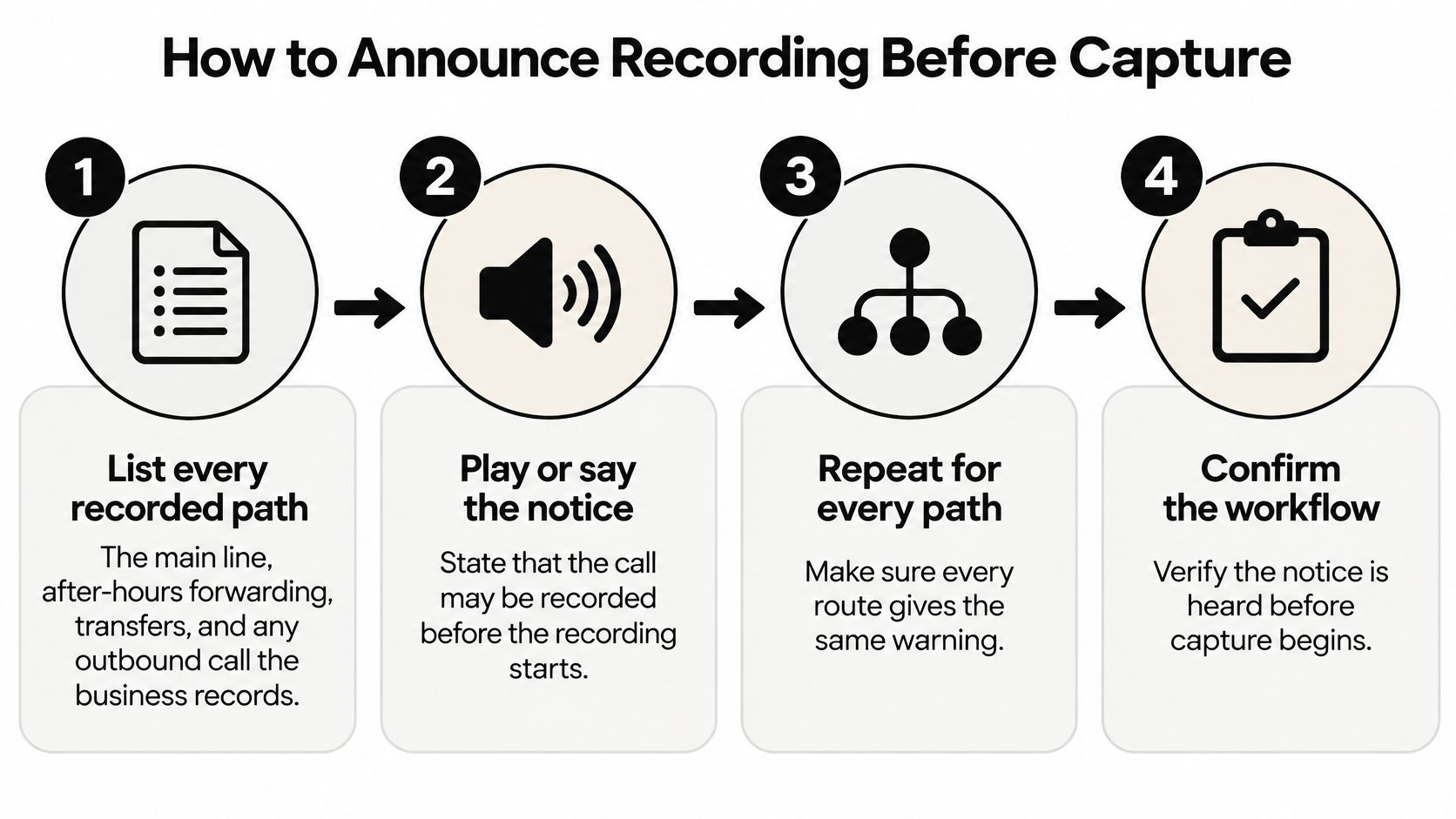
What to say and when to stop
- List every recorded path. That means the main line, after-hours forwarding, transfers, and any outbound call the business records.
- Play or say the notice before recording starts, loud enough for everyone already on the call.
- Ask for an explicit yes. This call may be recorded for scheduling and quality. Do you agree to be recorded? Wait for a clear yes before treating the caller as consenting.
- If the caller says no, stop recording and finish unrecorded, or offer a callback. Don't argue them into a yes.
- If the caller asks whether the call is recorded, answer truthfully and ask again.
- On a transfer to a tech, agent, or owner, repeat the notice for anyone who missed it.
- If a speakerphone guest or a new voice joins, pause and give that person the notice before recording continues.
Crime-evidence exceptions don't cover this workflow. More day-to-day wording sits in this guide to call recording for business, and shops that want tighter language can start from HVAC phone script examples and swap in their own services.
An AI receptionist on a forwarded number follows the same before-capture notice. Calls the business answers on its own phone never reach SkipCalls, so SkipCalls can't record or summarize them. The announcement duty tracks what is recorded.
The log that proves the notice
| Field | What to write | Example |
|---|---|---|
| Notice wording | Exact words played | This call may be recorded for scheduling and quality |
| Time notice played | Clock time and line | 4:12 p.m. on the shop line |
| Caller response | Yes, no, or silence | Yes, agreed to be recorded |
| Participants | Everyone who heard the notice | Caller and office manager |
| Transfer or added party | Yes or no, with name and time | Yes, tech Jordan at 4:14 p.m. |
Write the log while the call is fresh. Silence isn't a clean yes when you asked a direct question. General information, not legal advice. Last checked: October 2026.
What This Looks Like for Local Service Businesses
A roofing contractor misses an evening leak call. If an answering path records the homeowner describing the address and the damage, the notice has to play before that story is captured, and again if the call is handed to the on-call tech. The decision is simple. No notice, no recording of the damage story.
A salon books a color appointment. Names and times feel harmless. It's still a private customer call, so the same notice applies. Don't collect health details on that line.
A realtor or property manager taking an application should assume confidentiality. If the caller says no, stop recording and keep helping. A contractor answering service path has the same stop rule when a homeowner objects mid-call.
A small law firm or insurance agency has a higher stake because callers share sensitive facts. Use the notice, stop on objection, and don't treat this article as legal advice to the firm or its clients.
A California adjuster or agent calling a customer whose number looks out of state still uses the all-party notice. The area code isn't proof of where that person is standing.
Contrast a call the owner answers live on a handset they aren't recording. No system recording means no system transcript. The announcement tracks the recording, not the mere fact that a phone rang. Last checked: October 2026.
Put the Notice on Every Recorded Line
Do this in one week, not in a policy binder nobody opens.
Today, write one sentence of notice and put it on every recorded path before capture starts. Read it out loud on the shop line and on the after-hours forward. If the words are hard to hear over a truck or a dryer, they are not a notice.
This week, test a transfer and a speakerphone handoff. California's real question is whether each person on the line consented, and a caller who agreed with you never agreed with the tech who picks up mid-call. Confirm the second person hears the notice before recording continues. Start the consent log with the fields already listed: wording, time, response, participants, and any added party.
If a caller objects, keep helping without a recording. A booked job without audio beats a recorded call the caller refused. If the business records sensitive intake, have a lawyer review the script. This is general information, not legal advice. Last checked: October 2026.
Once the notice is real, recording pays off more when someone ties calls back to the ads that produced them. Teams that measure which campaigns generate qualified calls can see which lines deserve the log, instead of recording everything by habit.
SkipCalls answers the business's existing number in two rings, 24/7, including nights and weekends. It answers questions from the business's own information, captures caller details, books appointments, transfers urgent calls, filters spam, and sends a summary and a full transcript after each call. Calls the owner answers on their own phone never reach the service, so there is no summary or transcript for those. See current plans at SkipCalls pricing, or get started at SkipCalls.


