
Carpet Cleaning Marketing That Actually Books Jobs
Carpet cleaning marketing that turns calls into booked jobs. Learn the channels, offers, and follow-up systems carpet cleaners use to win in 2026.
Most carpet cleaning marketing advice is backward. It tells you to buy more clicks, post more before-and-after photos, and chase better rankings, while ignoring the part that who answers the phone, how fast they answer it, and what happens next decides whether you get paid.
That blind spot matters because the category is big and competitive. The global carpet and upholstery cleaning services market was estimated at USD 55.16 billion in 2022 and is projected to reach USD 83.50 billion by 2030, while carpet cleaning service alone accounted for USD 39.64 billion in 2022 revenue, according to Grand View Research's carpet and upholstery cleaning services market report. There's demand. The problem for a two-truck operator usually isn't whether people need cleaning. It's whether your business captures that demand better than the cleaner down the street.
In the U.S., that fight is even tighter. The carpet cleaning industry was valued at about USD 6.9 billion in 2026 and had only a 0.2% CAGR from 2021 to 2026, while a separate benchmark report noted that typical operators book only 25% to 35% of new-customer calls, top operators book more than half, and marketing investment commonly ranges from 3% to 5% of revenue versus 15% to 20% for top performers, according to the carpet cleaning benchmark report. Slow category growth means sloppy operators don't get saved by market tailwinds. They get squeezed.
Table of Contents
- Why Most Carpet Cleaning Marketing Leaks Money
- Defining Your Ideal Carpet Cleaning Customer
- Choosing the Right Acquisition Channels
- How benjiads Can Help
- Crafting Offers and Messaging That Convert
- Capturing Every Lead and Answering Every Call
- Tracking the KPIs That Prove It Is Working
- Your 90-Day Carpet Cleaning Marketing Plan
Why Most Carpet Cleaning Marketing Leaks Money
The usual fix for a slow month is “get more leads.” That's lazy thinking.
The problem is usually that you're already paying for attention, but your business can't reliably convert that attention into booked jobs. In home services, around 27% to 62% of inbound calls go unanswered depending on the benchmark, and a 2026 report found only 52% of calls are answered by a person, with 38% of answered calls becoming leads and 45% of those leads converting on the call, based on the missed call research summary. If your ads, map listing, or referrals generate calls you don't answer, your marketing doesn't have a traffic problem. It has a handling problem.
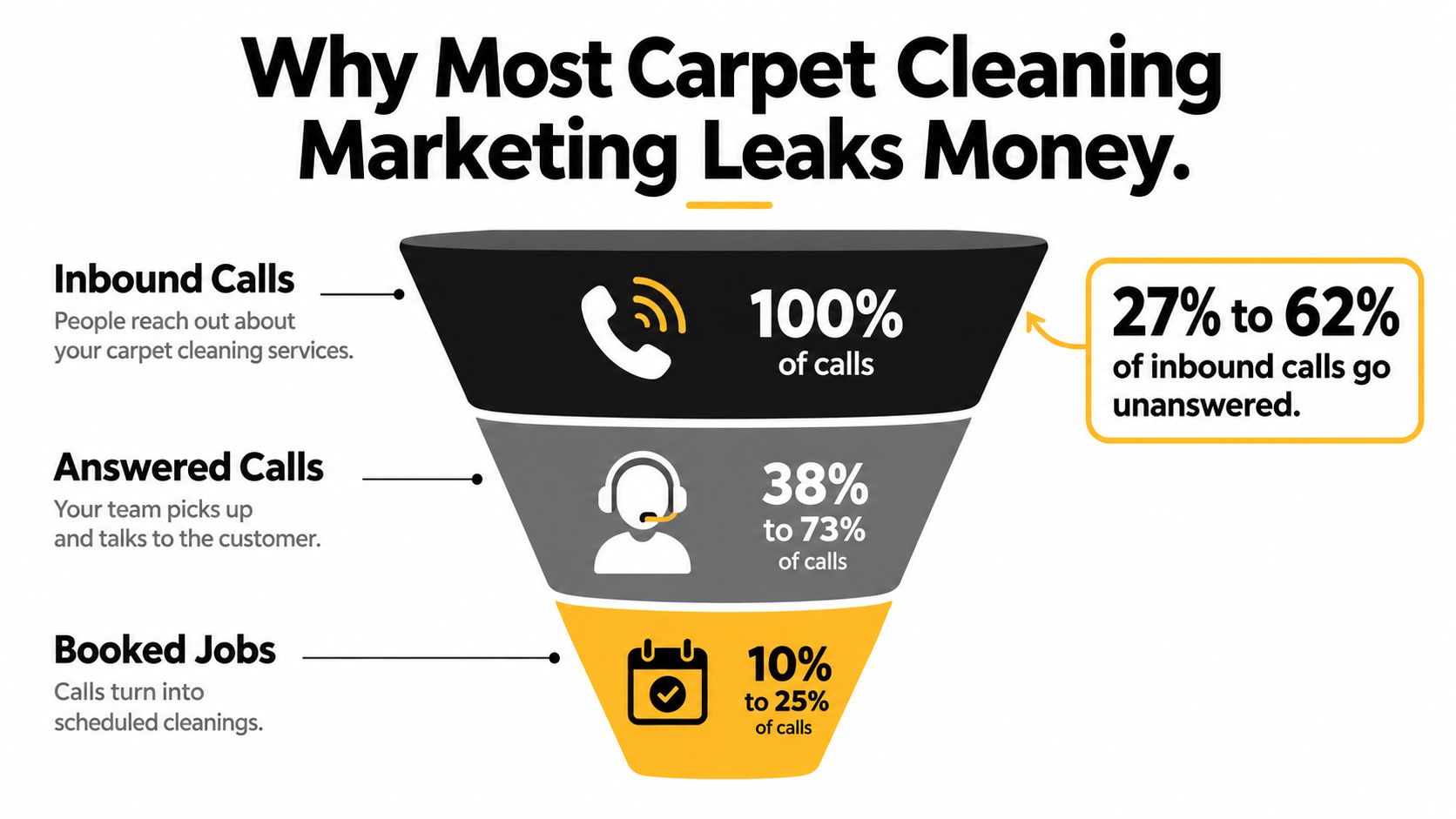
Many owners never calculate the cost of this leak. They look at lead cost and stop there. That misses the point. If you pay for calls and too many ring out, the cost per booked job rises fast because the failures still cost money. The clicks happened. The calls happened. The revenue didn't.
Practical rule: Before you raise ad spend, fix the point where paid demand turns into dead air.
You can see the same issue from a different angle in broader home-services call benchmarks. 38% of calls answered by a person are leads, and 45% of those leads convert on the call, while another benchmark found 37% of digital-marketing calls are leads and 46% of those leads convert on the call in home services, according to Invoca's home services lead conversion benchmarks. A live answer isn't administrative overhead. It's part of your conversion engine.
The three leaks that hurt most
Missed inbound calls
High-intent buyers often call when they want an answer now, not tomorrow.Slow callbacks
Even if you call back later, you're usually chasing someone who already talked to another cleaner.Weak follow-up to old customers
Many cleaners burn money chasing strangers while doing almost nothing with past clients, estimate requests, and seasonal reminders.
If you want a blunt breakdown of what those missed calls really cost, read the true cost of missed business calls. Then stop treating carpet cleaning marketing like an ad-buying contest. It's a funnel problem. Call conversion comes first. Advertising comes second.
Defining Your Ideal Carpet Cleaning Customer
Most small operators market too wide. They'll clean anything for anyone, anywhere, then wonder why the schedule is full but the bank account isn't.
Start narrower. Pick the customer, the radius, and the job type before you touch a channel. If you skip that step, your campaigns turn into random acts of promotion.
The three segments worth prioritizing
For most two-truck carpet cleaners, three customer groups tend to produce the cleanest economics.
| Segment | Typical Job Size | Revenue per Stop | Repeat Cadence | Best Channel |
|---|---|---|---|---|
| Homeowners in larger single-family homes | Whole-home cleaning with add-ons | Usually stronger because truck time is used efficiently | Recurring maintenance cycle | Google Business Profile, local SEO, referrals |
| Property managers | Turnover and unit-ready work | Can be solid when routing is tight and expectations are clear | Repeat when you earn trust | Direct outreach, referral partnerships |
| Real estate agents | Listing prep and move-related cleaning | Good when urgency is high and upsells fit the job | Irregular but referral-driven | Realtor partnerships, local networking |
The first segment is usually the most stable. Homeowners with larger homes often want whole-home service, odor treatment, protector, upholstery, or tile add-ons. That's better than sending a truck across town for a bargain single-room special.
Property managers are a different animal. They care about speed, reliability, and whether you can make a unit rentable again without drama. Real estate agents care about presentation and timing. If you can handle short deadlines, they can feed you jobs that don't depend on rankings or ad auctions.
Set a real service radius
Don't advertise everywhere your county map touches. Set a drive-time boundary that your trucks can handle profitably, then reject zip codes outside it unless the job size justifies the trip.
Use these filters:
- Travel efficiency: Favor neighborhoods that let you stack jobs without wasting half the day in traffic.
- Housing fit: Target areas with the kind of homes and flooring types that support your core offers.
- Upsell potential: Prioritize places where pet treatment, protector, upholstery, and tile cleaning are realistic add-ons.
- Operational sanity: If a job creates dead time on the schedule, it needs to pay for that inconvenience.
You don't need more territory. You need a tighter map and better stops inside it.
Build a one-page customer worksheet
Put this on one page and force yourself to answer it:
- Best customer type: homeowner, property manager, or realtor referral
- Best services: whole-home carpet cleaning, pet odor treatment, move-out refresh, tile add-on
- Worst-fit jobs: low-ticket one-room specials, distant zip codes, price shoppers
- Core service area: the neighborhoods your trucks can serve without losing half the day
- Reason they buy: odor problem, visible stains, upcoming guests, listing prep, tenant turnover
Here's the rule: if a channel can't put your message in front of that exact customer in that exact radius, don't run it. Good carpet cleaning marketing starts with choosing who you want to serve. It gets expensive when you refuse to choose.
Choosing the Right Acquisition Channels
Every carpet cleaner hears the same list. SEO, Google Ads, Facebook, mailers, referrals, directories. Most owners treat them like equal options. They're not.
Some channels bring buyers who already want service. Others create awareness and hope demand shows up later. If you run a small operation, you should bias hard toward intent.
What the benchmarks say about search traffic
Across 3,211 U.S. home-services search campaigns, cleaning services posted a 17.65% conversion rate, $46.99 cost per lead, $8.50 CPC, and 9.01% CTR, versus home-services medians of 7.33% conversion rate and $90.92 CPL, according to Benchmarketing's cleaning services benchmark page. That's why high-intent search matters. When someone searches with urgency, the economics are often better than broad awareness campaigns.
Carpet cleaning marketing channels compared
| Channel | Avg. Cost per Lead | Lead Intent | Time to Result | Best Use |
|---|---|---|---|---|
| Google Business Profile | No fixed media spend | High | Medium | Map pack visibility and inbound calls |
| Local SEO | No fixed media spend | High | Medium to long | Long-term local rankings |
| Google Local Services Ads | Varies by market | Very high | Fast | Call-driven local demand |
| Google Ads | Varies by keywords and setup | High | Fast | Emergency, stain, pet, and premium service offers |
| Meta ads | Varies | Lower to mixed | Fast to medium | Retargeting, awareness, reactivation |
| Direct mail | Varies by list, print, and route | Mixed | Medium | Neighborhood saturation and repeat visibility |
| Referral partnerships | Usually pay on closed work, not clicks | High | Medium | Realtors, property managers, maid services |
I'd rank them like this for a typical small operator:
Start with Google Business Profile
Your Google Business Profile is the cheapest long-game asset you can build. It influences map visibility, review trust, call volume, and whether a homeowner clicks at all. Add real job photos, service descriptions, service areas, and a process for requesting reviews after completed work.
Put Local Services Ads next
LSAs are built for intent. People searching there usually want someone local and available. If your business can answer calls well, LSAs deserve attention early.
Build referral partnerships before fancy campaigns
Realtors, property managers, maid services, and even flooring stores can create reliable deal flow without forcing you into an auction every day. These leads often come with built-in trust.
Use Google Ads for targeted growth
Run paid search for the jobs that justify the spend. Pet odors, move-out jobs, stain removal, same-week scheduling, and premium packages usually make more sense than generic “cheap carpet cleaning” traffic.
Treat direct mail as a route-density play
Mail isn't dead. Bad targeting is. If you use mail, keep it tight by neighborhood and pair it with online retargeting where possible. A postcard to the right subdivision can work. A blanket drop across random areas usually wastes money.
Put social last
Meta works better as support than as the engine. It's useful for retargeting site visitors, staying visible to past customers, and promoting timely offers. It's rarely the first channel I'd trust to carry a small carpet cleaner.
For operators starting under a modest monthly budget, the practical mix is simple: tighten your Google Business Profile, add LSAs if they're available in your market, build referral partners, and only then layer paid search. If you need help with local visibility basics, this local listings management guide is worth reviewing.
How benjiads Can Help
A lot of carpet cleaners know they should advertise online but never get consistent with it. That's not because they're lazy. It's because campaign setup, creative production, tracking, retargeting, and follow-up all sit on top of actual field work. Truck owners don't have time to become part-time media buyers.
That's where a tool like carpet cleaning marketing from benjiads fits. It's software that automates online advertising and lead follow-up for local service businesses. Instead of hiring a traditional agency or trying to stitch everything together yourself, you get one system that handles ad creation, campaign launch on Meta and Google, tracking, retargeting, and text-based lead follow-up, with the owner approving campaigns before they go live.
Where it solves a real problem
The strongest use case is the owner who needs ads running without building an in-house stack. benjiads generates creatives and copy designed for the trade and local area, launches campaigns, and tracks performance with server-side and client-side signals. It also includes prebuilt funnels and lead follow-up by text, which matters because leads go cold fast when no one responds.
That combination is useful when your bottleneck isn't deciding whether ads can work. It's managing the machinery around them. A lot of DIY campaigns fail because the owner launches ads but never builds the landing flow, the tracking, or the follow-up sequence.
When it's the right fit
benjiads makes sense if you want a single product instead of juggling freelancers, ad managers, landing pages, and texting tools. It also fits owners who want approval before anything runs and don't want to pay a traditional agency retainer structure.
It's less useful if your main issue is operational. If your team still misses calls, forgets to quote promptly, or can't book cleanly, ad automation won't fix that on its own. Good software can accelerate a good process. It can't rescue a broken front desk.
Crafting Offers and Messaging That Convert
Most carpet cleaning ads are dull because they sell the process. Buyers don't care about “hot water extraction” unless they already trust you. They care about the problem in their house.
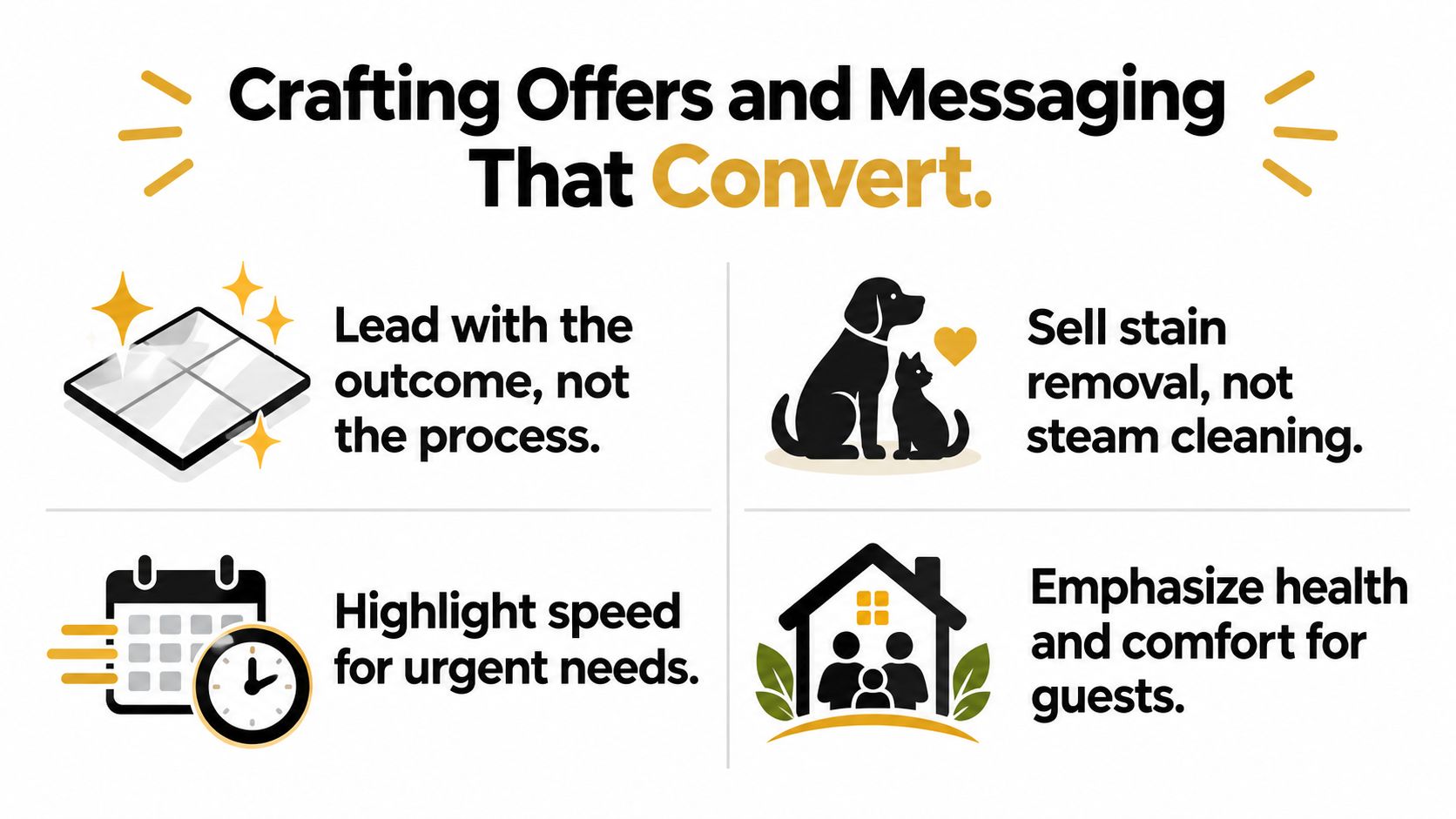
Sell the outcome. Stain removed. Pet odor handled. Guest-ready home. Cleaner air and fresher rooms before family arrives. That's the language people respond to because that's the reason they called.
Build offers around outcomes
Weak offer: “Professional carpet cleaning available.”
Stronger offer: “Get pet odor out before the weekend guests arrive.”
That shift matters. The first describes your service. The second describes the customer's win.
Use an offer ladder so buyers can choose without forcing you into discount-only selling:
- Entry offer: three-room refresh or hallway-and-stairs package
- Core offer: whole-home cleaning with protector or deodorizer
- Premium offer: stain treatment, pet odor treatment, upholstery, tile, or high-traffic restoration
That structure helps average ticket rise without making your brand feel cheap. It also gives the office or receptionist a clean way to present options.
Use urgency without sounding desperate
Urgency works when it's believable.
Try language like:
- Same-week availability: “Book today, clean Thursday.”
- Seasonal timing: spring allergy refresh, pre-holiday cleanup, move-in ready service.
- Schedule pressure: limited route availability in specific neighborhoods.
Don't train the market to wait for a coupon. Use offers tied to timing, convenience, or bundled value instead of endless discounts.
“Your ad should answer the customer's immediate problem, not describe your equipment like a product brochure.”
Differentiate from coupon cleaners
You don't beat the lowest-priced operator by shaving another few dollars off your price. You beat them by making the choice feel safer.
Use proof points such as:
- Before-and-after photos: Real work in local homes.
- Clear process explanation: What you inspect, treat, clean, and protect.
- Equipment distinction: Explain your setup in plain English if it affects results.
- Guarantee: Re-clean the area if the customer isn't satisfied.
- Referral hook: Give happy customers a simple reason to send the next job your way.
Messaging examples that usually work
Headline angles:
- Pet stains gone before guests arrive
- Whole-home carpet cleaning without the all-day hassle
- Move-out carpet cleaning that helps your place show better
- Deep carpet cleaning for high-traffic family homes
Price-anchoring script:
- Start with the full-home or higher-value package.
- Present the standard option next.
- Offer the entry package last for price-sensitive callers.
That order changes the conversation. Instead of defending your minimum price, you frame the higher-value option as normal. That's smarter carpet cleaning marketing than shouting “special” into the void.
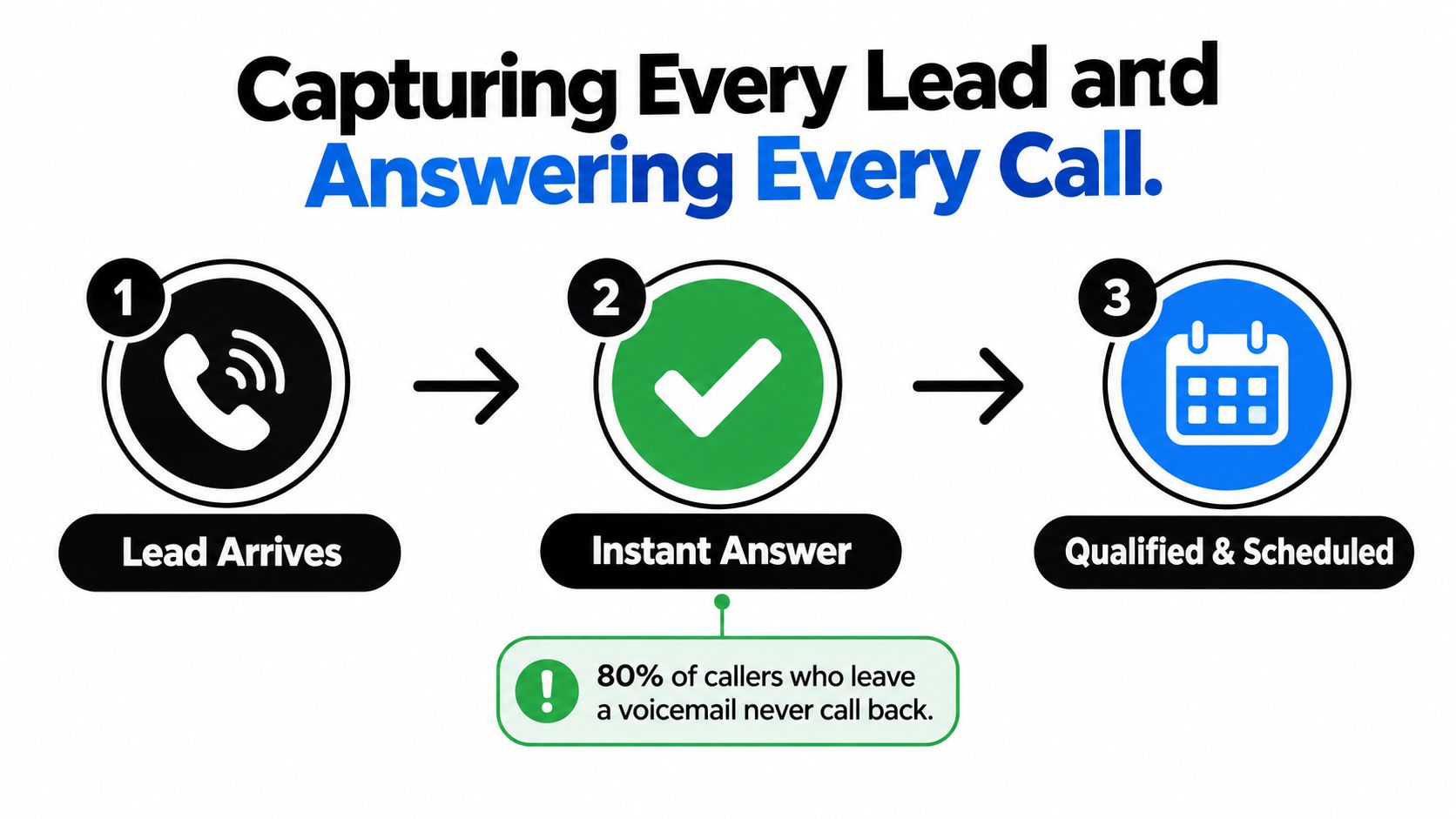
Capturing Every Lead and Answering Every Call
If you only fix one thing this year, fix lead capture.
A carpet cleaning company can survive mediocre ad creative for a while. It won't survive a front end that lets buyers hit voicemail, submit forms into a black hole, or wait around for a callback that never comes.
Build one intake path for every lead source
Your calls, web forms, text messages, and chat inquiries should land in one system. If your office staff has to bounce between inboxes, sticky notes, and random app notifications, leads will disappear.
Use a CRM that can:
- Create or update contacts: New and repeat callers shouldn't become duplicate chaos.
- Log calls and texts: You need a usable record of what happened.
- Attach summaries or recordings: This helps with training and follow-up.
- Identify caller intent: Stain issue, pet odor, move-out, estimate request.
- Create tasks and calendar actions: So a lead becomes an appointment, not a reminder in someone's head.
Those workflow functions are described in this overview of CRM integration for phone and text workflows. That's the standard. Anything less creates friction you don't need.
Answer fast or automate the answer
Local service businesses increasingly need tools that answer inbound calls, qualify leads, and book appointments from the same workflow because front-office automation products are built to combine those functions with CRM and calendar syncing, as shown by Flowstack Labs HQ. That setup fits carpet cleaning perfectly because callers usually want availability, a rough quote, and a fast path to booking.
One practical option is an AI receptionist. SkipCalls is a simple-to-set-up solution that works for any case, from customer support, lead qualification, appointment booking, and many more. It handles voice and text and does not require you to change your phone number to integrate into your workflow. It has many integrations with CRM and calendars.
Business texting doesn't have to force a number change either. Existing business numbers can support texting, and self-scheduling can connect to booking links with automatic confirmations and reminders, as described by Textellent's business texting and scheduling overview. That matters because you shouldn't have to retrain your market around a new phone number just to modernize intake.
The call flow that actually books jobs
Your intake flow should sound simple and feel fast:
Greeting and service confirmation
Confirm the caller reached the right business and ask what they need cleaned.Qualification
Ask the job type, the number of rooms or areas, whether there are stains or odors, and how soon they want service.Quote framing
Give a reasonable range or package recommendation based on the information gathered.Booking
Offer available time slots and lock in the appointment.Confirmation by text
Send the appointment details and any prep instructions immediately.
If you miss a call, a recovery workflow should fire instantly. A missed-call text-back process can detect the unanswered call, send a text within seconds, save the lead, assign it, and continue follow-up, as outlined in this guide to missed-call text-back workflows.
Fast answer, fast qualification, fast booking. That sequence does more for revenue than another round of “brand awareness” posts.
If you're evaluating AI reception specifically, this guide to AI phone answering for service businesses is a practical place to start.
Tracking the KPIs That Prove It Is Working
If you can't answer basic questions about lead cost, answer rate, booking rate, and revenue by channel, you're not running marketing. You're funding experiments without a scoreboard.
Don't overcomplicate this. A small carpet cleaning company needs a short KPI list and a weekly review habit.
Carpet cleaning marketing KPI benchmarks
| KPI | Target | Why It Matters |
|---|---|---|
| Cost per lead by channel | Compare channels against each other, not by gut feel | Shows where you're buying attention efficiently |
| Answer rate | As high as possible, with a clear internal standard | Tells you whether demand is being captured |
| Booking rate | Higher is better, tracked by source | Reveals call handling and offer strength |
| Average ticket | Increase through packaging and add-ons | Protects margin and truck productivity |
| Show-up rate | Keep it consistently strong | Exposes reminder and confirmation issues |
| Revenue per booked job | Track by source and service type | Tells you what actually produces profit |
This section doesn't need fake precision to be useful. What matters is the setup.
Wire your reporting correctly
Use:
- Call tracking software to attribute calls to channels
- Google Ads and Google Business Profile data for spend and visibility
- Your CRM for booked jobs, won jobs, lost jobs, and repeat customers
- A weekly scorecard that ties spend to leads, leads to bookings, and bookings to revenue
Offline conversion imports matter too. If booked jobs live only in your CRM and never flow back into ad platforms, your campaigns optimize around shallow events instead of real business outcomes.
A simple call attribution setup goes a long way. If you need the mechanics, review this guide to phone call tracking for marketing attribution.
The review cadence that keeps waste low
Every month, make three decisions:
- Cut channels or campaigns that create activity but not booked work
- Fix campaigns that bring leads but expose weak handling or poor fit
- Fund the sources that produce profitable jobs repeatedly
Good reporting doesn't exist to impress you. It exists to help you kill what isn't working.
That discipline is what turns carpet cleaning marketing from a pile of tactics into a manageable system.
Your 90-Day Carpet Cleaning Marketing Plan
Most owners don't need another list of ideas. They need a sequence they can start on Monday.
This is the sequence I'd use for a two-truck carpet cleaner that wants more booked jobs without turning the business into a marketing hobby.
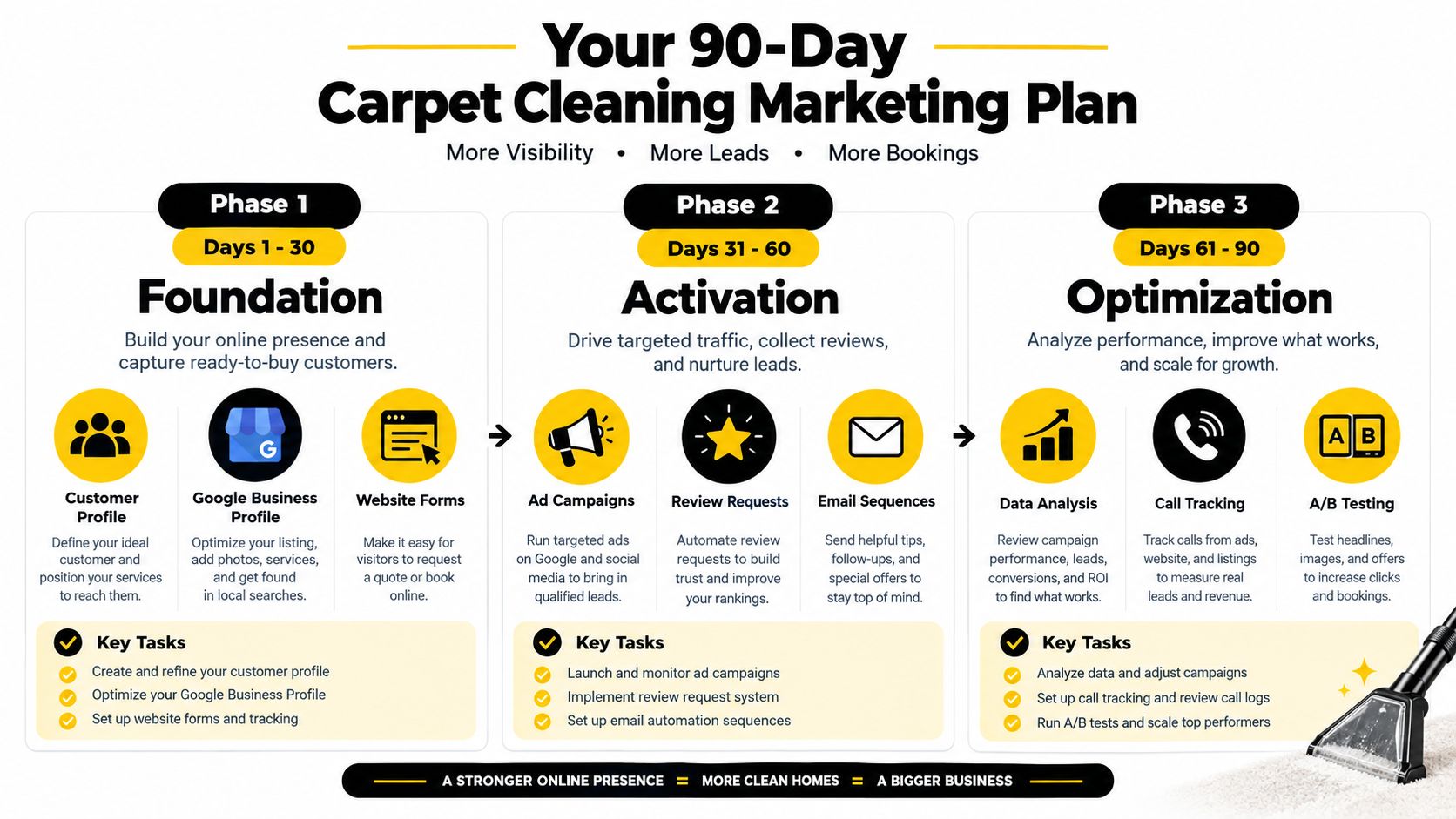
Days 1 through 30
Get the foundation right.
- Define the customer: Choose your best-fit segment, best job types, and service area.
- Tighten your Google Business Profile: Update services, photos, service areas, and review process.
- Install call tracking: Know which sources create calls and bookings.
- Fix intake: Route calls, forms, and texts into one CRM and set up instant follow-up.
- Wake up your past customer list: Ask for reviews and send a simple rebooking message tied to current needs.
This first month isn't glamorous. It's where the waste gets exposed.
Days 31 through 60
Turn on acquisition channels that match intent.
- Publish useful service and location pages: Make it easier to rank and easier for buyers to see fit.
- Launch Local Services Ads if available: Add another intent-heavy call source.
- Run a small search campaign: Focus on high-value services and urgent needs.
- Start referral outreach: Contact property managers, real estate agents, and adjacent local businesses.
- Test neighborhood mail if the route density works: Keep the targeting tight.
At this stage, you're not trying to be everywhere. You're trying to prove which channels can produce booked work inside your actual service area.
Days 61 through 90
Keep the winners. Cut the passengers.
Review channel-by-channel performance and identify the two sources that produce the best booked jobs. Then move more budget and attention there.
Add one seasonal promotion with a clear trigger. Pre-holiday cleaning, allergy-season refresh, move-out scheduling, or pet-odor cleanup all work if the message matches buyer timing. Re-engage dormant customers with a short email or text campaign and a direct booking path.
The final step is operational, not creative. Lock in the habits that made the quarter work:
- weekly KPI review
- rapid lead response
- consistent review requests
- clean referral follow-up
- clear package offers instead of random discounts
A good 90-day plan doesn't try to do everything. It removes leaks, sharpens targeting, and scales what already converts. That's what carpet cleaning marketing should look like when it's built to book jobs instead of just generate noise.
If your phones aren't getting answered, your campaign problem is really an intake problem. Fix that first, then spend harder.

