The True Cost of Missed Business Calls in 2026: Industry Data Shows Small Businesses Lose $26,000+ Per Year
New 2026 industry data reveals the shocking cost of missed business calls. Discover why 62% of calls go unanswered and how it costs small businesses $26,000+ per year.

It’s 2:00 PM on a Tuesday. You’re on a job site, deep in focused work, or perhaps you’re in a client meeting. Your phone buzzes in your pocket. You check the screen—unknown number. You let it go to voicemail, thinking, "I'll call them back in 20 minutes."
That decision just cost you money. Likely more than you think.
For years, business owners have treated missed calls as a minor annoyance—a housekeeping issue to be dealt with at the end of the day. But new industry data for 2026 paints a much more alarming picture. In an era of instant gratification, the "call back later" strategy is no longer just inefficient; it is actively draining your revenue.
According to recent reports, the average small business is now losing over $26,000 per year directly to missed calls, with some service-based businesses seeing losses exceeding $126,000.
Here is the breakdown of why silence is so expensive in 2026, and how you can stop the leak.
The 2026 Data: The "Silence Tax" on Small Business
We often underestimate the value of a single ring. It feels like just a phone call. But to the person on the other end, it is a solution to a problem they need fixed now.
Recent analysis from 2025-2026 has quantified exactly what happens when that phone rings unanswered:
- 62% of calls go unanswered: A staggering percentage of calls to small businesses never reach a human ear.
- 85% won't call back: If you don't answer, the vast majority of potential clients will not try again. They won't leave a voicemail. They will simply call the next number on Google.
- 78% buy from the first responder: Speed is the primary currency. The business that picks up first wins the job, regardless of whether they are the "best" or cheapest option.
When you combine these stats, the math becomes brutal. If you miss a call, you aren't just delaying a conversation; you are handing a lead directly to your competitor.
What Are Missed Calls Costing You?
Step 1 of 3 • Takes 30 seconds
On a typical busy day, how often does your phone ring when you can't pick up?
When you're with a customer, under a house, on a ladder...
Don't stress about the exact number – a rough guess is perfect
What Are Missed Calls Costing You?
Calculate how much revenue your business loses from missed phone calls. Most contractors lose $800-$1,500 per month from unanswered calls. SkipCalls AI phone answering costs only $199/year and captures every lead.
- Calculate how much money you lose from missed calls
- Average contractor loses $800-$1,500/month to unanswered calls
- SkipCalls AI answering costs only $199/year
- One captured job pays for 5+ years of service
The "Hidden" Costs You Don't See
The $26,000 figure is just the baseline. For high-ticket trades and professional services, the losses are often far steeper.
1. The Immediate Revenue Hit
Let’s say you run a plumbing business. Your average job is worth $450.
If you miss just one viable lead per day:
- $450 x 5 days = $2,250/week
- $2,250 x 50 weeks = $112,500/year
Even if you only convert 25% of those calls, that is still $28,125 in pure revenue walking out the door every single year. That’s the price of a new work van, a marketing campaign, or a significant bonus for your team.
2. The Lifetime Value (LTV) Drain
That missed call wasn't just a $450 repair. It was a potential relationship.
A customer who finds a reliable plumber for an emergency leak today is the same customer who will call for a $15,000 bathroom renovation next year. When you miss the first call, you lose the lifetime value of that client—which can easily range from $5,000 to $50,000 depending on your industry.
3. The Marketing Waste
You spend money to make your phone ring. Whether it’s Google Local Services Ads (LSA), Facebook ads, or just the cost of wrapping your truck, every inbound call has a "Cost Per Lead" attached to it.
If you pay $50 per lead and miss 50% of your calls, your effective cost per lead just doubled to $100. You are essentially paying Google to send customers to your competitors.
Why Voicemail Is Dead in 2026
"But I have voicemail!"
I hate to break it to you, but voicemail is on life support. In 2026, voicemail is where leads go to die.
Data shows that 80% of callers hang up as soon as they hear a recorded greeting. Why? Because modern consumers are conditioned for speed. They assume (often correctly) that a voicemail won't be heard for hours, if at all.
If you are relying on voicemail as your safety net, you are fishing with a net that has a massive hole in the bottom.
The Solution: How to Capture 100% of Calls (Without Hiring Staff)
The traditional solution to this problem was expensive: hire a receptionist.
A full-time receptionist costs roughly $35,000–$45,000 a year, plus payroll taxes and benefits. For a solo contractor or small team, that is a massive overhead increase just to answer the phone.
Fortunately, technology has bridged the gap.
1. The Call Forwarding "Hack"
At the very least, every small business owner should be using conditional call forwarding. This allows you to ring multiple phones—your partner, your foreman, or a second line—if the main line is busy. It’s a band-aid, but it’s better than nothing.
2. The Rise of the AI Receptionist
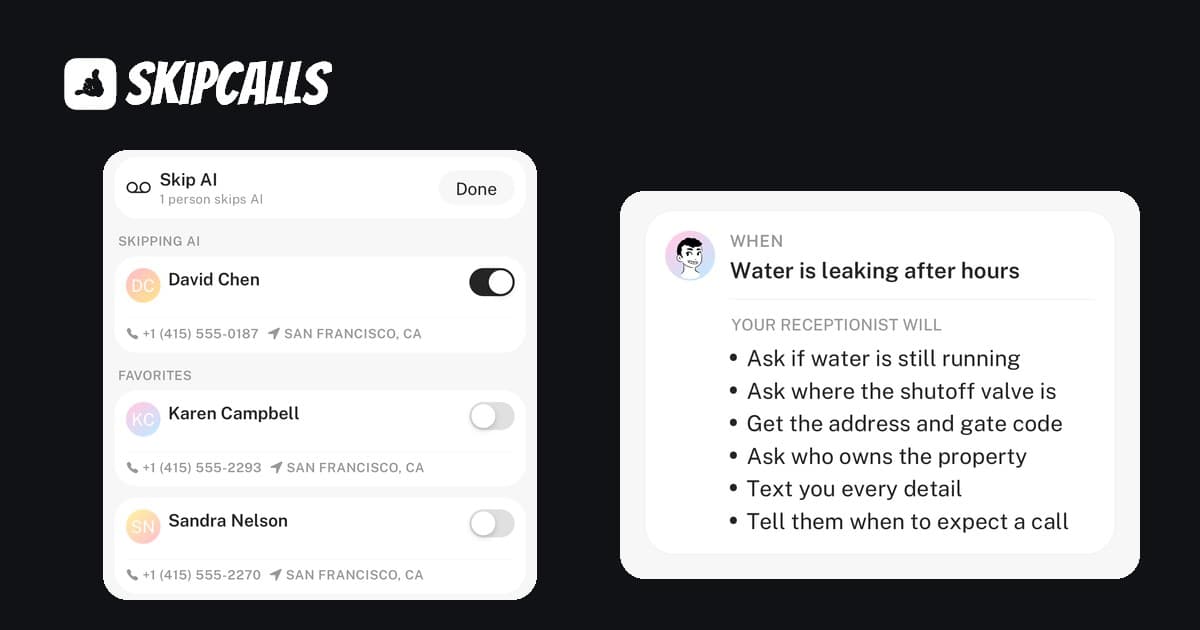
This is where the industry is shifting. Tools like SkipCalls have democratized 24/7 phone coverage.
Instead of paying a salary, you pay a small subscription (less than the cost of one missed job) to have an AI handle your calls. But this isn't the robotic "press 1 for sales" menu of the past.
Modern AI receptionists can:
- Sound human: Using advanced voice cloning, they sound professional and natural.
- Book jobs: They can check your calendar and schedule appointments directly.
- Filter spam: Our spam blocking feature ensures you only get notified for real leads.
- Work 24/7: They capture the night and weekend calls that human staff miss.
Your Business: Before vs After AI
- 80% of callers hang up
- Lose $26k+ annually
- Constant interruptions
- 100% answer rate
- Revenue captured instantly
- Peace of mind
Tap to switch between views
A Real-World Example: The Math of "Just One Call"
Consider "BrightSpark Electric," a small electrical contractor.
They receive about 10 calls a week after 5:00 PM or on weekends. Before fixing their phone system, these calls went to voicemail. Maybe 2 people left a message. The other 8 called a competitor.
By implementing an AI answering service, they started capturing those 8 "lost" calls.
- 8 recovered calls/week
- 40% conversion rate (conservative)
- 3 extra jobs/week
- $350 average profit/job
- = $1,050 extra profit per week
That is over $54,000 a year in found revenue, just by plugging the leak.
How to Stop the Bleeding Today
You don't need to overhaul your entire business to fix this. Here is a simple audit you can do right now:
- Check your call logs: Look at how many missed calls you had last month.
- Multiply by your average job value: Be honest. If you missed 10 calls and your average job is $500, that’s $5,000 in potential exposure.
- Implement a backup: Whether it's a lead capture solution or a dedicated answering service, ensure someone or something picks up when you can't.
If you are ready to stop donating revenue to your competitors, it’s time to modernize your phone system.
SkipCalls offers a simple, powerful solution designed specifically for trades and small businesses. For a fraction of the cost of a single missed job, you can ensure every lead is captured, qualified, and booked.
Don't let another $26,000 slip through the cracks this year.
Try SkipCalls free for 7 days and see how many jobs you've been missing.