

How to Improve Customer Experience That Lasts
Learn how to improve customer experience with proven strategies for phone handling, follow-ups, personalization, and team workflows that drive loyalty.
The phone rings while you're helping another customer. By the time you reach it, the caller has already tried the next business in Google. Maybe they leave a voicemail. More often, they don't. The missed call becomes a lost booking, and your team never learns what the customer needed.
That moment is the practical starting point for understanding how to improve customer experience in a phone-first business. The biggest gains rarely come from polishing a brand message or adding another empathy phrase to a script. They come from answering quickly, capturing the right details, preserving context, and making the next step easy.
Forrester's 2024 U.S. Customer Experience Index found that customer-obsessed organizations had 41% faster revenue growth, 49% faster profit growth, and 51% better customer retention than non-customer-obsessed organizations. The same report found average experience effectiveness at 64% and average ease of experience at 66%, leaving plenty of room for operators to remove friction.
The Call That Reveals Your Customer Experience
Tuesday morning, 9:12 a.m. A homeowner calls your plumbing business because water is spreading beneath a sink. The technician is driving, the office manager is helping someone at the counter, and the phone rings until the caller hangs up.
At 9:14, the homeowner calls another plumber. At 9:18, they may send a text through the contact number on your website. If that inbox isn't monitored, the second opportunity disappears too. By 9:30, your business hasn't only missed a call. It has demonstrated that reaching you is difficult when the customer needs you most.
That single incident contains the whole CX problem for a phone-first service business. The customer doesn't care whether your team is friendly in principle. They need contact, a clear answer, and a practical next step. A polished professional phone greeting helps, but it can't compensate for a call that nobody answers or a callback that arrives after the customer has hired someone else.
What happens after the missed call
A missed inquiry usually follows one of three paths:
- The caller chooses a competitor: Search results make switching easy, especially when the need is urgent.
- The caller leaves a voicemail: The message sits beside other tasks, without a clear owner or deadline.
- The caller sends a text: The message reaches a personal phone, a shared inbox, or nobody at all.
The cost isn't limited to the first interaction. A missed call often creates a broken handoff, incomplete customer information, and no record of why the person reached out. If the customer eventually reconnects, they may need to repeat the entire story.
Practical rule: Treat every unanswered call as an active customer case, not as an administrative task to review later.
The rest of the operation should support that rule. Calls need an owner, follow-ups need a time limit, and booking information needs to move from the person who answered to the person who will deliver the service. Empathy still matters, but speed and continuity decide whether the customer gets the chance to experience it.
Phone Handling That Wins the First Contact
A customer calls while standing beside a leaking pipe, locked-out door, or failing appliance. If the phone rings unanswered, the customer may contact the next business before your team gets a chance to help. Phone handling therefore needs a clear operating system: answer quickly, keep the caller engaged, and provide a useful fallback when the team is busy.
In a benchmark covering 70 million calls, only 56% were answered by a person overall, while calls lasting more than 15 seconds and 30 seconds had higher answer rates, according to Anthrova's missed-call benchmark. The practical lesson is to prevent short, abandoned attempts. A shared ring group, a staffed fallback, or a brief message can keep an inquiry from disappearing.
Set the first target at answering in under three rings. Send calls through a shared ring group so the next available person can respond instead of leaving one desk responsible for every inquiry. If nobody answers after four rings, route the call to a trained cell phone, an AI receptionist, or a message that explains exactly what will happen next.
Give the first ten seconds a job
The opening should name the business, identify the person answering, and guide the caller toward the reason for contacting you:
“Thanks for calling Oak Street Plumbing, this is Maya. Are you calling about a repair, an estimate, or an appointment?”
This question reduces uncertainty and starts qualification without forcing the caller through a long menu. Follow it with one decision-making question, such as the service address, urgency, or preferred appointment window.
Complete the next step during the call whenever possible. Capture the name, number, address, service need, urgency, and preferred time, then book, qualify, or assign the inquiry before ending the conversation. A concise telephone answering script helps new staff follow the same sequence while leaving room for a natural conversation.
| Metric | Target | Tactic |
|---|---|---|
| Time to answer | Under three rings | Use a shared ring group and clear queue ownership |
| Fallback point | After four rings | Route to a cell phone or staffed answering service |
| Lead capture | During the first call | Record contact details, need, urgency, and next action |
| Answered digital-marketing calls | Leads formed a substantial share of calls | Ask structured qualification questions, based on Anthrova's call benchmark |
| Lead conversion during the call | A substantial share of identified leads converted | Move directly to booking or qualification, based on the same call benchmark |
If nobody can answer live, use a short message: “Thanks for calling Oak Street Plumbing. We couldn't get to the phone, but we've received your call. Please leave your name, address, and service need, and we'll contact you as soon as possible.” The message should create an owned task, with someone responsible for the response, rather than just collecting audio.
Phone handling is a queue, a script, a fallback, and an outcome record. The customer experience improves when each part works together.
Follow-Ups and Bookings That Carry the Conversation
A customer inquiry becomes a reliable experience only when information survives the handoff. The person answering the phone may never meet the technician, but the technician should know what the customer asked, what was promised, and what time was agreed.
Start with a minimum sequence:
- Capture the inquiry: Record the caller's contact details, request, urgency, quoted range if applicable, and preferred time.
- Write the call note into the CRM: Use plain language that another employee can understand without replaying the call.
- Send a confirmation text: Restate the service, arrival window, and next action.
- Create the calendar event: Invite the responsible technician or team member and include the relevant notes.
- Log the outcome: Mark the job completed, rescheduled, quoted, lost, or awaiting a customer decision.
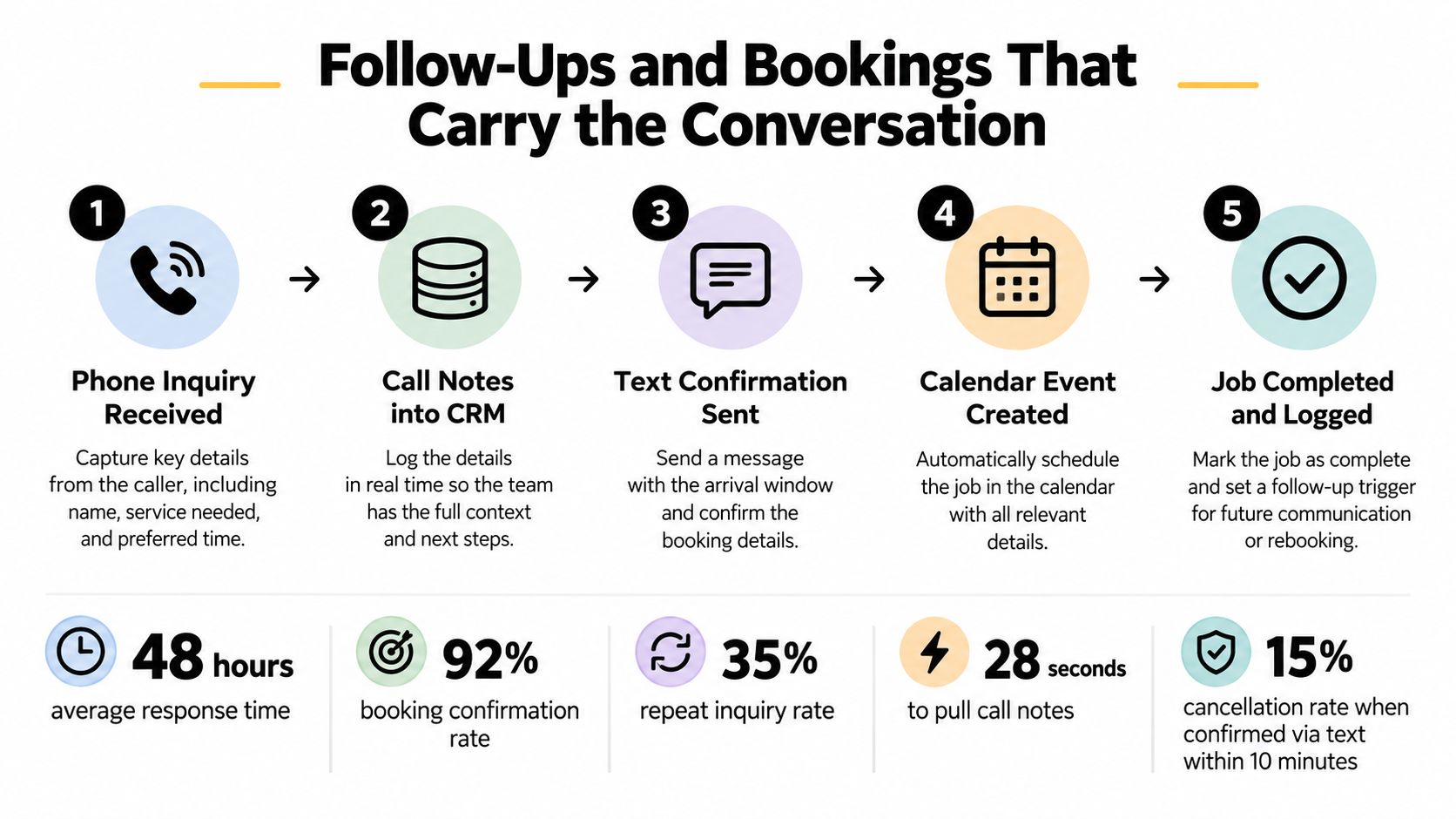
The confirmation text should continue the conversation rather than restart it. “Hi Jordan, this is Maya from Oak Street Plumbing. You called about the leaking kitchen pipe. We have you scheduled for Tuesday between 1 and 3 p.m. Chris will arrive and call when he's on the way. Reply here if anything changes.”
That message gives the customer a usable correction path. It also gives the field worker a clear promise to keep. Tools that support text message appointment reminders can automate confirmations and rescheduling while keeping the exchange in the same thread.
Close the two gaps operators miss
The first gap appears between the quote and the booking. A customer says they'll think about it, then nobody follows up because the quote was treated as the end of the interaction. Assign a same-day task with the quoted service, the customer's concern, and the exact question to answer.
The second gap appears after a deposit is taken. Payment confirms a transaction, not a relationship. Send the next instruction, confirm the appointment window, and tell the customer what they should expect before arrival.
Appointment tools can connect calendars such as Google Calendar, Microsoft Outlook, and iCal with CRMs including Salesforce, HubSpot, Zendesk, and Zoho CRM, as described in JustCall's scheduling overview. The technology matters less than the handoff discipline. Every inquiry should have one record, one next action, and one owner.
Personalization for Repeat Customers
Personalization for a repeat caller isn't a compliment or a carefully chosen adjective. It's remembering enough that the customer doesn't have to explain the same situation again.
A useful customer record should be readable in under thirty seconds. Store the previous job, price quoted, materials used, technician assigned, preferred contact method, and preferred appointment window. Keep those details in the CRM record, not in a notebook or one employee's memory.
Recall removes friction
Train the team to open the record when a known number appears, then confirm the relevant detail naturally. “I see we replaced the pressure valve in March. Is this the same issue, or has something else changed?” is more useful than asking, “Have we been out there before?”
Job notes should also flag recurring problems. If a customer has reported the same drainage issue more than once, the technician can arrive with the right context and equipment. The office can also prepare the customer for a likely diagnostic step instead of making them repeat a history the business already owns.
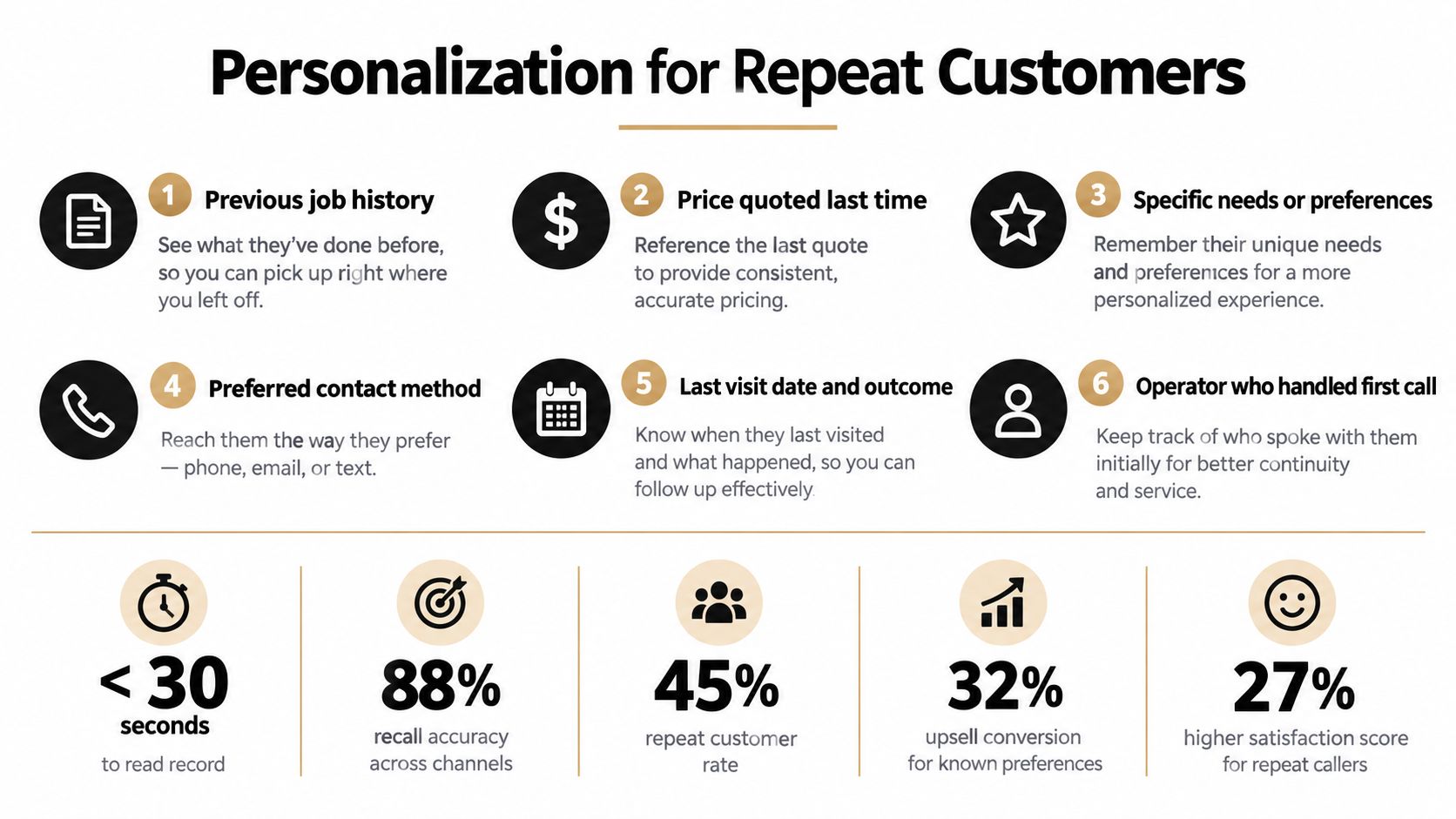
Use preferences as operational instructions. If a customer prefers texts rather than calls, record it. If they need morning visits because of work, make that visible during scheduling. If a referral led to the relationship, note it so the owner can acknowledge the contribution in a personal, proportionate way.
Avoid performative personalization
Customers notice when a business uses their first name but forgets their unresolved problem. A small gesture tied to a real milestone, such as recognizing a third annual service or thanking someone for a referral, works better than a generic loyalty message because it reflects a specific event that occurred.
The practical test is simple: Does this record save the customer effort? If it does, keep it. If it only makes the message sound more polished, it probably isn't improving the experience.
Feedback Loops That Work When Customers Stay Silent
A customer asks for a quote, receives an appointment option, then disappears. No complaint arrives, but the silence still signals friction. Surveys capture only the customers who choose to respond, while others stop calling, stop booking, or take their business elsewhere.
Qualtrics' 2025 consumer experience trends report describes feedback as reaching a new low, with customers increasingly staying silent about positive and negative experiences. Medallia's 2026 research, cited in the same discussion, reports that 60% of consumers question whether reporting a negative experience is worth their time. A phone-first CX process therefore needs behavioral signals, not surveys alone.
Listen to behavior, not only answers
Review calls and texts for requests to speak with a manager, repeated explanations, cancellation language, or a sudden shift in tone. Record and transcribe calls where appropriate, then use call recording for business to support quality review while following applicable consent and privacy requirements.
Create a weekly silent-churn list:
- Formerly regular customers: Check customers who used to call on a predictable cycle but have gone quiet.
- Unfinished inquiries: Find people who stopped responding after receiving a quote or appointment option.
- Referral changes: Watch for referral sources that previously sent work but have stopped.
Prioritize accounts by value, urgency, and the likelihood that a prompt call can recover the relationship. An owner or customer-service lead should make those calls personally. Ask what worked, where the process broke down, and what the customer would change. Keep the conversation short and specific rather than turning it into a scripted survey.
| Channel | Signal Captured | Response Rate | Best Use |
|---|---|---|---|
| Inbound call | Urgency, confusion, objections, unresolved needs | Varies by caller intent | Identify friction during the interaction |
| Call review | Repeated questions, escalation requests, missed promises | Internal review | Coach staff and repair process gaps |
| Proactive text | Confirmation, silence, cancellation risk, simple replies | Varies by message and timing | Check whether the next step is clear |
| Customer conversation | Context behind dissatisfaction or silence | Depends on outreach | Recover important relationships |
| Survey | Voluntarily reported satisfaction or frustration | Declining, according to Qualtrics' 2025 consumer trends report | Add structured feedback to other signals |
Send a short post-job text within two hours of completion. Ask one focused question and provide a direct reply path, such as replying with a concern or requesting a call. Surveys still help, but they should confirm patterns already visible in calls, messages, booking behavior, and follow-up results. Review those patterns weekly, then change the script, callback timing, or handoff that created the friction.
Team Processes That Make CX Stick
A customer-experience plan fails when it lives in a folder. The team needs to know who owns the queue, who handles overflow, who calls missed leads, and who sends the text when a customer doesn't answer.
Assign the phone queue before the day starts. One person answers by the third ring, another handles overflow, and a named owner returns missed calls within fifteen minutes. If the customer doesn't pick up, that same owner controls the text follow-up. Without named responsibility, everyone assumes someone else has handled it.
Turn the plan into daily behavior
Write the first twenty seconds of the call as a flexible script. It should contain the greeting, the employee's name, the business name, and one clarifying question. Rehearse it during a short weekly practice, then let staff speak naturally once the sequence is familiar.
The office-to-field handoff should include:
- Before dispatch: Service need, address, access details, promised arrival window, customer preference, and quoted information.
- At arrival: Technician confirms the issue and repeats the expected work before starting.
- At completion: Office or technician sends the result, payment instruction, warranty detail, or next recommended action.
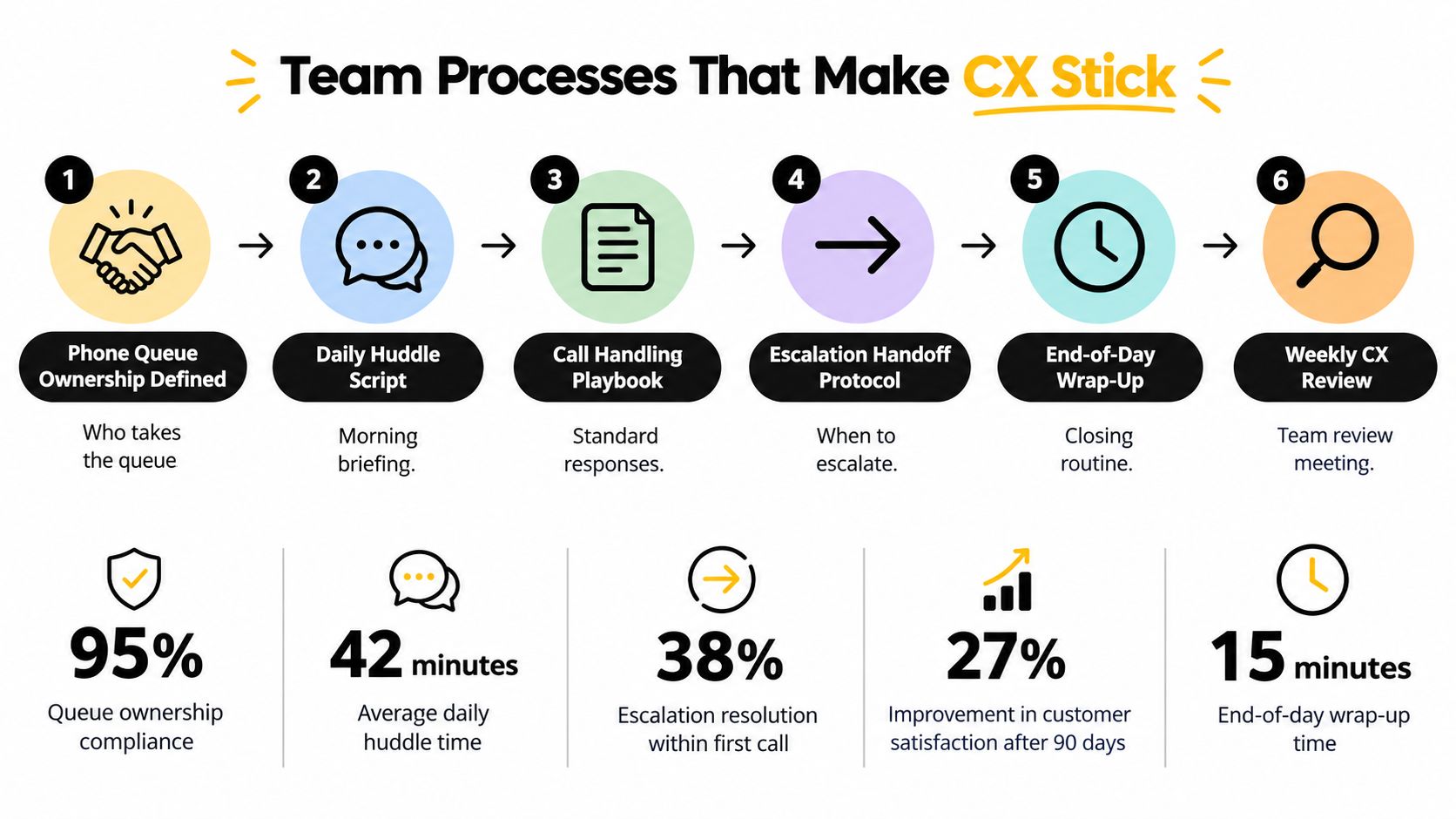
A five-minute daily standup should surface yesterday's misses, not become a general meeting. Review missed callbacks, scheduling errors, complaints, and jobs where the customer had to repeat information. Put three operating numbers where the team can see them: speed to answer, callback time, and repeat-customer bookings.
Owner's habit: Review the same CX process every week, even when the numbers look acceptable.
Consistency matters more than a one-time training session. If the owner stops checking the queue, notes, and callbacks, the process will gradually return to personal habits and informal memory.
Measuring Customer Experience and Reviewing It Quarterly
A useful scorecard is short enough to update and specific enough to expose a leak. For a small service business, start with five measures and define each one before collecting data.
First-call resolution rate measures the share of calls resolved without a callback. Pull the result from phone logs and CRM outcomes. Speed-to-lead measures the median time from inquiry to the first response, using the phone system, text platform, or web inquiry log.
Booking-to-inquiry ratio divides completed bookings by qualified inquiries. The CRM and calendar provide the inputs, but the team must use consistent outcome labels. A quote that was never accepted shouldn't be mixed with a job that was booked and later canceled.
Repeat-customer percentage comes from matching new bookings to existing customer records. Billing records can validate the result. Passive listening response rate tracks replies, callbacks, or other actions generated by proactive outreach, rather than counting survey completions alone.
Review the scorecard on a fixed schedule
Use a 90-minute quarterly review with the same agenda:
- Pull the four-week trend for each KPI.
- Compare it with the previous quarter.
- Identify the single largest leak in the contact-to-booking path.
- Assign one owner to repair that leak.
- Set a numeric target for the next quarter.
- Schedule the next review before ending the meeting.
The visual scorecard may also include customer satisfaction and referral measures. The supplied measurement framework illustrates 78% first-call resolution, a 42-second speed-to-lead median, a 45% repeat customer rate, a 4.3 out of 5 satisfaction score, and a net promoter score of 62 as exact reference points in its quarterly review design.
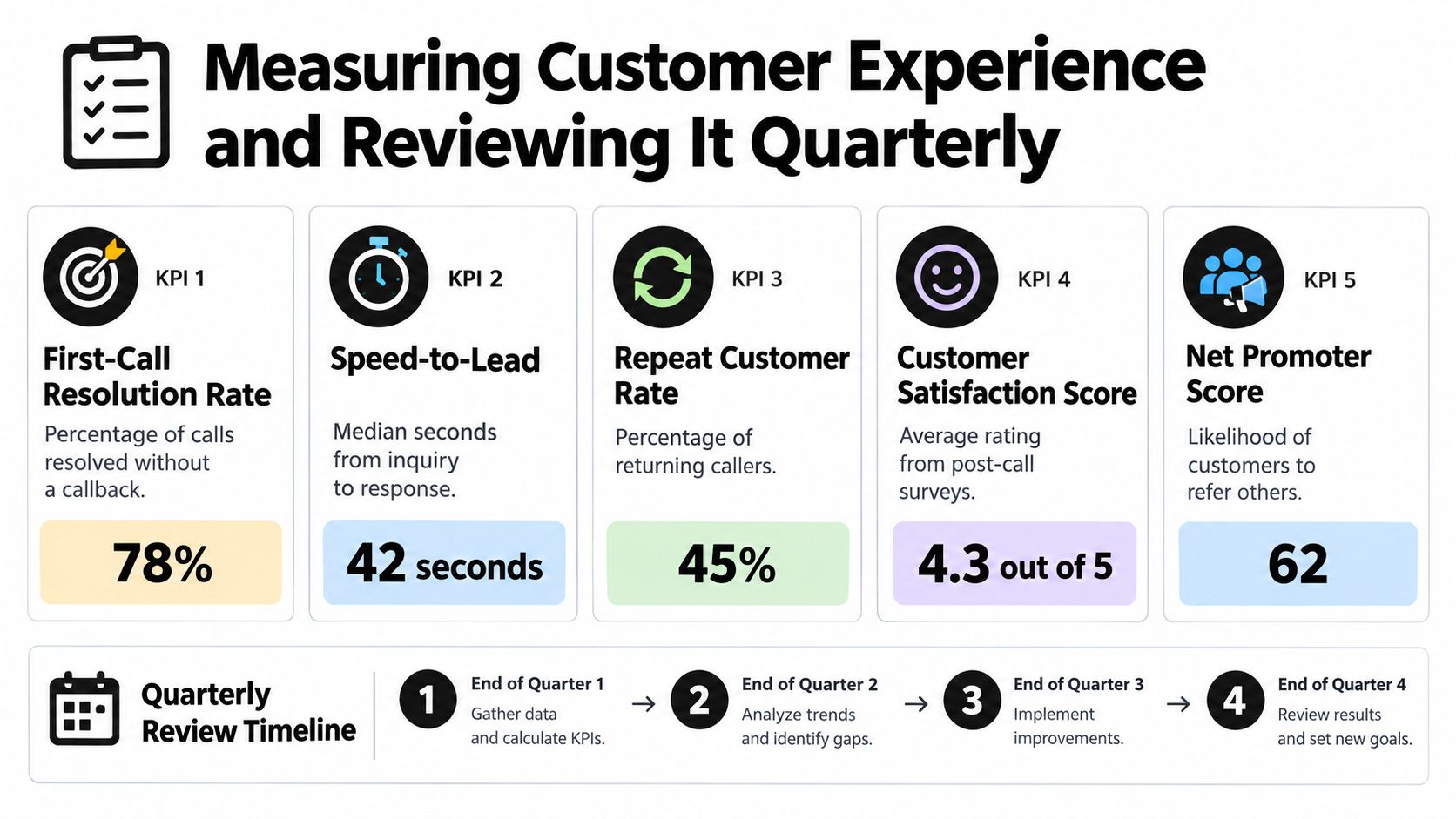
Don't chase every metric at once. If missed calls are the largest leak, fix answer ownership before redesigning the survey. If bookings are healthy but repeat work is falling, inspect job completion messages, follow-up timing, and recurring-service reminders.
After two quarters of disciplined review, good should look operationally clear. Staff know who owns every queue, managers can explain why a lead was lost, customers don't repeat basic information, and the team can point to one process change connected to each meaningful movement in the scorecard.
SkipCalls handles voice and text for customer support, lead qualification, and appointment booking, while connecting with CRM and calendar workflows without requiring you to change your business phone number. Visit SkipCalls to see how a simple call-handling and follow-up system can help your team respond faster and carry each customer conversation through to the next step.