

Remote Paralegal Services: A Practical Guide for Small Firms
Learn how remote paralegal services work, what they cost, and how small law firms can hire, vet, and integrate them without losing control of client work.
You get back from court to seventeen voicemails, two missed intake calls, and a discovery deadline on Friday. Your inbox is full, your calendar is unreliable, and the work that actually requires a lawyer's judgment is buried under records requests, document naming, chronology building, and client follow-up.
That's the situation remote paralegal services can solve. It's also the situation that causes firms to hire badly, grant too much access, and discover too late that a cheap contractor has created more review work than capacity. I've hired remote legal support, and my advice is simple: treat remote staffing as a supervision and access-control decision, not a payroll shortcut.
Table of Contents
- What Remote Paralegal Services Actually Are
- The Real Task List You Can Delegate
- Remote Versus In-House Paralegals
- What Remote Paralegals Actually Cost
- How HireParalegals Can Help
- Vetting and Onboarding Remote Paralegals
- Confidentiality, Supervision, and Access Control
- Connecting Phone, Intake, Documents, and Calendar
- When Remote Is the Wrong Call and a 30/60/90 Plan
What Remote Paralegal Services Actually Are
Remote paralegal services are legal-support activities performed by a contractor, freelancer, agency team, or offshore delivery center outside your firm's physical office. The person might work from home across town, from another state, or through an organized international provider. Physical distance matters less than the firm's controls, instructions, permissions, and review process.
This model differs from a traditional full-time hire in one important way. You're buying defined capacity for defined work, rather than automatically taking on a permanent employee, office costs, benefits, and an open-ended role. It also differs from a temp agency. A temp agency may supply general administrative labor, while a specialized provider may offer legal assistants, paralegals, litigation support staff, or a managed delivery team.
The main provider types are straightforward:
- Independent contractors offer flexibility and direct communication. They work best when you can supervise closely and have a narrow, repeatable scope.
- Boutique agencies provide more coverage, replacement options, and process support. They suit firms that need continuity without building internal recruiting capability.
- Offshore delivery firms can provide organized teams, time-zone coverage, and process-based work at a different cost structure. They require stronger confidentiality, security, jurisdiction, and review controls.
The model has lasted beyond its pandemic origins because the labor market supports ongoing replacement demand. The U.S. Bureau of Labor Statistics data on paralegals and legal assistants reports approximately 404,900 jobs in 2025, a $62,890 median annual wage, and roughly 40,800 projected openings each year from 2025 through 2035, even though total employment is expected to show little or no change. Firms need trained support personnel because people leave roles, change careers, and move into other positions.
Practical rule: If your firm has recurring work that follows a documented process, remote support may fit. If every task depends on your immediate judgment, you need a different staffing solution.
A useful introduction to the broader front-office role appears in this guide to what a virtual receptionist does for a law firm. Keep the distinction clear. A remote paralegal supports legal operations. A receptionist or intake service handles communications and scheduling. The two roles can work together, but they solve different bottlenecks.
The Real Task List You Can Delegate
The safest delegation model uses three tiers. Don't start by asking whether a person is “good enough” to handle a file. Start by asking whether the task itself requires legal judgment, and then decide what level of instruction and review belongs around it.
Tier one administrative processing
Assign repeatable work that doesn't require the contractor to decide what legal position the client should take. Examples include:
- Intake preparation: Organize contact details, incident dates, opposing-party information, and documents for attorney review.
- Records collection: Send approved requests, track responses, identify missing records, and maintain a follow-up log.
- Chronology construction: Place supplied facts and records into a dated timeline without drawing legal conclusions.
- Document organization: Apply naming conventions, create folders, remove duplicates, and index received materials.
- Discovery administration: Sort documents by agreed categories and prepare a first-pass index.
These tasks can still damage a matter if performed carelessly, but the delegation boundary is clear. Give the worker a written checklist, a sample completed file, and a rule that uncertainty gets escalated rather than guessed.
Tier two research and drafting
Research, drafting, and procedural preparation require more supervision. A remote paralegal might prepare a first-pass memo, check citations against approved authorities, draft a discovery response for attorney revision, assemble a filing package, or research procedural requirements.
The lawyer should provide the question, jurisdiction, source limitations, formatting requirements, and deadline. Every tier-two deliverable needs a defined review checkpoint. The attorney remains responsible for deciding whether the work is accurate, complete, and appropriate for the matter.
If intake volume is the problem, a dedicated law firm intake specialist can help separate information gathering from legal evaluation. That separation protects your paralegal from making judgments they shouldn't make and protects you from treating administrative notes as legal advice.
Tier three lawyer-only work
Legal advice, case strategy, negotiation, settlement decisions, court appearances, and client representation stay with the lawyer. A paralegal can prepare materials, organize facts, and flag questions. The supervising attorney must make the judgment.
Write down three tasks you could delegate next week. If you can describe the inputs, output, deadline, quality standard, and escalation trigger, the task is probably ready for remote support. If you can't describe those items, fix the process before you hire.
Remote Versus In-House Paralegals
Remote and in-house paralegals aren't interchangeable products. They sit on a spectrum that includes a domestic contractor nearby, a specialized agency, and an offshore delivery team. Your choice should depend on workload consistency, client-contact needs, supervision capacity, and how much operational resilience you need.
| Decision factor | In-house paralegal | Remote paralegal |
|---|---|---|
| Cost structure | Predictable employee compensation, plus office, benefits, payroll, and related overhead | Variable capacity, provider fees, software access, review time, and onboarding |
| Daily control | Immediate physical availability and informal communication | Written instructions, scheduled check-ins, and documented review |
| Bench depth | Usually concentrated in one person | May include backup capacity through an agency or delivery team |
| Integration friction | Easier hallway coordination, but still requires systems | More setup around access, communication, files, and calendars |
| Exit risk | One employee departure can disrupt the workflow | A provider may offer replacement capacity, but knowledge transfer still matters |
An in-house paralegal wins when the workload is steady, client-facing, and closely intertwined with the attorney's daily rhythm. If the person regularly sits in meetings, handles sensitive client conversations, coordinates local filings, and resolves exceptions in real time, physical or dedicated internal presence may justify its cost.
Remote capacity wins when demand rises and falls. Discovery surges, records-heavy personal injury files, immigration packet preparation, deadline tracking, and after-hours intake can overwhelm a small team without justifying another permanent hire. An offshore team may expand coverage, but it also increases the need for matter-specific permissions, written procedures, and time-zone planning.
My recommendation for most small firms is a hybrid model. Keep at least one person in-house for client-facing coordination and institutional knowledge. Use remote support for surge work, specialized tasks, structured production, and overflow intake. That arrangement preserves a human center while giving the firm room to absorb demand.
Don't compare a remote contractor's hourly quote with an employee's wage and stop there. Compare the whole operating model, including the time you spend correcting, supervising, training, and recovering from missed communication.
What Remote Paralegals Actually Cost
The hourly rate is the least reliable financial metric. The number that matters is cost per accepted work product, meaning the cost of work that reaches your standard without avoidable correction.
Published provider benchmarks place a fully loaded U.S. paralegal cost at roughly $55,000 to $75,000 annually, compared with approximately $18,000 to $24,000 for an offshore equivalent, a potential 60% to 70% direct-cost differential. These figures come from provider-reported benchmarks in outsourcing cost guidance from Sourcefit, not government statistics. Treat them as a starting point, not a promise.
The cost lines owners forget
A remote quote may exclude attorney review, rework, onboarding, software seats, insurance, security controls, training, and the cost of a missed client communication. A low rate becomes expensive when the paralegal misunderstands an issue, misses a deadline signal, or produces work that takes twice as long to correct.
| Cost Line Item | In-House Paralegal | Remote Paralegal |
|---|---|---|
| Base labor | Salary or wages | Contractor, agency, or provider fees |
| Employment overhead | Benefits, payroll, office, equipment | Usually reduced, but verify what the provider includes |
| Supervision | Informal access plus structured review | Written instructions, meetings, review checkpoints |
| Technology | Firm-provided systems and hardware | Software seats, secure access, device and transfer controls |
| Quality cost | Training, turnover, rework | Onboarding, sampling, rework, replacement risk |
| Capacity | Fixed availability | Variable or scalable availability |
Use this worksheet before signing anything:
- List the monthly number of files or tasks you expect to assign.
- Estimate your internal loaded cost for completing those tasks.
- Add attorney review time, rework hours, software, onboarding, security, and communication overhead.
- Add the cost of errors that delay billing, intake, filing, or client response.
- Divide the total by the number of work products that pass review.
That final number is your comparison point. If a provider offers a low hourly price but produces weak first drafts, the lawyer's correction time can consume the apparent savings. Track first-pass acceptance rate, turnaround time, rework hours, and escalation frequency from the first paid pilot.
A remote arrangement makes financial sense when it creates accepted capacity, not merely activity. If your team spends all day checking, rewriting, and clarifying, you haven't gained a real advantage. You've moved administration from one desk to another.
How HireParalegals Can Help
HireParalegals is a specialized on-demand talent platform built for U.S. law firms seeking qualified remote legal support. Its curated network includes over 10,000 pre-vetted paralegals, legal assistants, junior attorneys, and other legal professionals, with an average of more than four years of experience, according to the company's service description.
The platform can reduce hiring time to 24 hours and cut payroll costs by up to 80%.
The useful part is the structure around selection. Candidates go through a four-step process involving sourcing, interviewing, background checking, and skills validation. Firms can review custom shortlists, video introductions, and CVs, then interview candidates in their local timezone. The network covers areas including immigration, litigation, corporate, family law, and niche specialties.
That can solve the problem most small firms have. You don't need a flood of resumes. You need a shortlist of people who understand legal workflows, communicate professionally, and can perform a defined task without creating avoidable review work. The platform also combines human expertise with AI matching and offers payroll management and compliance guidance for Latin American hires.
If you're evaluating this route, use the platform to hire virtual legal assistants, then keep your own controls in place. Confirm conflicts screening, confidentiality terms, work-product ownership, device and access expectations, review checkpoints, replacement procedures, and the provider's handling of offboarding.

During the first 90 days, don't delegate your most sensitive matters. Start with a narrow task class, measure accepted work, review rework, and expand only after the person demonstrates reliable judgment about when to escalate.
Vetting and Onboarding Remote Paralegals
The first hire determines whether remote support becomes amplification or supervision debt. I'd use a five-part vetting process before giving anyone access to a live client file.
Start with a sharp scope
Write the task, inputs, output, deadline, quality standard, and escalation rule. “Help with litigation” is not a scope. “Create a chronology from supplied medical records using this template, flag missing dates, and return it for review” is a scope.
Test real work safely
Give candidates a redacted sample based on work your firm performs. Test organization, issue spotting, writing clarity, citation discipline, and whether the candidate asks sensible questions. A polished interview can't tell you whether someone will follow your naming convention or identify a missing exhibit.
Verify experience and references
Confirm credentials, jurisdictional exposure, and the type of matters the candidate has handled. Ask references specific questions about rework, turnaround, missed instructions, escalation, and client communication, rather than asking whether they were “good.”
Use a structured interview
Ask the candidate to explain how they would handle an ambiguous instruction, a conflicting deadline, a suspected conflict, and an incomplete record set. You're testing boundaries, not just confidence.
Make the first month probationary
Use a written agreement with deliverables, confidentiality terms, service levels, access limits, payment terms, and termination provisions. Run conflict screening before file access, require attorney review for every tier-two task, and hold a weekly quality conversation.
Hiring rule: A candidate who never escalates uncertainty is more dangerous than one who asks too many questions.
Give the new hire a training matter or redacted file first. Grant only the permissions required for that assignment, document the workflow, and record the first recurring errors. At the end of the initial period, decide whether to expand, retrain, narrow the scope, or end the engagement.
Confidentiality, Supervision, and Access Control
Remote work isn't the main risk. Poorly defined supervision and excessive system permissions are. The Florida Bar's outsourcing guidance for lawyers explains that outsourced paralegal assistance can be permissible, including overseas support, while the lawyer remains responsible for supervision, confidentiality, conflicts, unauthorized-practice-of-law risks, training, and billing.
Use a risk-based control system:
- Screen conflicts before access: Collect the matter name, parties, opposing counsel, and related entities before assigning work. Do not treat a later conflict check as a substitute for pre-access screening.
- Restrict permissions by matter and role: A contractor assigned to one litigation file doesn't need the entire practice-management database. Maryland guidance specifically supports limiting contract-paralegal access so unrelated confidential files aren't visible.
- Require review checkpoints: Administrative processing may follow a checklist. Research, drafting, and procedural preparation require documented instructions and attorney review. Legal advice and strategy remain with the lawyer.
- Keep an audit trail: Record who accessed, changed, uploaded, or downloaded matter information. Review permissions quarterly and remove access when an assignment ends.
- Secure the exchange: Use encrypted file transfer, confidentiality agreements, multifactor authentication, current software, secure networks, and firm-controlled devices where practical. The ABA's virtual-practice guidance preserves duties of competence, diligence, communication, confidentiality, and supervision.
- Define escalation: A contractor should know exactly what to do when a client asks for advice, a deadline changes, a filing requirement is unclear, a conflict appears, or a complaint arrives.
Your phone and intake process need the same discipline. A receptionist or intake layer can collect information, but it shouldn't decide whether a matter is legally sound. A remote paralegal can prepare that information for review, but the attorney controls communication that crosses into advice.
Small firms should also read practical guidance on customer data security for business communications. The principle is simple: reduce the number of systems, users, and files each person can reach.
Remote support is the wrong choice when the matter contains highly sensitive information, the deadline is too urgent for reliable review, or the supervising lawyer cannot consistently inspect the work. If you can't supervise the task, don't delegate it.
Connecting Phone, Intake, Documents, and Calendar
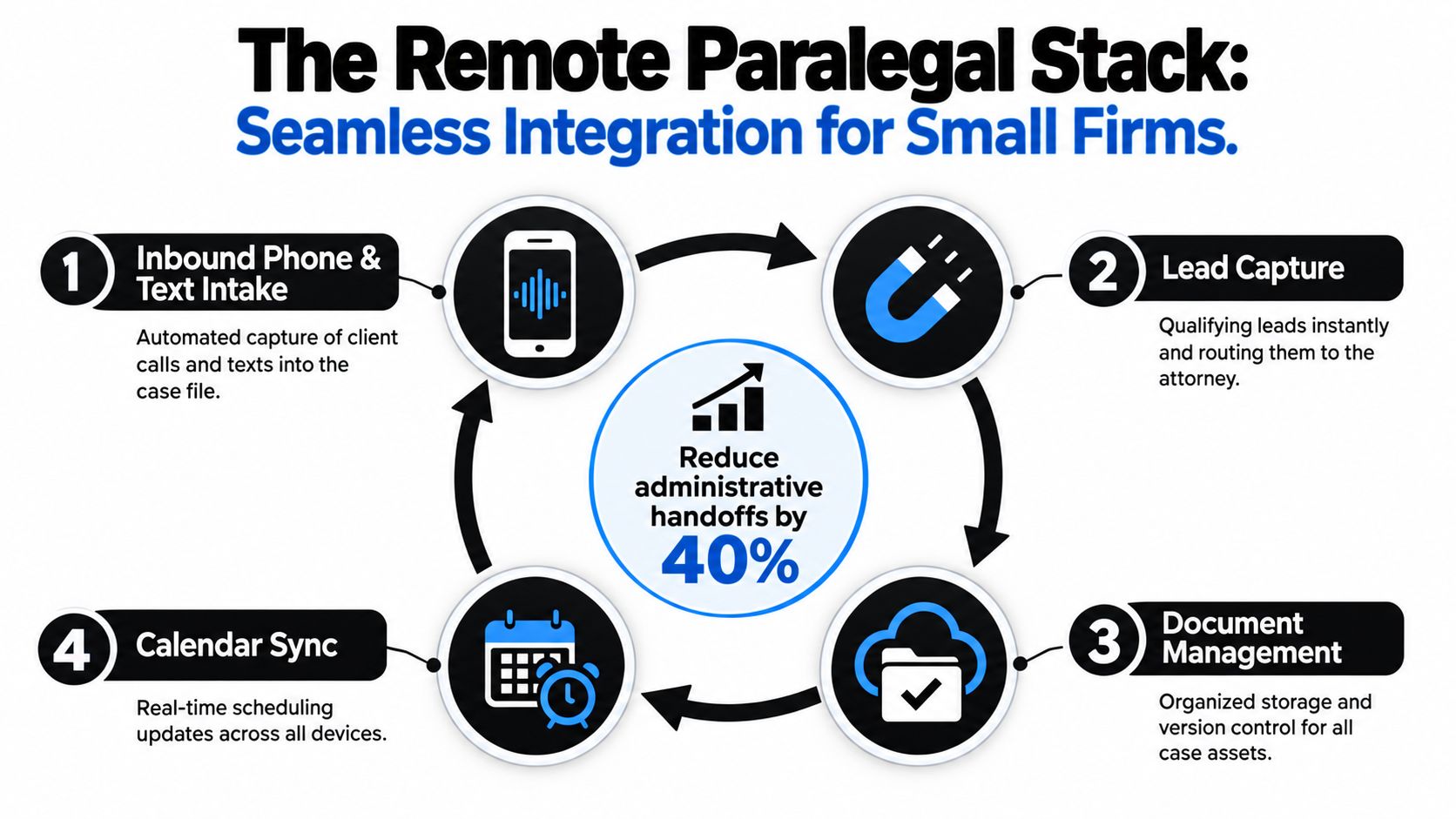
A remote paralegal can't fix a fragmented front office. If calls stay in one inbox, texts in a personal phone, documents in random folders, and appointments on a separate calendar, the contractor spends time reconstructing information instead of advancing matters.
Build one connected workflow:
- Inbound phone and text intake: Capture the caller's identity, matter type, urgency, opposing parties, and preferred contact method.
- Lead capture: Store the information in a CRM, run the appropriate conflict-screening process, and route qualified inquiries for attorney review.
- Document management: Place records, forms, signed agreements, and correspondence in the correct matter with version control.
- Calendar synchronization: Book consultations and follow-ups from the approved system, then update the responsible attorney and assigned support person.
In the United States, a business can generally retain its existing phone number when switching between wireline, IP, and wireless providers if it stays in the same geographic area. The Federal Communications Commission's number-porting guidance says simple ports, typically one line without complex switching changes, should be completed within one business day. You don't need to reprint every business card to add a remote or automated intake layer.
Text deserves a deliberate role. The 2025 State of Business Texting Report found that 75.9% of respondents used texting for customer service, while 58.9% considered texting the most effective response channel, compared with 21.8% for phone calls and 10.3% for email. These figures come from the report published by Text Request. They support using text alongside voice, especially for confirmations, missing information, and inbound lead follow-up.
Salesforce documentation describes Google Calendar as both a data source that can trigger automation and a data target, supporting workflows such as contact synchronization and transactional messages through Google Calendar integration in Salesforce.
A phone-handling service such as SkipCalls can sit at the front of this stack. It answers voice and text, captures customer details, supports customer service, lead qualification, and appointment booking, and can notify the remote paralegal or attorney through CRM and calendar integrations. The firm keeps its existing number while the legal team receives structured intake instead of scattered messages.
Start with the CRM workflow described in this guide to CRM integration for small businesses, then add document and calendar rules. The technology should remove handoffs, not create another dashboard nobody checks.
When Remote Is the Wrong Call and a 30/60/90 Plan
Remote support isn't universally cheaper or smarter. It creates risk when the matter demands constant judgment, the file contains exceptionally sensitive information, the deadline leaves no room for review, or the attorney lacks time to supervise. It can also fail in a very small practice where the remote worker spends more time waiting for answers than completing work.
Don't outsource just because a contractor's rate looks lower. Avoid remote delegation for legal advice, negotiation, court appearances, strategic decisions, and any workflow where you cannot inspect the final work before it affects the client.
The first 30 days
Define one task class, write the scope, establish the quality standard, and identify the responsible supervisor. Shortlist providers or candidates, complete conflict and confidentiality procedures, confirm technology access, and prepare a redacted sample.
Days 31 through 60
Run a paid pilot on one matter type. Use strict review checkpoints for every research, drafting, or procedural task. Track turnaround, first-pass acceptance, rework, escalation frequency, and the time you spend supervising. Don't expand the scope because the first few tasks feel promising.
Days 61 through 90
Compare the pilot's accepted work with your internal baseline. Expand only if the remote worker consistently follows instructions, escalates uncertainty, protects confidential information, and reduces your net workload. If rework remains high, narrow the assignment, change the provider, or walk away.
The central decision is not whether a remote paralegal can perform tasks. Many can. The decision is whether your firm has built enough structure to preserve lawyer control while another person performs those tasks.
Remote paralegal services are a supervision problem dressed up as a staffing problem. Firms that define the work, restrict access, review judgment-intensive output, and connect intake to matter management can gain real capacity. Firms that hand over broad access and hope a low rate solves a process problem usually buy themselves another inbox.
Start your first week by choosing one repeatable workflow, such as records collection, intake preparation, or discovery indexing. Write the scope, set the review checkpoints, restrict access to the relevant matter, and measure accepted work before expanding. Once that process is stable, add a connected phone and text intake layer with SkipCalls so calls, lead details, appointments, and remote paralegal follow-up move through one controlled workflow without forcing you to change your existing number.

