
AI Agent Evaluation: How to Test What Actually Matters
AI agent evaluation explained: the metrics, benchmarks like AgentBench and SWE-bench, and a practical way to test agents on real tasks, not just fluent answers.

 Reviewed by Nikita Podelenko, Founder & Engineer of SkipCalls
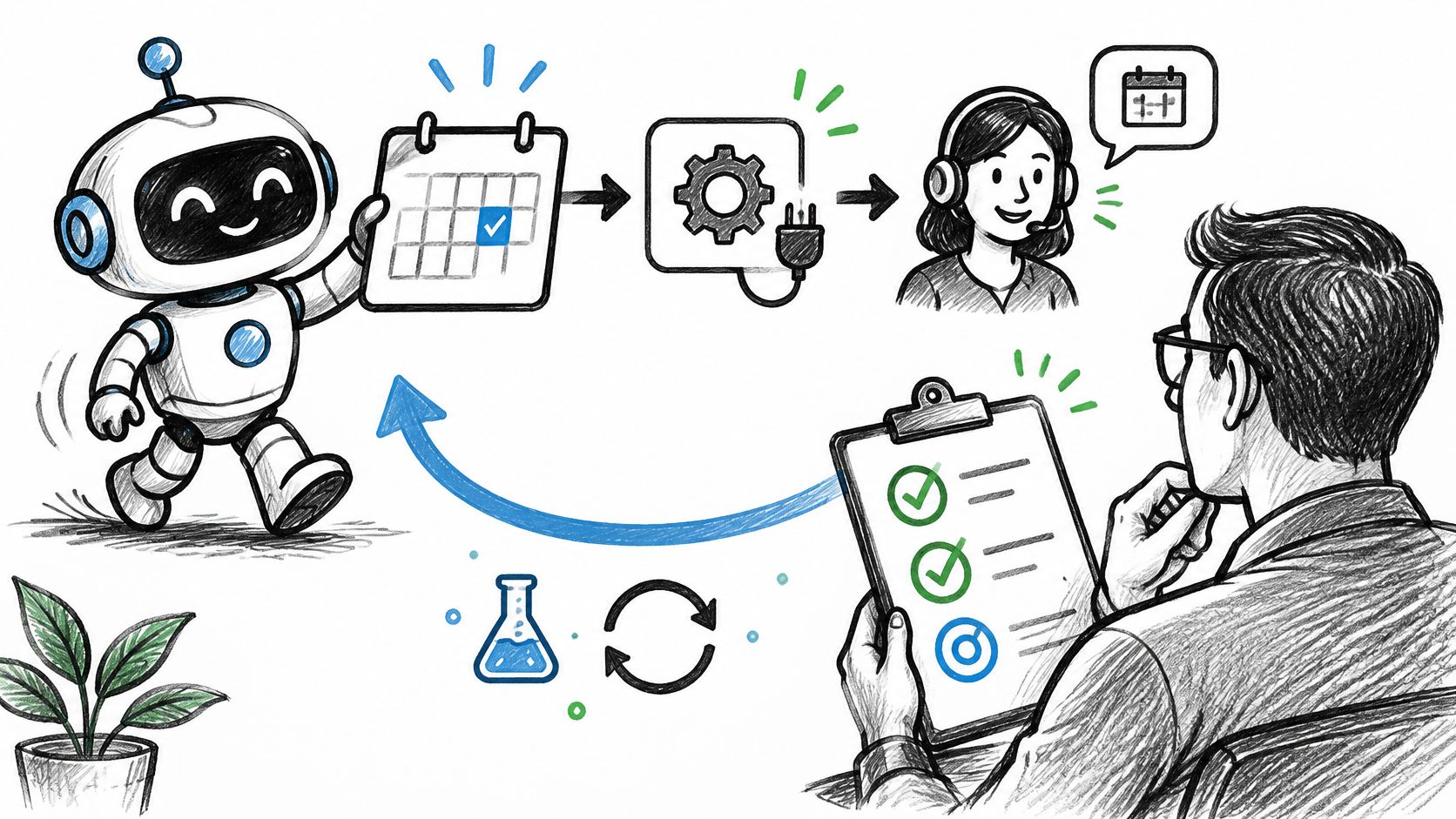
Table of contents
- Table of Contents
- Why AI Agent Evaluation Needs Its Own Playbook
- What AI Agent Evaluation Actually Measures
- Key Metrics for Measuring Agent Performance
- How Lighthouse Legal Can Help
- Benchmarks That Shaped AI Agent Testing
- How Benchmark Scores Can Mislead You
- How to Evaluate an AI Agent for Your Business
- Putting Your Evaluation Plan Into Practice
An AI receptionist handles every question in a polished demo. On its first live call, a customer changes the requested appointment time mid-sentence, the agent misses the correction, and the calendar ends up with the wrong booking. The agent sounded capable. The workflow failed.
That gap matters to any business relying on calls, messages, or automated follow-up to capture customers. A chatbot can give a fluent but unhelpful answer. An agent can go further and save the wrong details, make an invalid booking, or fail to involve a person when a caller needs one. AI agent evaluation needs to test what the system does, not just how it sounds.
Table of Contents
- Why AI Agent Evaluation Needs Its Own Playbook
- What AI Agent Evaluation Actually Measures
- Key Metrics for Measuring Agent Performance
- How Lighthouse Legal Can Help
- Benchmarks That Shaped AI Agent Testing
- How Benchmark Scores Can Mislead You
- How to Evaluate an AI Agent for Your Business
- Putting Your Evaluation Plan Into Practice
Why AI Agent Evaluation Needs Its Own Playbook
A demo usually follows a clean path. The caller gives one clear request, the system finds the right tool, and the agent replies with a confident confirmation. Real customers interrupt themselves, omit details, change their minds, and ask for things that don't fit a standard workflow. A good-sounding answer doesn't tell you whether the agent saved the right information or completed the requested action.
That's the core difference between testing a language model and testing an agent. A language model evaluation might score whether an answer is accurate or relevant. An agent evaluation has to follow the whole interaction: what the caller said, what the system understood, which tools it used, what changed in the business system, and whether the final outcome was correct.
A fluent answer can hide a broken workflow
Consider a caller asking to book a visit and giving their name, phone number, and preferred time. The agent repeats the details clearly and says the booking is confirmed. But perhaps it called the calendar with the wrong date, failed to save the customer's phone number, or never secured an available slot. A transcript might look excellent even though the caller still has no appointment.
The same issue appears in urgent calls. An agent could sound calm and empathetic while failing to route a time-sensitive request to a person. In a small business, that isn't an abstract benchmark failure. It can mean a lost lead, a missed opportunity to help a customer, or time spent by staff repairing a mistake later.
Test the job, not the performance
For a business, the useful question isn't “Did the agent respond well?” It's “Did the agent complete the job safely and correctly?” That means checking the saved customer record, the calendar entry, and any notification or transfer that should have happened. Where the agent shouldn't act on its own, the test should check whether it asks a clarifying question or escalates.
This guide takes a practical approach: define the work the agent is responsible for, test realistic interactions, and track outcomes that matter to the business. You don't need a research lab to find the obvious failure modes. You need test cases that resemble actual calls, a way to inspect what the agent did, and the discipline to run those tests again after a change.
Practical rule: A promise in a transcript isn't proof that the task was completed. Verify what changed in the system.
What AI Agent Evaluation Actually Measures
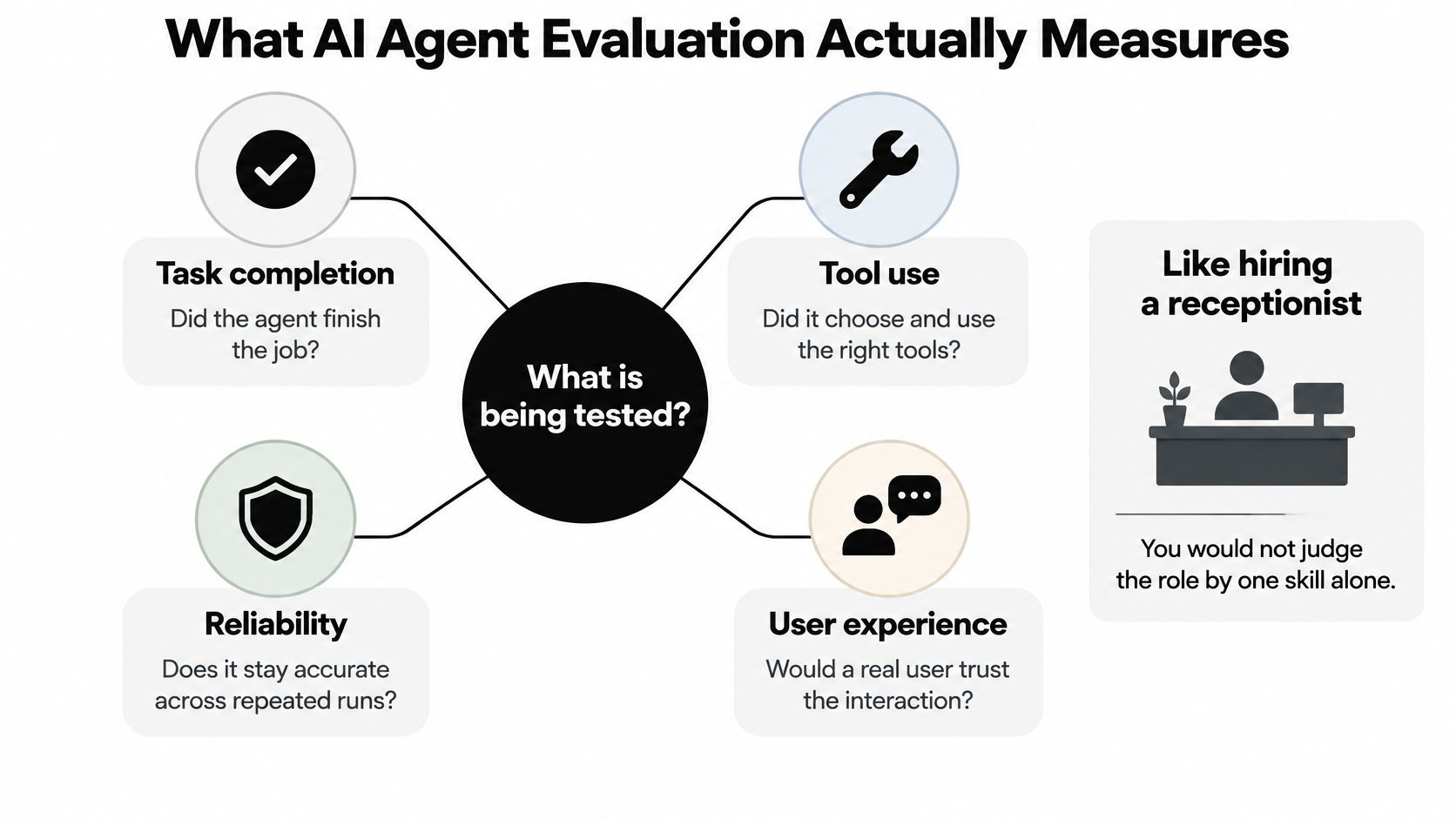
Hiring a receptionist, you wouldn't judge them on vocabulary. You'd check whether they understand a customer, collect the right details, use the booking system, handle a correction, and get help when a request falls outside their authority. Evaluating an AI agent calls for the same distinction: separate the component you're testing from the complete customer experience.
The model, the scaffold, and the workflow
Start by asking what the evaluation is meant to describe. The model generates and interprets language. You might test whether it understands an unclear request, follows an instruction, or extracts a caller's contact details accurately. Those checks help pinpoint a problem, but they don't prove the finished agent will work.
The scaffold is the system around the model: tool definitions, memory, retry logic, error messages, and the order in which actions run. If a calendar tool is poorly described, the agent may struggle to book an appointment even when the model understood the caller perfectly. If retries aren't handled well, a temporary tool failure becomes a lost customer interaction.
I've watched teams blame a model for failures that traced back to a badly written tool description. The fix had nothing to do with the model.
That's why a single score from an agent test is hard to interpret on its own. A low number might reflect the model, the configuration around it, or the way the workflow was stitched together. Until you separate those layers, you can't tell what needs fixing.
The complete workflow is the interaction the customer experiences. For a phone agent, that means understanding the call, capturing required fields, checking availability, booking correctly, and confirming the result. That's the business-level test: did the caller get the right outcome?
Measure the whole experience
A practical evaluation looks at more than the final words. Check task completion, tool use, reliability, and user experience separately. An agent might book correctly but never tell the caller what happened. Another might sound helpful while making an invalid booking. Both need attention, but they're different failures with different fixes.
The distinction matters when selecting a solution, too. A useful introduction to what conversational AI means can clarify what an AI system does during an interaction, but an agent evaluation should go beyond conversation to verify the action and its result.
The hiring analogy keeps the standard grounded. You're not proving the model is impressive in isolation. You're checking whether the complete system can do the work your customers and team depend on, call after call.
Key Metrics for Measuring Agent Performance
A single score can make a complicated workflow look simpler than it is. If an agent completes the booking but saves the wrong callback number, should that count as success? If it answers quickly but fails to transfer an urgent call, does speed make up for the error? A useful scorecard reports different kinds of performance separately so the team can see what works and what needs attention.
One helpful reminder comes from GAIA, a benchmark of real-world questions requiring reasoning, browsing, multimodal interpretation, and tool use. Across its 466 human-annotated tasks, GPT-4 with tools achieved roughly 15% success compared with 92% for human respondents. It remained below 30% even on the easiest level, and the reported success rate on the hardest level was 0%. The lesson for customer-facing agents is direct: measure whether the whole task was completed, not whether the answer sounded convincing (GAIA benchmark results).
Build a scorecard around outcomes
| Metric | What It Measures | Why It Matters |
|---|---|---|
| Task success | Whether the requested workflow reached the correct outcome | A fluent reply can conceal a missed booking or incomplete lead record. |
| Tool-call validity | Whether the agent selected the right tool and supplied valid information | Incorrect inputs can create real errors in calendars, CRM records, or routing. |
| Human intervention | How often a staff member must correct, complete, or take over the task | This shows whether the agent reduces work or merely moves it downstream. |
| Escalation accuracy | Whether the agent transfers or alerts a person when it should | Overlooking an urgent or out-of-scope request can carry greater consequences than awkward wording. |
| Reliability across runs | Whether the same kind of interaction succeeds consistently | One successful test can't establish dependable performance. |
| Latency and per-interaction cost | How long the workflow takes and what it costs to run | A system can be accurate but too slow or costly for the way a business needs to use it. |
Keep the measures separate
Averages can hide where the system breaks. A strong task-success score might sit alongside weak escalation or a high need for staff intervention. If those are rolled together, a team may not notice that one class of call is routinely failing.
For phone agents, the evaluation should also capture the interaction itself: Did the system understand the caller? Did it confirm important details? Did it keep the customer informed while a tool was working? The SkipCalls guide to call analytics offers useful context for thinking about call records and performance, but the evaluation still needs a clear definition of success for each workflow.
A good scorecard tells you not only whether the agent passed, but how it passed, where it failed, and what a staff member had to do next.
How Lighthouse Legal Can Help
A specialized agent changes what you test for. A general receptionist succeeds by booking appointments and relaying messages. A legal intake agent has a different bar: capturing the facts a firm screens on, routing the right callers, and staying inside its role. Giving legal advice is not a minor wording problem in this domain; it is a failure mode of its own. Lighthouse Legal, which builds voice agents for personal injury intake, shows how evaluation criteria shift once the workflow gets specific.
Its agents answer calls continuously, apply firm-defined screening criteria, gather prospective-client details, and transfer callers who ask for a person. Every call produces recordings, transcripts, and reports, and the firm owns that call data.

Turning call records into a test suite
That call data is the evaluation asset. A firm can pull a month of conversations and score each one against its own criteria: did the agent capture the details intake needs, apply the firm's qualification rules rather than generic ones, and hand off safely when a caller pushed outside scope? One clean demo call proves little. A month of transcripts reveals the patterns. The company has published an AI agent evaluation walkthrough describing how it structures that review for its answering workflow, and its customer examples describe firms signing additional cases and filtering out a large share of unsuitable callers. Read those as individual results, not a forecast for your firm.
Buying terms are not performance evidence
The website says deployment can happen within one business day, through a new number or forwarding from an existing line, and describes pricing as a flat monthly rate by call volume rather than per-minute billing. Those terms lower the cost of running a pilot, which matters for a small firm. They say nothing about call quality.
The practical use is a short paid run graded against your own scorecard. Test whether the agent captures what your intake team needs, confirm the screening fits your practice areas, and check how it handles callers who need a person. No intake agent substitutes for legal judgment, and specialized tools deserve an equally specialized evaluation.
Benchmarks That Shaped AI Agent Testing
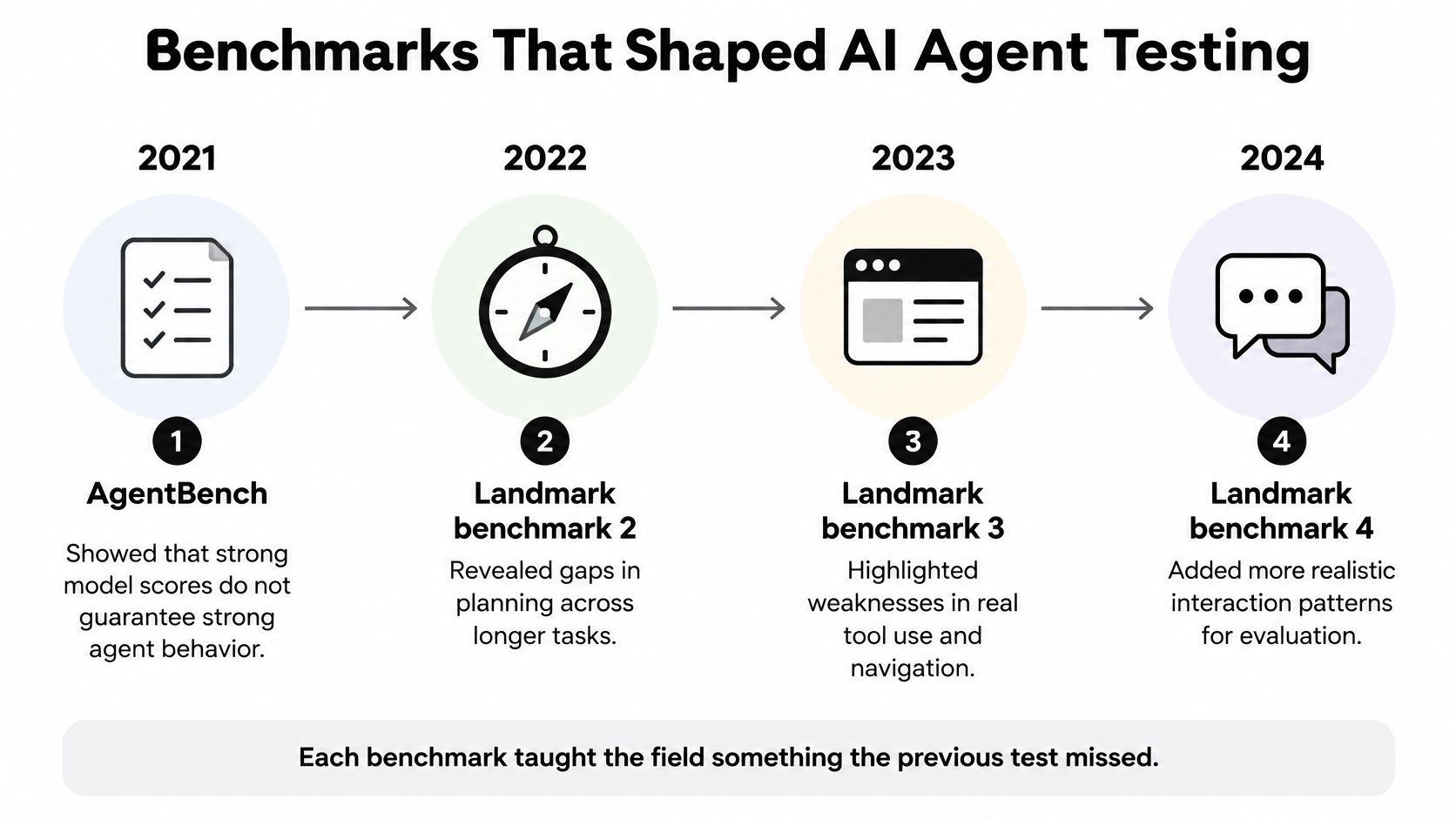
Public benchmarks help researchers compare systems, but their scores do not answer whether a particular agent will handle your customers. The field's testing history makes that distinction clear: researchers progressively moved from testing responses toward testing actions and outcomes.
From interactive environments to verifiable work
AgentBench, introduced by a Tsinghua-led team in August 2023 and accepted at ICLR 2024, tested large language models as agents rather than limiting evaluation to a question-and-answer dataset. It covered eight interactive environments, including operating systems, databases, knowledge graphs, web shopping, web browsing, and household tasks, with more than 1,000 tasks requiring models to make decisions, use tools, observe outcomes, and keep working toward a goal (AgentBench benchmark details and results).
The important finding was the spread, not a single number. Strong proprietary systems separated themselves from many open-source contemporaries, and conventional language-model scores were not enough to predict how well a system would act. AgentBench also exposed weaknesses that matter on real work: long-horizon reasoning, decision-making, and instruction following.
SWE-bench made the evaluation more concrete by giving agents actual software-engineering issues from open-source repositories and checking whether their patches resolve the issues and pass the relevant tests. OpenAI reported that leading agents at the time reached approximately 20% on full SWE-bench and 43% on SWE-bench Lite, while later results on the human-validated SWE-bench Verified subset of 500 tasks exceeded 49% for advanced agentic systems (OpenAI's introduction to SWE-bench Verified).
The lesson for a business is to define a result that can be checked. A patch either passes its tests or it does not. A customer's booking either exists in the calendar and contains the right details, or it does not.
What a benchmark can't tell you
GAIA broadened testing to real-world questions requiring reasoning, browsing, multimodal interpretation, and tools, as covered earlier. Together, these benchmarks show why outcome-based testing matters, but a research score cannot guarantee performance on a specific company's calls, tools, or customer expectations.
Before relying on a published result, ask what the benchmark tests. Does it resemble your workflow? Can the score confirm a real outcome, or only judge a response? Does it show how the agent behaves when the request is unclear? A leaderboard can be useful for comparing research systems. It cannot replace testing the agent in the environment where your customers will use it.
How Benchmark Scores Can Mislead You
A benchmark score looks precise, but precision isn't the same as real-world reliability. Test cases can be unusually tidy, familiar to a model, or too lightly checked. Even when an agent does well on a published test, it may struggle when a customer asks the same thing in a less formal way.
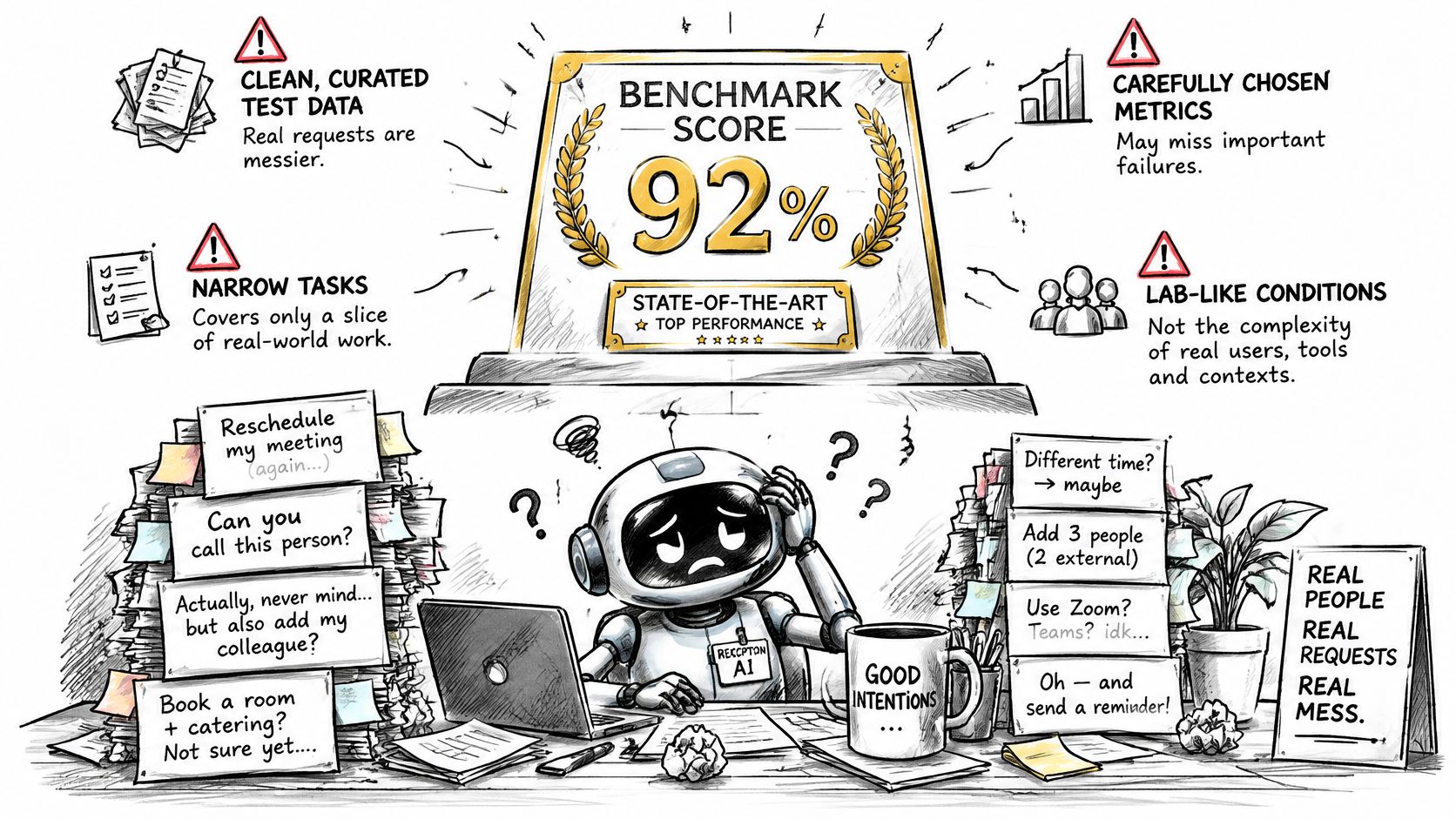
Research on SWE-bench-style evaluation found that models' performance dropped 20–40% in relative terms when formal GitHub issue descriptions were rewritten as more realistic user queries. One comparison found models performed about three times better on SWE-bench Verified than on alternative tasks, raising concerns about benchmark familiarity or leakage. These results aren't a forecast for a phone agent. They're a warning that performance on tidy, familiar tests might not carry over to messier requests (research on benchmark realism and evaluation robustness).
Four ways a test can flatter an agent
Over-specified requests tell the agent exactly what to do, in the order it should do it. Real callers may leave out a detail, use local phrasing, or correct themselves halfway through. Ask a vendor whether its tests include natural paraphrases, interruptions, incomplete contact details, and ambiguous requests.
Benchmark familiarity can make a system look stronger on a known test than on a fresh one. Ask whether evaluation scenarios are hidden or newly written, and whether the vendor can demonstrate how the agent behaves on an unfamiliar case.
Weak validation can give credit for the wrong thing. An agent may announce that a booking is complete without creating a valid calendar event. Verify the final record, not just the transcript or the system's report.
One-run averages can hide inconsistent behavior. Ask whether test cases are repeated and whether the results show failures separately from successes. A single successful demo call doesn't tell you what happens when the caller phrases the request differently.
Here's a simple test-plan recipe for a phone receptionist: write realistic scenarios, include a mix of clear and difficult requests, repeat them, and label which errors would harm the business most. A missed confirmation or fabricated booking detail should count more heavily than slightly awkward phrasing. For an agent such as SkipCalls, that means checking whether the caller's details were saved, the appointment is valid, the right person was notified, and the agent escalated when needed.
The video below offers another perspective on agent testing. Use it as a prompt for questions, not as a substitute for checking your own system's outcomes.
How to Evaluate an AI Agent for Your Business
You don't need a large engineering team to build a useful test suite. You need examples of the calls your business handles, a clear definition of a good outcome, and a consistent way to record what happened. Start with cases that matter to customers and staff, not a long list of abstract capabilities.
Make the scenarios sound real
List the work your team handles: booking, lead qualification, customer support, after-hours calls, and requests that need a person. Then turn those workflows into test cases. A phone receptionist should be tested with realistic variation, including different accents, background noise, a caller changing details, ambiguous availability, and a request that needs escalation.
For each scenario, write down what should happen. If a caller asks for a booking, specify which details must be captured, what counts as a valid time, whether the agent should confirm before saving, and what the caller should hear after the action succeeds. If a caller asks for something outside the agent's authority, define when it should transfer the call or alert a human.
Repeat the test and grade what matters
Identical calls can produce different results. Research on AI evaluation warns that prominent benchmarks don't jointly control for contamination, nondeterminism, and execution cost. A more useful business report includes repeated-trial success, worst-case failures, escalation accuracy, latency, and per-call cost (Brookings analysis of AI model evaluation).
That source gives a useful illustration: an agent that completes 95% of bookings but invents details in 1% of calls may be riskier than an agent completing 90% while consistently escalating uncertain cases. Those figures are an example, not a recommended threshold. Your own acceptable risk depends on what the agent handles and how costly mistakes are for your business.
A compact review can use three labels for every test: passed, failed, or escalated correctly. Then record why a failure matters. A slightly unnatural greeting is different from booking the wrong time, losing a lead's contact details, or failing to hand off a high-priority request. Review those serious failures separately rather than letting a good average conceal them.
A phone-and-text receptionist also needs to be checked across the tools it uses. SkipCalls, for example, handles voice and text, can support customer support, lead qualification, and appointment booking, and integrates with CRM systems and calendars without requiring a business to change its phone number. To assess any similar setup, test the complete path: customer request, information capture, tool action, confirmation, and staff notification. If appointments are part of your workflow, you can book appointments with SkipCalls, then apply the same outcome-based checks before relying on it.
Putting Your Evaluation Plan Into Practice
A useful evaluation plan is small enough to run and specific enough to catch meaningful failures. Keep five questions in view: What exactly am I testing? What outcome should happen? Did the agent use its tools correctly? Does it behave consistently? What happens when it can't safely complete the task?
Use those questions during a vendor demo as well as an internal review. Ask to test a request that isn't neatly worded. Change a detail midway through the call. Make the calendar unavailable or leave out information the agent needs. Watch whether it checks the facts, confirms a change, and escalates rather than guessing. Then inspect the actual record and notification, not only the conversation.
Keep a living test list
Every useful test should have a clear scenario and a pass condition. For example, a booking test might require the correct customer name, phone number, and available appointment time to appear in the calendar. An escalation test might require the agent to recognize that a person needs to take over and route the call accordingly. A text follow-up test might check whether the message reflects the actual booking record.
When the agent changes, rerun tests that cover the parts of the workflow most likely to break. Add new cases after a customer complaint or staff correction. If the business connects a receptionist to its existing systems, it should verify that records and booking details travel through the workflow as intended. Teams reviewing how to connect your receptionist to your CRM should make those data handoffs part of the test plan, not assume an integration guarantees correct outcomes.
Start with the calls you can't afford to get wrong
The best evaluation suite isn't the one with the most cases. It's the one that reflects the situations your team needs to handle reliably and gives you a fair account of what the agent did. Don't let an overall score erase the difference between a minor conversational stumble and a serious operational mistake.
This week, write ten realistic test calls covering the scenarios your team is most concerned about. Run each one three times, record what the agent said and did, and compare the result with what should have happened. Track valid task completion, incorrect tool actions, successful escalations, human intervention, and failures that could cost the business a customer or create a safety concern. If the agent passes, keep the cases as a baseline. If it fails, you'll have a specific problem to fix and a way to check whether the next change helped.
If missed calls, incomplete bookings, or slow lead follow-up are costing your team opportunities, try SkipCalls for your business. It handles calls and texts for customer support, lead qualification, appointment booking, and more, connects with calendars and CRMs, and fits into your workflow without requiring a phone-number change. Test it against the calls your business needs to get right, then decide whether its outcomes meet your standards.


