
One Party Consent States: Full 2026 State Reference
Find which states are one party consent states, where all-party rules apply, and what to say before recording a business call. Last checked October 2026.

 Reviewed by Nikita Podelenko, Founder & Engineer of SkipCalls
Table of contents
- All-Party Consent States to Check First
- Federal Law and the One-Party Baseline
- How Many States Use One-Party Consent
- Which Rule Applies When Calls Cross State Lines
- Special Rules in Washington, Pennsylvania, Delaware and Nevada
- How to Announce a Recorded Call
- Retention, Access and Purpose Limits for Recordings
- Set One Nationwide Recording Policy Today
The one-party consent survey counts 37 states plus the District of Columbia on the one-party side: 37 of the 50 states, or about three-quarters, with the District of Columbia counted separately.
That majority is not the rule for the call you are about to take. The caller, a tech in a truck, or the system that stores the audio can sit in a state that requires every person's consent, and most state lists never explain that split.
One party consent states are the home-state rule for many local businesses. Treat the count as a starting point, then confirm the law in each state tied to the call and have a lawyer licensed where you and your callers operate review the workflow.
All-Party Consent States to Check First
Start with the states that want every participant's consent. This is the short list, and it is where a contractor, salon, property manager, or law office gets into trouble, because the caller's location controls which rule applies, not the office address.
The Digital Media Law Project recording guide separates a small all-party group from the one-party majority, placing 37 states plus the District of Columbia on the one-party side and treating the rest as requiring every participant's consent for covered private communications. Commonly cited all-party jurisdictions are California, Connecticut, Florida, Illinois, Maryland, Massachusetts, Montana, New Hampshire, Pennsylvania, and Washington. Delaware and Nevada appear on some versions of the list, and scope can turn on whether the communication counts as confidential.
| State | Consent rule | Statute |
|---|---|---|
| California | All-party for confidential communications | Cal. Penal Code § 632 |
| Connecticut | All-party for telephone recording | Conn. Gen. Stat. § 52-570d |
| Florida | All-party | Fla. Stat. § 934.03 |
| Illinois | All-party for private conversations | 720 ILCS 5/14-2 |
| Maryland | All-party | Md. Code, Cts. & Jud. Proc. § 10-402 |
| Massachusetts | All-party | M.G.L. c. 272, § 99 |
| Montana | All-party | Mont. Code Ann. § 45-8-213 |
| New Hampshire | All-party | RSA 570-A |
| Pennsylvania | All-party, with purpose limits on business exceptions | 18 Pa.C.S. § 5704 |
| Washington | All-party for private communications, including calls with outside participants | RCW 9.73.030 |
| Delaware | Treated as all-party by several legal references | 11 Del. C. § 2402 |
| Nevada | Treated as all-party by several legal references | NRS 200.620 |
| All other states and DC | One-party, the majority rule | A separate statute in each state |
Washington's consent rule sits in the Revised Code of Washington, chapter 9.73. Each row cites the current code for that state, and the statute text is where the one-word label gets its limits, so pull the section for any state your callers dial from.
Most published state lists stop at one rule per state, which is exactly where they fail a multistate call. A one-party label describes the state where your office sits. It says nothing about the state where the person on the other end is standing, and when two states touch one call, the stricter standard is the safer one to follow.
Two limits the labels hide
Confidential communications. California's cited section is aimed at confidential communications, not every sound in a public place. A private customer call is the usual case for a shop. A shouted exchange on a sidewalk may not be.
Purpose limits. Pennsylvania's row is not a flat ban or a flat permission. The business exception has limits on why a recording may be made and kept. Those limits live in the statute text, not in a one-word label.
States outside the all-party rows generally follow one-party consent. A nationwide shop is still safer treating unknown callers as if an all-party rule might apply, because customers move and phone numbers travel across state lines. Consent logic can be built state by state, but one conservative policy is easier to defend. Pair recording rules with a broader guide to US data protection requirements so call audio is not the only privacy duty you track.
Practical rule: If you cannot name the caller's state with confidence, do not use your home state's one-party label as the green light.
Last checked: October 2026. Legislatures change these rules. Recheck the code before you lock a script.
Federal Law and the One-Party Baseline
Federal law sets the floor, not a pass for every call. On June 19, 1968, Congress enacted Title III of the Omnibus Crime Control and Safe Streets Act. That statute added 18 U.S.C. § 2511, which generally bans intentional interception of wire, oral, or electronic communications, as the U.S. Code text of section 2511 shows.
The exception is the part owners hear about. Interception is not unlawful when the recorder is a participant, or when at least one participant has given prior consent, if the recording is not made to commit a criminal or tortious act. People call that one-party consent because federal law asks for one participant's permission, not everyone's.
The floor is not a permission slip
A state may demand more than that floor. Say a roofing owner in Texas, a one-party state in the surveys above, records a lead who is standing in an all-party state. Federal law may be satisfied because the business is on the call. The caller's state can still treat a secret recording as unlawful. The same split shows up when a remote employee, a subcontractor, or a customer is the person in the stricter state.
Run four questions before anyone hits record. Copy them onto the wall by the phone.
- Am I a participant? If nobody from the business is on the call, this is not one-party recording.
- Has any participant consented in advance? Under the federal exception, prior consent from one participant can be enough, unless a state requires more.
- Is the recording for a lawful purpose? A recording made to commit a crime or a tort falls outside the exception.
- Where is each participant located? Home state, caller state, and the place the audio is captured can differ.
If question 4 is fuzzy, stop treating the federal rule as the answer. State statutes decide the rest, and they do not all match the 1968 baseline.
How Many States Use One-Party Consent
Most states use one-party consent, and the published size of the all-party group does not match from one write-up to the next.
| Source and year | What it counts as one-party | What it counts as all-party |
|---|---|---|
| Cartesia, 2026 | 37 U.S. states and the District of Columbia | 13 states |
| Maryland Matters, 2025 | The remaining states, described as the majority | 10 states with two-party or all-party laws |
Fifty states minus a 37-state one-party group leaves 13. That is the arithmetic behind the 2026 all-party count. A 2025 news report lands on 10. Other legal guides name about ten all-party states and then add Delaware, Nevada, or both. The gap is not a math error. It is a classification fight.
Why the totals move
Mixed statutes. Some states draw a line between phone calls and in-person talk, or between criminal bans and civil lawsuits. A checklist that forces every state into one box will disagree with a checklist that allows a split.
Narrow triggers. Some laws cover confidential or private communications, not every conversation. A state can look like an all-party state on a phone call and look different at a jobsite.
Moving text. Bills and court readings change what a summary meant last year. A figure without a year is not a figure you can operate on.
The count tells you the majority rule. It does not tell you the rule for this call.
Date every number you keep. The 2026 classification and the 2025 report can both be accurate to their methods and still hand you a different short list. When a legislature amends a wiretap statute, both columns change.
Which Rule Applies When Calls Cross State Lines
Interstate calls are where the majority rule stops helping. Participants can sit under different consent standards. A call from a one-party state to a person in an all-party state can involve conflicting rules, and courts do not use one method for every dispute. The Reporters Committee criminal-penalties guide describes that risk and points to a conservative practice: get consent from everyone before recording when people are in multiple states, especially when the caller's location is uncertain. The same guide identifies Delaware wiretap violations that require one-party consent as felonies punishable by up to five years' imprisonment and a fine of up to $10,000. That is one state's exposure, not a national fine chart, and it is a reason to read the current code rather than guess.
The stricter applicable standard is the safer baseline. A business that is legal at home can still face a claim because the customer was somewhere else.
| Scenario | Rule to follow | Why it matters |
|---|---|---|
| Business and caller both in one-party states | One-party rule, with notice given anyway | Majority rule applies, and notice still lowers risk |
| Business in a one-party state, caller in an all-party state | Follow the all-party state's rule and get everyone's consent | The stricter standard is the baseline operators use |
| Caller location unknown | Assume all-party and give notice to every caller | Area codes do not reliably show location |
| Call transferred or conferenced to another person | Check the new participant's state before recording continues | Each added party can bring a new rule |
| Answering service or cloud system in another state | Treat the system's location as a participant location to check | The recorder can sit apart from the business and the caller |
Location is three places, not one
Caller ID and an area code show an assigned number, not a person standing in a state. A Florida mobile number can ring from a Texas jobsite. Your office, the caller's body, and the cloud recorder can be three different states on one inbound lead.
A transfer does the same thing mid-call. The original pair may have been fine under a one-party reading. The attorney, estimator, or on-call tech you add may be in a state that was never in the first analysis. Pause and treat the new person as a new consent question.
When people may be in several states, or you do not know, get everyone's consent before capture starts. Offer a path that continues the conversation with no recording when you can provide one.
Special Rules in Washington, Pennsylvania, Delaware and Nevada
Four statutes change the operating answer even after a call has been sorted into one-party or all-party. Each one matters most in the situation state lists ignore: a multistate call where a single participant from a stricter state raises the standard for the whole recording.
Washington reaches past its border. The state's privacy law is generally read as all-party consent for private calls, and that question comes up even when only one person on the line is in Washington. The statute covers recording and disclosure alike, for communications sent by telephone or other device. Consent from the receptionist, or from the business alone, is not something to assume covers a Washington caller.
Pennsylvania is all-party, with a narrow business exception. For telephone marketing or customer-service calls, that exception is limited to training, quality control, or monitoring. Recordings covered by it may need to be destroyed within one year unless another legal requirement applies, which is the limit described in this Pennsylvania recording overview. Read 18 Pa.C.S. § 5704 for the exact wording before you keep a file for a billing dispute, a lawsuit, or model training. A quality-control label does not automatically bless a later use.
Delaware is a verification state. Some references list it as all-party; others read its wiretap provisions as one-party. Check 11 Del. C. § 2402 in the current code before you pick either story. Until you have, the safe operating rule for any call touching Delaware is all-party consent.
Nevada shows up on some all-party lists and not on others. Verify NRS 200.620 against the live statute, and do not import a blog's label into a greeting until you have.
A three-point check before you keep the file
- Which state's rule did you verify, including the caller's state and the recorder's state, not only the shop's mailing address?
- When did you verify it? A printout from last season is not a current code section.
- Does the statute limit purpose or confidentiality? If it does, the consent sentence is only half the compliance job.
How to Announce a Recorded Call
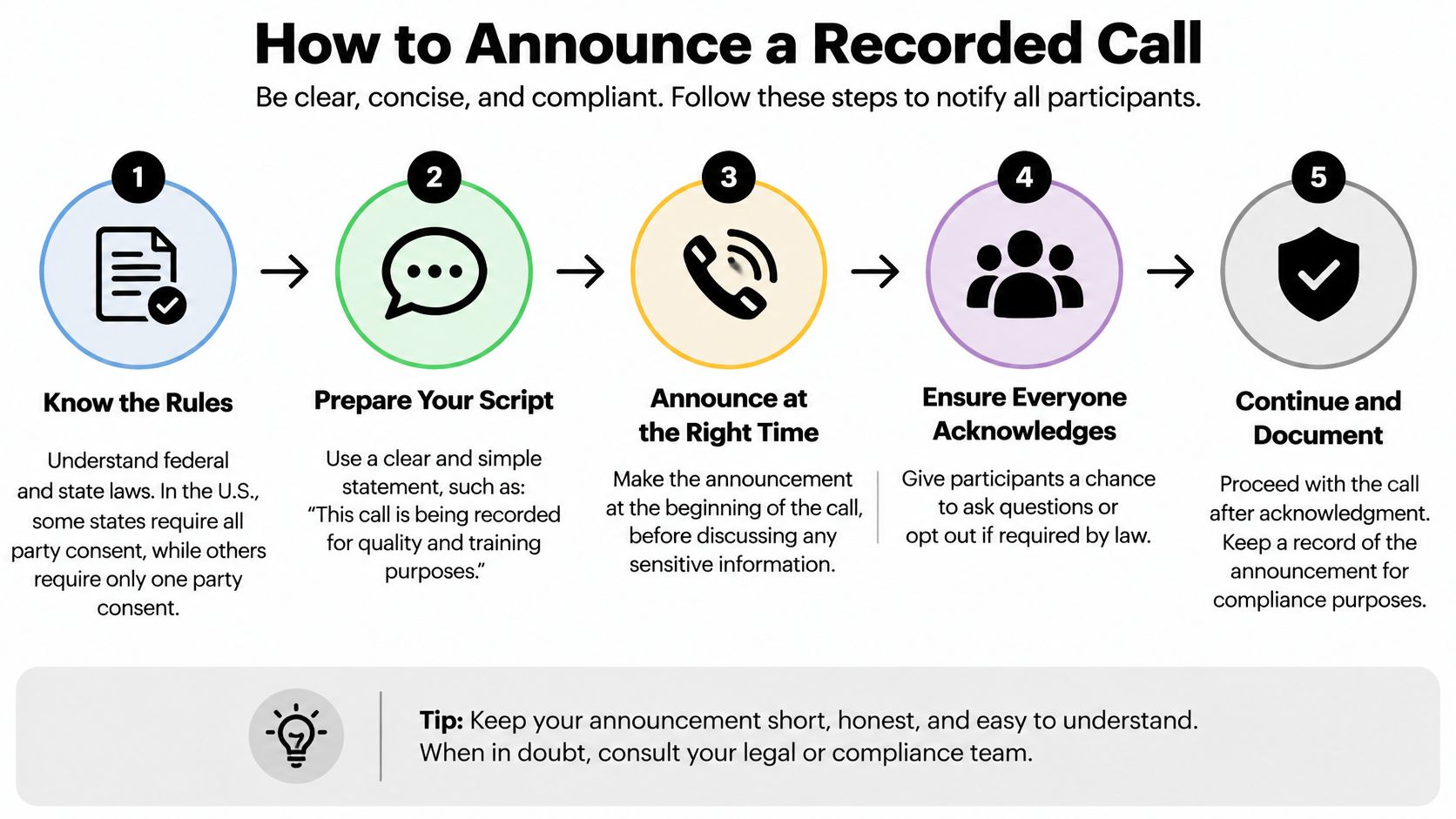
Notice works only if the caller hears it before capture. A sentence buried after the greeting, or played only on the main line, leaves the transferred call bare.
- Write down which calls you record. Inbound leads, outbound reminders, and internal transfers can follow different rules. If it is not on the list, do not record it by habit.
- Play the notice before recording starts. Prior consent means the warning comes first. Starting the file and talking over the beep is the failure mode.
- Keep the words short. Say the business name, say that audio may be recorded and transcribed, and say why. Service and quality are plain reasons. Skip legal filler.
- Offer a real unrecorded path. That can be a key press, a spoken refusal, or a callback. Do not announce "press 2" unless that key exists on your system.
- Test every line and every transfer. Call the main number, the after-hours forward, and the path to a person. If the notice dies when the call moves, the test failed.
Standard business line. Replace the bracketed name. Use the press-2 sentence only if your phone does it.
Thanks for calling [Business Name]. This call may be recorded and transcribed for service and quality purposes. To continue, stay on the line. To speak without recording, press 2 or ask us to call you back.
Multistate shops, and any line where the caller's state is unknown, should ask for a yes instead of relying on silence.
This call is being recorded and transcribed. Do you agree to continue?
The notice has to cover transcription and any AI analysis, not only the audio file. A transcript is a second copy of the conversation. If you describe how call transcription works to staff, use the same description in the greeting so callers are not surprised by a text version later.
If an AI receptionist such as SkipCalls answers forwarded calls around the clock, sends a summary, and produces a transcript, confirm that its greeting finishes before any recording or transcript starts. More setup detail for recorded business lines is in the call recording for business guide.
If the caller says no, stop the recording and finish the call without it. Take a written message. Do not argue the caller into a yes, and do not keep a file "just in case" after a refusal.
Retention, Access and Purpose Limits for Recordings
A recording that was lawful to make can still create trouble when someone reuses it. Permission to capture is not permission to do every later thing the file could support.
Picture a heating company that records for quality checks. Six months later someone wants that file to train an AI model, to settle a disputed invoice, to hand to a lawyer, or to score an employee. Those are different purposes. Before any reuse, answer three questions. Who can open the file? How long does it stay? Was the caller told that transcription or analysis would happen?
Build the program around call recording basics, not around the greeting alone.
- Name one purpose for each recording type, and write it where staff can see it.
- Limit access by role. The owner, the office manager, and a vendor should not all have the same keys.
- Set a retention period and a deletion date. If a state sets a shorter limit, follow that shorter limit.
- Keep a notice record with the timestamp, call direction, and the jurisdiction you relied on.
- Pause when someone reads a card number. Do not store payment-card data in the audio or the transcript.
- Write the refusal steps. Who stops the recorder, and what the caller hears next.
- Put vendor duties in the contract. Storage, access, and transcripts should be spelled out, not assumed.
Shops comparing tools can review call recording platforms with PSA integration when the recording stack has to sit next to scheduling software. Integration does not replace a retention rule.
Transcripts follow the same purpose, access, and deletion rules as the audio. Deleting the recording and keeping the text is not deletion. A disclosure script is the front door. It is not the whole program.
Set One Nationwide Recording Policy Today
A plumbing crew in Ohio answers a call routed to a cell phone parked in Pennsylvania, while the recording lands on a vendor's server in a third state. The one-party rule that covers most states does not settle that call. A single written policy, built around an all-party default, does.
Treat the one-party shortcut as the exception. Use it only after confirming that every participant, and the system capturing the audio, sits in your state, and play the notice anyway. That default is what protects a salon desk, an insurance agency, and a two-lawyer office that cannot see where the caller is standing.
- List the states where callers, staff, home offices, and cloud recording vendors sit. One forwarded call across a border changes which statute governs.
- Check each current statute against the tables in this guide, then open the official code. Blog labels go stale.
- Write the notice and test it on every number and every transfer, including after-hours forwarding.
- Set access, retention, and deletion in the same document as the script, with a named owner who answers for both.
- Re-check every six months and again after any new statute or court ruling you hear about.
Law offices carry extra file-handling duties around client calls. A useful companion is this overview of cybersecurity for legal practices, read next to your own engagement terms. Whatever vendor answers the phone, read its privacy terms for AI receptionist services the same way you read a statute, and match what the product stores to what your policy allows.
This is general information, not legal advice. A lawyer licensed in the states where you and your callers operate should review your script, your vendor contract, and your retention calendar.
Last checked: October 2026.
See how SkipCalls answers your business calls, captures caller details, books appointments, and calls you about hot leads at SkipCalls.


