The 72-Hour Availability Challenge: How to Find the Hidden Revenue in Your Missed Calls
Think you answer every call? Stats say otherwise. Take the 72-hour challenge to find the 'ghost leads' costing you thousands—and fix it for free.
Here is a comfortable lie many small business owners tell themselves: "I answer my phone most of the time."
It feels true. You have your cell phone on you constantly—on the job site, in the truck, even at the dinner table. You pride yourself on being responsive. But the data tells a different, much more expensive story.
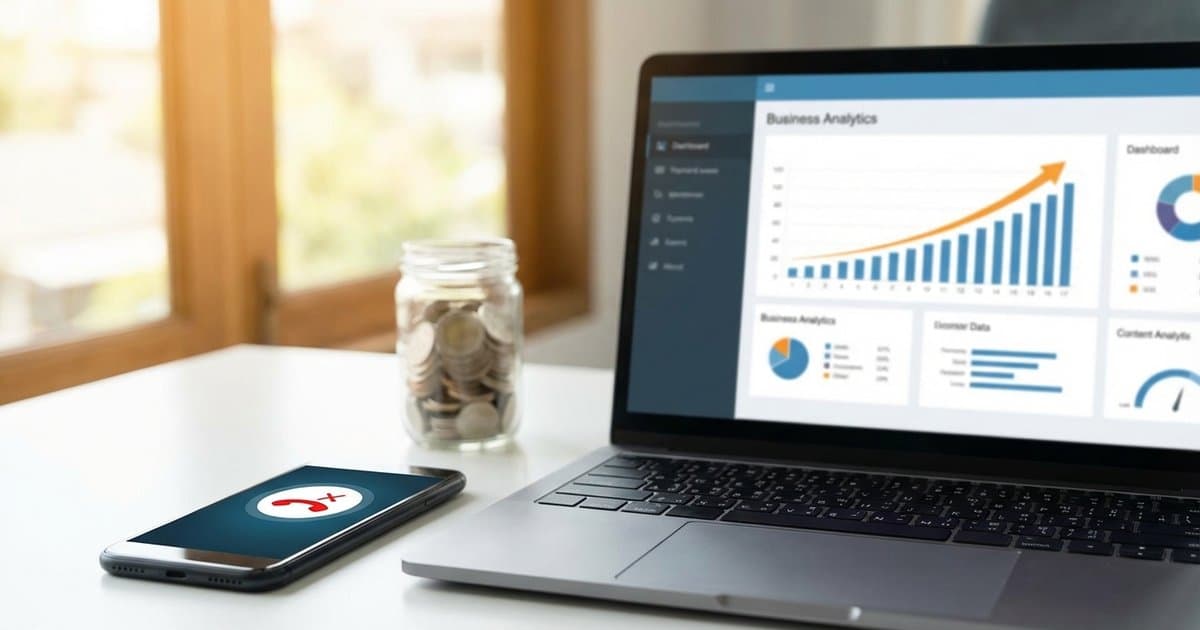
Recent industry statistics reveal that small businesses miss approximately 62% of incoming calls during normal business hours. Even more alarming? 85% of customers whose calls go unanswered will not call back—they simply move on to the next competitor on Google.
These aren't just missed calls; they are "ghost leads." They are the jobs you never knew you lost because the potential client didn't leave a voicemail. They just hung up and hired someone else.
If you want to know exactly how much revenue is slipping through the cracks, you don't need a consultant. You need to run a simple, 3-day experiment. We call it The 72-Hour Availability Challenge.
The Problem: The High Cost of "Ghost Leads"
For a plumber, electrician, or HVAC tech, the phone is the lifeline of the business. Yet, the very nature of the work makes answering impossible. You can't safely answer while wiring a breaker box, you can't hear the ringtone over a circular saw, and you certainly can't take down customer details while under a sink.
So, calls go to voicemail. And that is where the sale dies.
In 2026, voicemail is a digital graveyard. Homeowners want instant gratification. If they reach a machine, they assume you are too busy, too small, or simply unresponsive. A study by Phonely found that 37.8% of calls to small businesses end up in voicemail, but a staggering portion of those callers leave no message at all.
This creates a blind spot. You look at your phone and see "3 Missed Calls." You assume those are just spam or unimportant. But if just one of them was a water heater replacement or a roof inspection, you might have lost $500 to $5,000 in pure revenue.
Why You Need to Run This Experiment
You can't fix what you don't measure. Most contractors operate on gut feeling rather than data. The 72-Hour Availability Challenge is designed to give you hard data on three things:
- True Call Volume: How many calls are you actually receiving (including spam)?
- Missed Opportunity Rate: How many valid leads arrive when you are physically unable to answer?
- Revenue Potential: What is the dollar value of the work you are turning away?
Best of all, you can run this test for free using SkipCalls' 3-day trial, without changing your phone number or disrupting your business.
What Are Missed Calls Costing You?
Step 1 of 3 • Takes 30 seconds
On a typical busy day, how often does your phone ring when you can't pick up?
When you're with a customer, under a house, on a ladder...
Don't stress about the exact number – a rough guess is perfect
What Are Missed Calls Costing You?
Calculate how much revenue your business loses from missed phone calls. Most contractors lose $800-$1,500 per month from unanswered calls. SkipCalls AI phone answering costs only $199/year and captures every lead.
- Calculate how much money you lose from missed calls
- Average contractor loses $800-$1,500/month to unanswered calls
- SkipCalls AI answering costs only $199/year
- One captured job pays for 5+ years of service
Step-by-Step: How to Run the 72-Hour Challenge
Ready to see what you've been missing? Follow these steps to set up your "Ghost Lead" trap.
Step 1: Set Up the "Trap" (10 Minutes)
The goal here is to capture everything for three days. You aren't hiring a human receptionist for $4,000/month; you are using AI to clone yourself.
- Download SkipCalls: Get the app on your iPhone or Android.
- Configure Call Forwarding: This is the most critical step. You will set up "Conditional Call Forwarding." This means your phone will still ring like normal. You can still pick up if you're free. But if you decline the call, are on the other line, or just let it ring, it forwards to the AI instead of your carrier's voicemail.
- Customize Your Voice: Choose a voice that sounds professional. The AI will answer, "Thanks for calling [Your Business], how can I help you?" just like a human staff member.
Step 2: The "Business as Usual" Phase (Days 1-3)
For the next 72 hours, do not change your behavior. Go to work. Focus on the job site. Eat lunch without staring at your screen. Spend time with your family in the evening.
The difference: When you can't pick up, the AI handles it.
- Scenario A (The Job Site): You're on a ladder. The phone rings. Usually, you'd scramble to get down or let it go to voicemail. Now? Let it ring. The AI picks up, books the appointment, and sends you a text summary: "John Doe needs a quote for a panel upgrade. Booked for Thursday at 2 PM."
- Scenario B (The Spam Call): You get a call from an unknown number. Usually, you'd waste 30 seconds answering a "car warranty" robot. Now? The AI answers. It detects the robocall, filters it out, and you never get bothered.
- Scenario C (After Hours): It's 7:30 PM. You're watching TV. A call comes in. It's an emergency leak. The AI answers, takes the details, and marks it as "Urgent." You get a notification and can decide whether to take the job or schedule it for morning.
Step 3: The Audit (Day 4)
After 72 hours, open the SkipCalls dashboard. This is your moment of truth. Look at the Call Summaries.
Ignorance is not bliss; it's bankruptcy. You will likely see a list of calls that you would have otherwise missed. Categorize them:
- Spam: Calls you are glad you didn't answer.
- Existing Clients: Questions about arrival times or invoices (handled by AI).
- New Leads: This is the gold mine. Count how many new job inquiries came in that the AI captured.
The Math: Calculating Your ROI
Let's say over the 3-day period, the AI captured 3 new leads that you couldn't answer because you were working or sleeping.
- Average Job Value: Let's assume you're a plumber and an average job is $400.
- 3 Leads x $400 = $1,200 in potential revenue.
- Weekly Projection: If you miss $1,200 in 3 days, that's roughly $2,800/week or $11,200/month in lost opportunity.
Now compare that to the cost of the solution. SkipCalls costs $19.99/month (or $199/year).
In this experiment, capturing just one of those jobs pays for the entire year of service 5x over. The ROI isn't 10% or 20%; it's closer to 5,000%.
Beyond the Money: The Professionalism Gap
There is a secondary benefit to this experiment that is harder to measure but equally valuable: Perception.
When a customer calls a tradesperson and gets a professional, intelligent response—even at 7 PM or during a lunch rush—their trust in that business skyrockets. They stop calling competitors. You have effectively taken yourself out of the "race to the bottom" pricing war because you were the first to answer.
As B2B HQ notes, 60% of customers prefer phone calls for urgent issues. By automating that channel, you aren't just "answering phones"; you are building a brand that looks bigger and more reliable than the solo operator down the street who relies on a full voicemail box.
Conclusion: Stop the Leak
The 72-Hour Availability Challenge usually ends in one of two ways:
- You realize you don't get many calls (rare, but possible—and good to know!).
- You realize you are losing thousands of dollars a month to missed calls.
If you fall into the second category, the solution is already installed on your phone. You don't need to hire a receptionist. You don't need to work longer hours. You just need to let the AI do what it was built to do.
Ready to start your test? Download SkipCalls today and start your 7-Day Free Trial. Prove to yourself exactly what your missed calls are worth.