Automated Phone Calls: A Complete Guide for Business
Learn how automated phone calls work, where businesses use them, the legal rules to follow, and how AI receptionists like SkipCalls capture every lead.

 Reviewed by Nikita Podelenko, Founder & Engineer of SkipCalls
Table of contents
- Why Automated Phone Calls Matter for Small Businesses
- What Automated Phone Calls Actually Are
- The Main Types of Automation Businesses Actually Use
- Do Automated Phone Calls Actually Convert Better
- Legal Rules Every Business Must Respect
- Designing the Caller Experience So Automation Does Not Backfire
- How to Roll Out an Automated Calling System Step by Step
- Where SkipCalls Fits and How to Get Started This Week
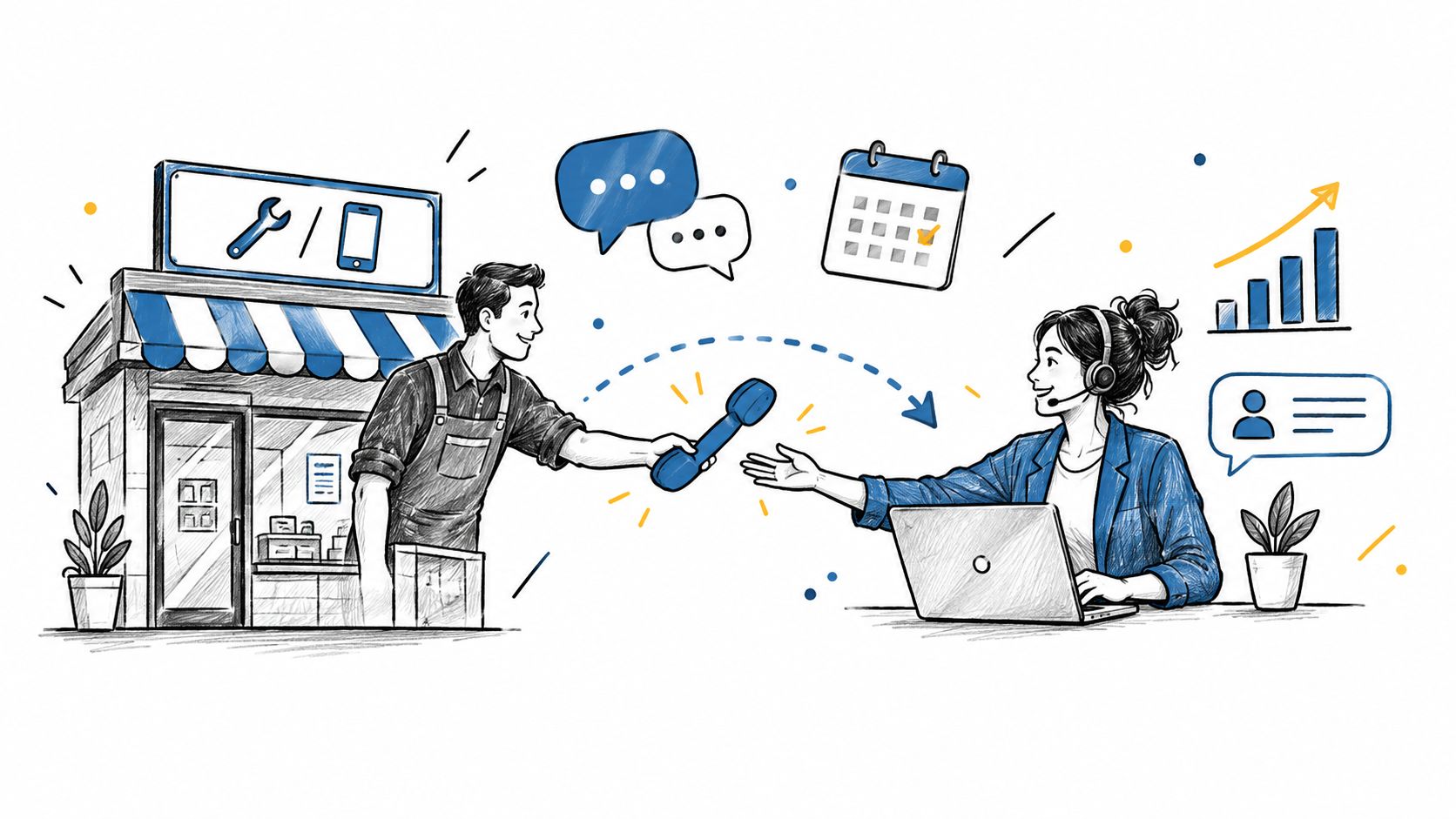
The phone rings while you're on a ladder, in a showing, or walking a client through a repair. You know the call is hot, but you can't drop everything, so it rolls to voicemail and the lead goes cold. That's the reason people start looking at automated phone calls. They don't want a gimmick. They want the phone to answer, qualify, route, and book work before the opportunity disappears.
Why Automated Phone Calls Matter for Small Businesses
A solo operator loses money in the same place every week, on the ring that lands at the wrong time. A plumber is under a sink. A realtor is in a closing. A salon owner is with a client. The caller doesn't care, they just want an answer now.
That's why automated phone calls matter. They keep the first response from falling apart when nobody on your team can pick up. The point isn't to replace people, it's to stop a good lead from dying in voicemail. If you're already thinking about how leads come in and where they get lost, the discipline in lead generation best practices is a useful lens, because the phone is just one more conversion point that has to be handled well.
The real job is not “make calls,” it's “save outcomes”
A good system answers, identifies the caller's intent, and moves the conversation somewhere useful. For a contractor, that might mean emergency triage. For a beauty studio, it might mean booking. For a real estate team, it might mean lead qualification and a callback for the hottest prospects.
Practical rule: automate the call only if you can name the outcome in one sentence. If the result is fuzzy, the automation will be fuzzy too.
The hard question isn't whether automation is trendy. It's whether a specific call type can be automated without damaging trust or slowing the customer down. That's where a lot of teams go wrong. They buy a system because it promises coverage, then discover they've automated the wrong part of the conversation.
Scale is the problem, not effort
Small teams aren't failing because they're lazy. They're failing because one person can only answer one call at a time. When volume rises, missed calls pile up, callbacks slip, and the team starts losing work that should've been captured at the door.
That's the upside of automation, if you use it with discipline. It can pick up after hours, handle overflow, ask basic questions, and send the caller to a human when the situation calls for it. The rest of this guide is about the parts that decide whether that setup becomes an asset or a headache.
What Automated Phone Calls Actually Are
The clean definition is simple. Automated phone calls are voice interactions handled without a live human on the originating end. That includes outbound calls a business sends and inbound calls a system answers first.
Two flavors show up in real operations
Outbound systems start the call. Think reminders, alerts, follow-ups, and voice campaigns. Inbound systems receive the call and handle the first stretch of the conversation, like an IVR menu or an AI receptionist that gathers details before routing to the right person.

The easiest way to picture the mechanics is an air-traffic controller. The telephony layer brings the call in. Speech-to-text listens. The language model decides what the system should say next. Text-to-speech speaks back. Orchestration keeps the whole exchange moving, including the handoff when a human has to take over. Real-time systems are usually designed for an end-to-end latency of roughly under 800 ms, and they need barge-in support so callers can interrupt naturally, because nobody wants to wait for a machine to finish its script before they can say “I've got a problem” (Forasoft's AI call assistant API guide).
What happens between hello and booking
An AI receptionist isn't thinking in the abstract. It's listening, classifying intent, choosing the next prompt, and pulling from a flow that's already been designed. If the caller says they need an appointment, the system can ask for details, check availability, and move toward a booking. If the caller is upset, confused, or urgent, it can route out fast.
For a plain-English breakdown of how that looks in a working product flow, see the internal walkthrough on AI phone answering service. The important thing is this, the technology is a stack, not magic. When a call feels smooth, it's because the stack is designed to act like a competent dispatcher, not a script reader.
The Main Types of Automation Businesses Actually Use
Most owners don't need every flavor of automation. They need the right one for a specific job. That's why the buying decision gets easier when you stop thinking in buzzwords and start thinking in call patterns.
IVR, reminders, AI agents, and hybrid workflows
IVR phone trees are the old workhorse. The caller presses a number, hears a menu, and gets routed based on the choice. This works when the questions are predictable and the call volume is more annoying than complex.
Automated outbound reminders and alerts are the blunt instrument. They're good for confirmations, appointment reminders, and payment nudges when the message is short and one-way. The call should be tight, clear, and easy to exit.
AI voice agents are the newest layer. They can answer questions, collect caller details, and make decisions in real time. They fit better when the conversation is messy, like lead qualification, intake, or after-hours triage.
Hybrid systems are the compromise most small teams live with. They combine voicemail-to-text, live callbacks, and a human fallback path. That combination matters because not every call needs a full AI conversation, but plenty of calls still need a fast response after the first touch.
Here's the blunt version. If the job is simple and repetitive, use a tree or reminder. If the job is conversational, use an AI agent. If the job turns urgent quickly, keep a live fallback ready.
The best system is the one that matches the call, not the one with the most features.
If you want a deeper look at how routing choices affect the caller path, the overview on call routing software is a useful companion. The main takeaway is operational, not theoretical. Pick the call type first, then pick the tool.
Match the system to the use case
A salon confirmation call doesn't need the same setup as a debt collection reminder or a real estate lead qualifier. If you're designing for after-hours trade calls, speed to human matters. If you're handling routine reminders, brevity and clarity matter more. The wrong match creates friction fast.
Do Automated Phone Calls Actually Convert Better
A lot of vendor content skips the uncomfortable question. Delivery is not the same as conversion. A call that gets answered and a call that changes behavior are two different things.
Evidence says the lift is not automatic
A randomized study of credible robotic voter-turnout calls found no significant impact on turnout or vote choice, while a personalized service-center call intervention for health insurance did lift enrollment by 2.7 percentage points overall and 22.5% relative to baseline, with effects concentrated among lower-income households (JPAL evaluation). That's the lesson business owners should care about. The channel itself doesn't guarantee success. The message, timing, and audience do the work.
What actually decides whether the call pays off
If you want the automation to earn its keep, focus on four things. The script has to be short enough that the listener doesn't drift. The timing has to fit the caller's context. The target audience has to be specific. And hot leads need a clean path to a human when the system detects high intent.
A lot of teams automate because they assume speed equals effectiveness. That's lazy thinking. Speed only helps if the call lands on someone who wants the next step. Otherwise, you just create a faster way to annoy people.
If you're trying to evaluate whether your own call automation is worth the spend, the ROI framing in SaaS lead gen ROI strategies from DMpro is a good reminder that the metric should be tied to business value, not just activity. Measure the result, not the volume.
Use a simple conversion filter
- Answer rate: Are people picking up?
- Containment versus transfer: Is the system resolving the call or handing it off cleanly?
- Conversion per campaign: Is the call producing bookings, qualified leads, or completed tasks?
- Lead temperature: Are the hottest callers getting to a human fast enough?
That's the difference between automation that looks busy and automation that changes revenue.
Legal Rules Every Business Must Respect
Small teams get burned when they buy the system first and then ask legal later. That's backwards. If you're calling consumers in the United States, the rules are not optional, and the details matter.
Consent is the starting line
Under the TCPA and FCC rules, automated or prerecorded telemarketing calls to a consumer's cell phone generally require prior express written consent. For non-telemarketing autodialed or prerecorded calls to wireless numbers, the bar is at least prior express consent (TCPA explanation). The FCC also says callers must obtain consent before making prerecorded telemarketing calls, and that consent can be captured on paper or electronically through a website form or telephone keypress (FCC robocall guidance).
AI voices are not a loophole
In February 2024, the FCC unanimously said calls made with AI-generated voices are “artificial” under the TCPA, which means the same requirements apply to outbound calls using voice cloning or other AI-generated artificial voices (Mayer Brown summary of the FCC ruling). Don't let anyone sell you a workaround. There isn't one.
Practical rule: if you can't prove opt-in, don't dial for marketing.
The safe operating model is boring
For most small businesses, the cleanest policy is simple. Call only people who opted in. Keep proof of that consent. Make the opt-out obvious. Use emergency exceptions only for actual emergencies involving danger to life or safety, not for convenience.
A useful internal reference for capture and storage practices is how to record conversation. That kind of process discipline matters because compliance failures are usually paperwork failures first, tech failures second.

The short version is brutal but useful. If your list is dirty, your consent records are weak, or your script hides who's calling, you're building a liability machine.
Designing the Caller Experience So Automation Does Not Backfire
The biggest failure in phone automation is not technical. It's human frustration. Callers hang up when they feel trapped, confused, or tricked.
Keep the menu narrow and the escape hatch obvious
Small-business guidance points in the same direction. The first menu should stay at 3 options, never exceed 5, and total depth should stay at 2 to 3 levels. There should always be a Press 0 route to a live person, because repeated use of that option is a sign the tree is too complex (Alliance Virtual Offices guidance). That's not a nice-to-have. It's the difference between a usable system and a maze.
The same logic applies to outbound messages. Developer guidance recommends keeping them under 30 seconds, stating the purpose in the first 5 seconds, and providing IVR choices plus opt-out paths because passive playback increases hang-ups while interactive branching reduces abandonment and compliance risk (Exotel automated calls guidance).

Make the system sound decisive, not decorative
A caller should know three things fast. Who's calling. Why they're calling. What to do next. If the system buries that under unnecessary phrasing or robotic padding, the caller starts hunting for an exit.
Keep the voice conversational. Keep the choices obvious. Keep the handoff path real, not hidden three menus deep. When callers need a human, they should get one without fighting the tree.
If people keep pressing zero, your design is telling you something. Listen to it.
Measure completion, not just contact
A lot of teams brag about how many calls they can place. That's the wrong scoreboard. What matters is whether callers finish the journey, reach the right person, and leave with the issue handled.
If the system is making people work too hard, it's costing you bookings. If the menu is too clever, it's hurting conversion. Good caller experience is boring on purpose.
How to Roll Out an Automated Calling System Step by Step
Start with one call type, not five. If you try to automate support, sales, reminders, and collections at once, you won't know what broke when the results get messy. Pick the most repetitive, least risky call first.
Build the first version around your existing stack
Choose a platform that fits your number and your workflow, then connect it to the tools your team already lives in. Calendar integration matters if the job is booking. CRM integration matters if you're qualifying leads or logging outcomes. If the call leads nowhere in your systems, it doesn't count.
A practical option here is SkipCalls, which handles voice and text, works without changing your phone number, and integrates with CRM and calendar tools. Use it if you need a straightforward AI receptionist rather than a pile of separate tools.
Roll out conservatively
Start with after-hours and overflow. That's where automation usually helps fastest and hurts least. Then run live QA on transcripts, listen for routing failures, and watch whether callers are getting the answer or bouncing into fallback paths.
If you're looking for a setup guide, the internal walkthrough on how to set up AI receptionist 5 minutes is the right operational reference. The point is not speed for its own sake. The point is a controlled launch.
Track the numbers that matter
The four metrics worth watching from day one are straightforward.
- Answer rate: Are more callers getting picked up?
- Containment versus transfer rate: Is the system solving the easy calls and escalating the hard ones?
- Conversion per campaign: Are bookings, qualified leads, or completed actions rising?
- Cost per booked appointment: Is the automation producing work you'd otherwise miss?
If those numbers move the wrong way, tighten the script, shorten the path, or narrow the use case. Don't scale a bad flow just because it's running.
Where SkipCalls Fits and How to Get Started This Week
A lot of teams don't need a giant contact-center rebuild. They need a receptionist that answers, captures details, books appointments, and flags hot leads before the caller disappears. That's the lane SkipCalls is built for, and it fits the small-team reality better than bloated systems do.

It works across customer support, lead qualification, appointment booking, and related use cases. It handles voice and text, doesn't require you to change your phone number, and plugs into CRM and calendar tools. That matters for home services, real estate, insurance, law, salons, solo operators, and debt collection, because those teams usually need phone coverage without adding a full-time front desk.
The launch question is simple. Which call are you replacing first. Which integration has to work on day one. Which two metrics will tell you if the system is helping or hurting. If the answer is fuzzy, start smaller. If the answer is clear, wire the system to the highest-value call path and cut the dead weight.
If you're ready to stop losing calls to voicemail, use SkipCalls to put a working receptionist in front of the phone without changing your number. Keep the rollout tight, watch the metrics, and expand only when the calls are turning into booked work instead of noise.