Outsourced SDRs for Local Service Businesses in 2026
See how outsourced SDRs help local service businesses book more qualified appointments, cut hiring costs and scale outreach without adding headcount.

A homeowner calls three contractors after a pipe bursts. One answers immediately. One calls back later. The third never responds. The job usually goes to the first business, even if the others offer better workmanship.
That's the uncomfortable reality behind many outsourced SDR decisions. A local service company may believe it needs more outbound prospecting, while its real problem is unanswered calls, delayed follow-up, and appointment details trapped in voicemail. Before paying an external sales team to create demand, determine whether your business can handle the demand it already receives.
Table of Contents
- What Outsourced SDRs Actually Are
- The Growing Market for External Prospecting Teams
- Outsourced SDRs Versus In-House Hiring and AI Options
- Why Meeting Volume Is the Wrong Metric
- How LatHire Can Help
- How to Evaluate and Choose an Outsourced SDR Vendor
- When Outsourced SDRs Make Sense and When They Do Not
- Integrating Outsourced SDRs with AI Receptionist Workflows
- Getting Started with the Right Lead-Gen Strategy
What Outsourced SDRs Actually Are
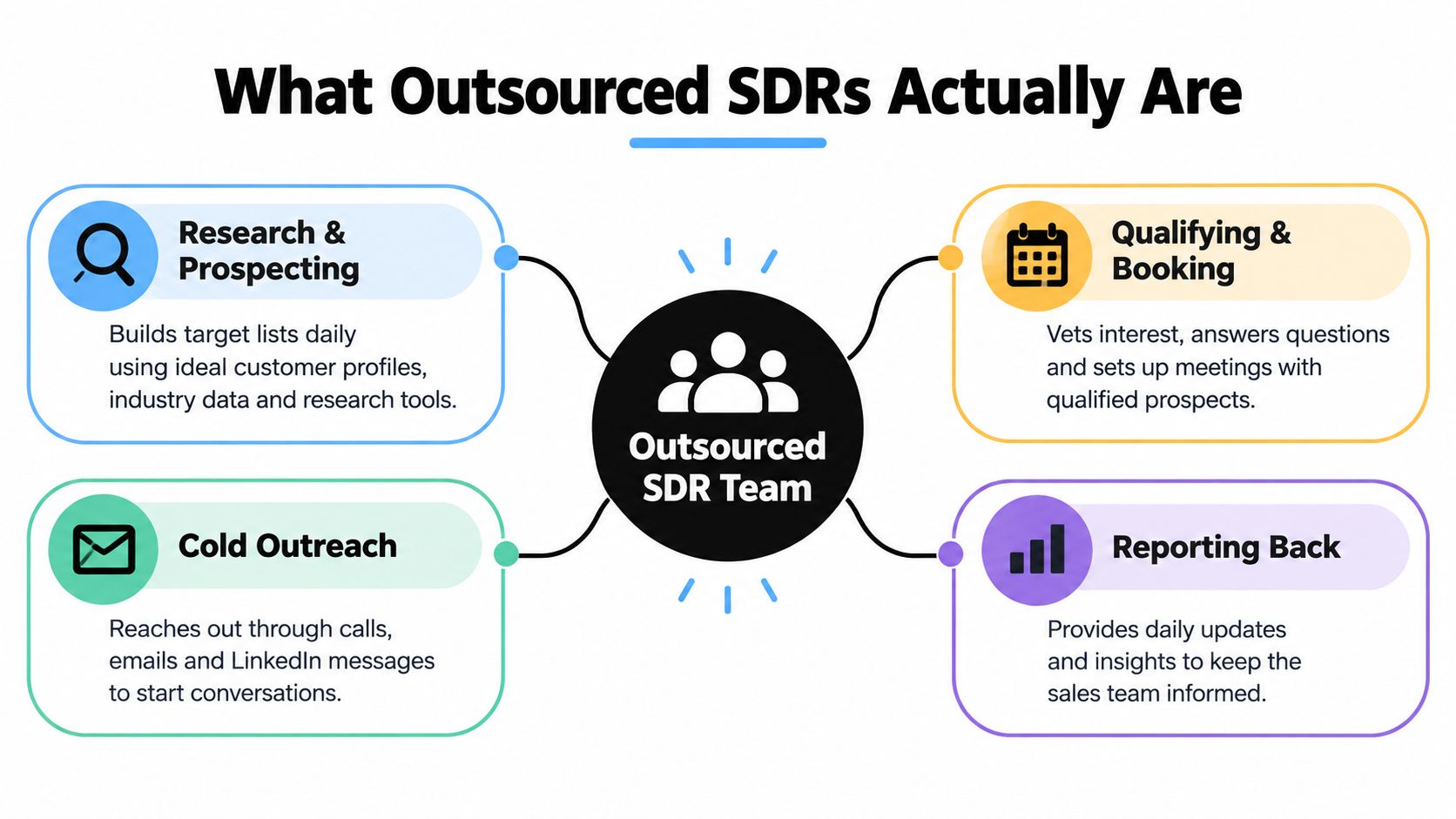
An outsourced SDR team is an external sales-development function. Its representatives research target accounts, contact prospects, qualify interest, book appointments, and report activity back to your sales team. A serious provider operates from an agreed ideal customer profile, approved messaging, qualification rules, CRM fields, and follow-up process.
That differs from generic telemarketing. A telemarketer may work from a broad script and optimize for call activity. An SDR program should connect prospecting to a defined sales pipeline. The team identifies the right prospects, explains the initial value proposition, records objections, confirms fit, and gives an account executive a usable next step.
The daily workflow
A real outsourced SDR operation may begin by building a prospect list, checking territory or firmographic fit, and identifying the right contact. Reps then use calls, email, social outreach, or follow-up sequences. When someone responds, the rep tests urgency, need, authority, timing, and the next action before placing a meeting on the calendar.
For a local service company, that workflow can be the wrong tool. If the prospect already called because a furnace failed, a roof is leaking, or a legal consultation is urgent, outbound prospecting isn't the bottleneck. The business needs a dependable intake process that answers, captures the details, and routes the opportunity.
Practical rule: Buy outsourced prospecting when you lack enough qualified conversations. Don't buy it to compensate for a phone system that loses conversations you already earned.
The model has still matured beyond transactional calling. A 2024 outsourcing summary attributed to Deloitte reported that 50% of executives use outsourced front-office capabilities, including sales, marketing, and research and development. The same summary reported that 34% of organizations cited cost reduction as their primary outsourcing reason in 2024, compared with 70% in 2020, which points toward capability, flexibility, and specialist expertise as increasingly important motives.
For a deeper explanation of the appointment-setting function, see how appointment setting works. The essential distinction is simple: an outsourced SDR creates and qualifies conversations, while an inbound receptionist workflow protects conversations that customers initiate themselves.
The Growing Market for External Prospecting Teams
External prospecting is no longer a fringe staffing arrangement. It has become a substantial service category because companies can buy specialized process, management, data work, reporting, and flexible capacity without building every layer internally.

Published estimates differ because analysts count different activities. One 2025 outsourced SDR market estimate placed global revenue above $3.2 billion and described annual growth of approximately 24%. Another estimated the 2025 market at $4.85 billion, with a projection of $11.06 billion by 2032 and a 12.5% compound annual growth rate. Those figures shouldn't be treated as a precise census, but they establish the commercial scale of the category.
What the market shift means for buyers
The industry's growth reflects more than a search for cheap labor. Buyers increasingly want:
- Specialized execution: A provider already knows how to build lists, write cadences, coach reps, manage objections, and report pipeline.
- Flexible capacity: A company can test a segment or territory without immediately creating permanent headcount.
- Operational accountability: A managed provider can own training, supervision, process documentation, and replacement planning.
- Faster experimentation: External teams can help test messaging and audiences before the client commits to a larger internal structure.
North America remains the largest major market in the cited estimate, with 2025 revenue of $2.43 billion, or about 50.2% of global revenue. That regional concentration reflects the depth of B2B technology, professional-services, and sales-outsourcing demand there, not a guarantee that every local business should adopt the same model.
The important question isn't whether outsourced SDRs are accepted. They are. The question is whether your revenue motion resembles B2B outbound sales. If your team sells to identifiable accounts through repeated prospecting and scheduled discovery, external SDRs can fit. If customers mostly discover you locally and call with immediate needs, response operations may create more value than cold outreach.
Outsourced SDRs Versus In-House Hiring and AI Options
A local contractor can spend money on cold outreach while unanswered calls go to voicemail. That is a hiring mistake, not a lead shortage. These options solve different problems: outsourced SDRs buy managed human prospecting. In-house hiring buys control and institutional knowledge. An AI receptionist buys continuous intake and workflow automation.
Cost helps frame the decision, but it cannot make it. Available coverage cites outsourced retainers of roughly $3,000 to $8,000 per SDR-equivalent and fully loaded in-house costs of about $9,800 to $14,200 monthly in the outsourced team cost comparison. Those figures describe different operating models. Compare the bottleneck, response standard, and output you need rather than comparing fees alone.
Choose by bottleneck
| Model | Best suited to | Main advantage | Main risk |
|---|---|---|---|
| Outsourced SDRs | B2B prospecting and account-based outreach | Specialist process and flexible capacity | Poor-fit meetings or weak brand alignment |
| In-house SDRs | Complex products and long-term sales development | Direct coaching and deep product knowledge | Hiring, management, ramp, and turnover burden |
| AI receptionist | Phone-led inbound inquiries and appointment booking | Fast response and consistent intake | Limited nuance in unusual conversations |
Choose an outsourced team when closers need more qualified conversations and the target account is clearly defined. Choose in-house SDRs when reps must master technical details, maintain continuity across complex deals, and grow inside a long-term sales function.
Choose an AI receptionist first when marketing already generates calls but staff cannot answer them consistently. An AI receptionist can answer within two rings, capture the service address and urgency, and place the appointment on the calendar before the caller contacts another contractor. It handles intake and routing, not strategic account development.
That distinction matters for phone-led businesses. A roofing company, salon, insurance agency, or solo law practice often does not need someone hunting cold accounts. It needs urgent callers handled professionally, qualification details recorded, and appointments placed correctly.
Read this comparison of AI receptionists versus live answering services before choosing an answering model. If the problem is missed inbound demand, an outsourced SDR proposal is solving the wrong problem.
Why Meeting Volume Is the Wrong Metric
A vendor can book meetings and still create a mess for your sales team. Low-fit appointments consume calendar space, require rescheduling, frustrate account executives, and make the pipeline appear healthier than it is.
Available outsourced-SDR campaign data indicates that only 40% to 60% of booked meetings convert into qualified opportunities, according to the outsourced SDR campaign benchmark. That conversion gap usually begins upstream, with weak account selection, generic scripts, unclear acceptance rules, or a compensation model that rewards calendar volume.
Replace activity theater with funnel accountability
Your vendor agreement should define a qualified meeting before the first campaign launches. Include:
- Fit requirements: Firmographic, geographic, service-area, or industry criteria.
- Buyer requirements: The attendee's role and authority must match the sale.
- Need requirements: The prospect has a verified problem, trigger, or use case.
- Discovery requirements: The rep records the fields your closer needs.
- Next-step requirements: The prospect agrees to a specific follow-up action.
- Exclusion reasons: Existing customer, wrong territory, duplicate, no budget, no need, or other disqualifiers.
Track the complete funnel:
| Funnel stage | What to measure |
|---|---|
| Contacts | Target accounts or people reached |
| Conversations | Real two-way interactions |
| Accepted meetings | Appointments that meet the contract |
| Held meetings | Appointments attended |
| Qualified opportunities | Meetings accepted by sales |
| Revenue | Pipeline created and closed business |
Evaluate accepted opportunities per 100 attended meetings, pipeline per accepted opportunity, and disqualification reasons. Review call recordings with the vendor every week. If the same rejection reason appears repeatedly, change the list, script, qualification form, or territory before the problem expands.
For local services, apply the same discipline to inbound appointments. A meeting that lacks the service address, urgency, job type, availability, or relevant coverage information isn't sales-ready. It's administrative work passed to your team.
How LatHire Can Help
LatHire fits businesses that want human sales capacity without handling every part of international recruitment themselves. The platform connects U.S. and Canadian companies with pre-vetted Latin American professionals across sales, marketing, technology, and operations.
Its process combines AI assessments, skills evaluations, and human-led background checks. LatHire describes a talent pool of more than 800,000 candidates, job-description importing or AI-assisted creation, candidate matching in as fast as 24 hours, and support for HR, international payroll, benefits, and legal compliance.
Where the model fits
LatHire is worth considering when you want more control than a fully managed SDR agency provides. You can evaluate candidates with validated skills, see time-zone availability, choose flexible engagement models, and build a sales or support function around people who become more familiar with your business over time.
The platform also handles administrative areas that often discourage smaller companies from cross-border hiring, including payroll, benefits, compliance, and talent management. LatHire states that its approach can cut hiring costs by up to 80% and reduce time-to-hire by over 80%. Treat those as provider claims to validate against your role, location, supervision model, and employment arrangement.
Use LatHire when you can supply coaching, messaging, CRM access, and daily direction. Don't use it as a substitute for a qualification process. A well-sourced rep with no clear definition of a good opportunity will still create weak pipeline.
For companies comparing talent pools and role-specific recruiting options, best place to hire SDRs is a useful starting point. Ask every candidate to complete a practical exercise, review a sample call, explain how they would handle an objection, and document the fields they'd capture before booking.
How to Evaluate and Choose an Outsourced SDR Vendor
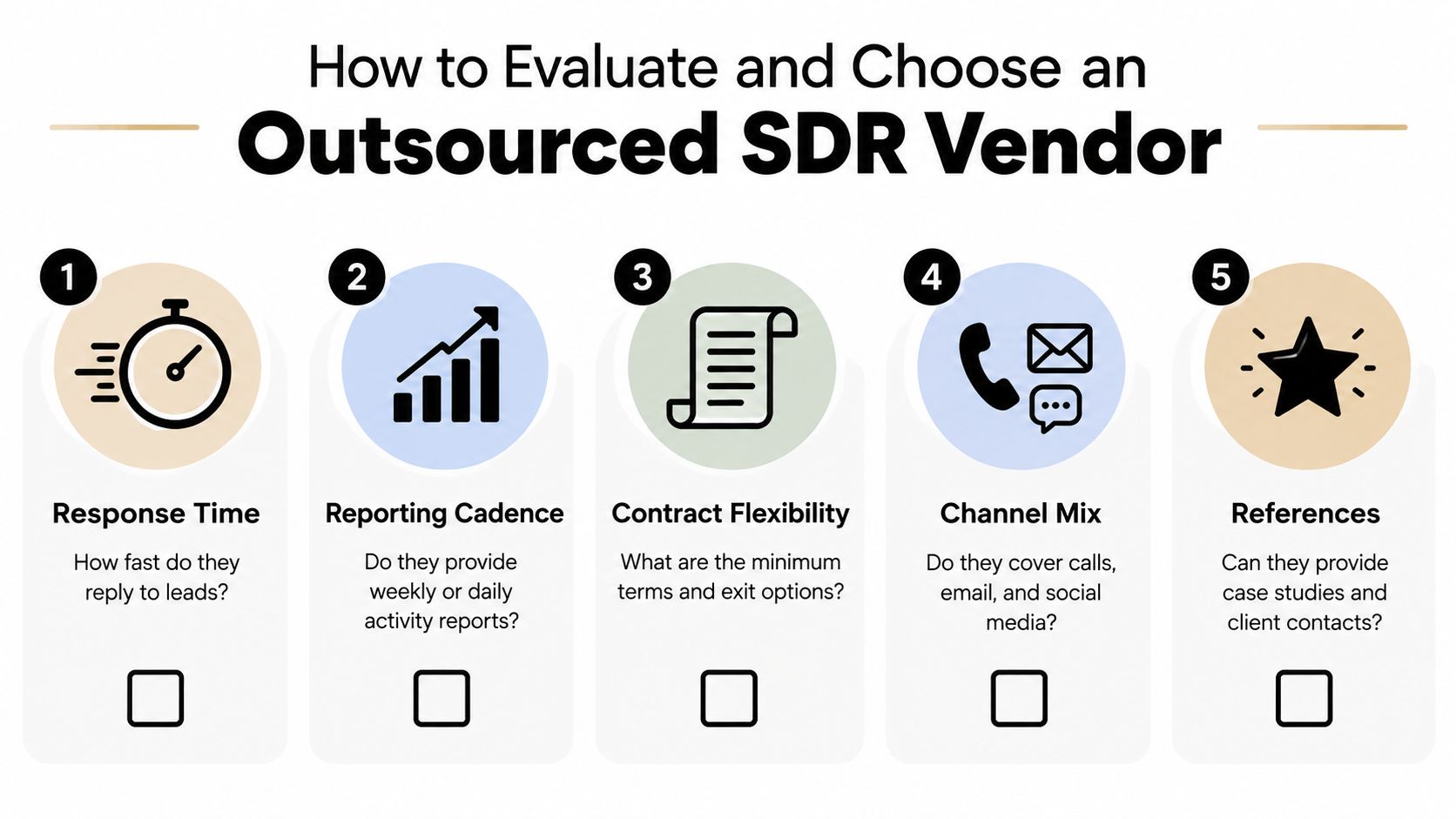
Start with the operating contract, not the sales presentation. A polished dashboard and confident account executive won't protect you if the vendor can't respond quickly, qualify consistently, or show what happens after a meeting is booked.
The five checks that matter
Response time comes first for inbound or high-intent events. A study of 2,241 U.S. companies found that organizations contacting inbound leads within one hour were seven times more likely to establish a meaningful conversation with a key decision-maker than those waiting longer. Companies waiting 24 hours or more were 60 times less likely to qualify the lead, according to LeanData's speed-to-lead analysis.
Require a sub-five-minute SLA for high-intent leads. Report response buckets under five minutes, 5 to 30 minutes, 30 to 60 minutes, and over one hour. Record the first-touch timestamp, assignment, disposition, and exception reason.
Qualification standards should be written as acceptance criteria, not described with phrases such as “good fit.” Specify territory, buyer role, need, urgency, required discovery fields, and exclusion reasons.
Reporting cadence must reach beyond booked meetings. Demand contact rate, qualification rate, held-meeting rate, accepted-opportunity rate, pipeline, and disqualifications by campaign and representative.
Calibration keeps the program honest. Hold weekly reviews of rejected meetings, recordings, reason codes, and downstream outcomes. Give the vendor permission to revise targeting and talk tracks when the evidence says the process is failing.
Contract flexibility matters because your motion may change. Ask about pilot length, replacement rules, data ownership, cancellation terms, and whether the vendor is paid for booked meetings, held meetings, accepted opportunities, or a combination.
Vendor test: If the provider resists showing rejected meetings and disqualification reasons, it probably wants you to judge activity instead of commercial value.
When Outsourced SDRs Make Sense and When They Do Not
Outsourced SDRs make sense when you have a genuine outbound problem. You know the account type you want, your sales team can handle qualified conversations, and a repeatable process can move prospects toward a meeting.
They're a poor choice when customers call because they need immediate help. In that situation, cold outreach adds another layer while the original opportunity still waits in voicemail.
Use this decision filter
Choose outsourced SDRs when:
- Your buyer is identifiable: You can define target companies, roles, territories, and triggers.
- Your sale is consultative: A scheduled discovery conversation leads naturally to the next sales step.
- Your closers have capacity: The internal team can attend and follow up on accepted meetings.
- You need flexible prospecting: You want to test a market or add outreach without permanent hiring.
- Your qualification rules are clear: The vendor can verify fit before booking.
Choose an inbound workflow when:
- The phone is the primary channel: Most demand arrives through calls or texts.
- Urgency determines the winner: The first responsive business often gets the opportunity.
- After-hours demand matters: Customers contact you outside the owner's availability.
- Details determine routing: Service address, job type, insurance, language, or appointment availability must be captured.
- The cost of a missed lead is high: One lost job can outweigh the cost of reliable intake.
A study summarized by Harvard Business Review analyzed more than 100,000 web-generated leads and found that companies attempting contact within five minutes were 100 times more likely to reach the lead and 21 times more likely to qualify it than companies waiting 30 minutes, as reported in this summary of the response-time research.
That finding changes the buying decision for local service businesses. If your issue is speed, hire or automate for speed. If your issue is account coverage, hire for prospecting. Don't confuse the two.
Integrating Outsourced SDRs with AI Receptionist Workflows
The strongest setup is often hybrid. An outsourced SDR team handles outbound account development, while an AI receptionist handles inbound calls and texts, captures information, books appointments, and alerts the team when a lead is urgent.
That division prevents a common failure. Your SDR vendor can create new conversations during business-development campaigns, while your intake workflow protects the people who already chose to contact you. Each channel gets a defined owner instead of forcing one team to perform two unrelated jobs.
Build the routing rules first
Route inbound events based on intent. A quote request, missed call, appointment request, or urgent service inquiry should trigger immediate handling. A lower-intent inquiry can enter a slower follow-up queue. The CRM should preserve the source, time, contact details, requested service, qualification outcome, and appointment status.
CRM-connected scheduling can support two-way appointment management through text. Salesforce Scheduler documentation describes customers using chat or SMS to schedule, view, reschedule, and cancel appointments, while CRM Analytics can report appointment volume, resource types, locations, topics, average duration, scheduled versus actual duration, and appointment type data in Salesforce's scheduling documentation.
Booking isn't the end of intake. A useful system changes the calendar, updates the customer record, alerts the right person, and preserves the operational trail.
Your business also doesn't necessarily need a new public phone number. The FCC describes local number portability as the ability for U.S. businesses to retain an existing number when changing providers within the same geographic area, as explained in the FCC's number-porting guidance.
Use CRM integration for lead handling to connect call outcomes, customer records, calendars, and follow-up ownership. Then measure the combined system, not each vendor in isolation.
Getting Started with the Right Lead-Gen Strategy
Start with the source of your demand. Review where recent opportunities came from, what happened after first contact, how quickly someone responded, and which details staff needed before taking action.
If outbound account work created most opportunities, an outsourced SDR pilot may fit. If calls, texts, referrals, maps, or existing customers generated most demand, fix inbound handling before paying for prospecting.
Make the decision operational
Write down clear answers:
- Where does demand originate? Separate outbound targets from inbound inquiries.
- How urgent is the first response? Set the maximum acceptable delay for each lead type.
- What makes a lead qualified? Record role, location, service, urgency, need, and next step.
- Who owns the next action? Assign every accepted meeting, missed call, and unanswered text.
- What does success mean? Track held appointments, accepted opportunities, pipeline, revenue, and disqualification reasons.
- What must remain human? Keep nuanced conversations, sensitive matters, and complex consultations with trained staff.
- Can your calendar and CRM stay synchronized? If not, automation will create confusion instead of removing it.
If you use profile-based booking, confirm the handoff and ownership requirements described in Google's Business Profile support documentation. Use the lead capture process guide to define what every caller must provide before an appointment is booked.
For a local service company, begin with an inbound-response audit. Log unanswered calls, delayed callbacks, incomplete customer details, missed appointments, and calendar conflicts for two weeks. If these failures dominate the pipeline, outsourced SDRs are premature.
If your business depends on phone calls, texts, and appointments, protect inbound demand first. SkipCalls answers calls and texts, captures customer details, books appointments, connects with CRM and calendar integrations, and can notify you about hot leads without requiring a new phone number. Set up the workflow around your existing line, then consider outsourced prospecting only after the business reliably converts the demand it already receives.