Law Firm Receptionist Duties, Intake Steps and AI Options
Learn what a law firm receptionist does, how to run safe intake calls, the confidentiality limits to follow, and when an AI receptionist fits a small firm.

 Reviewed by Nikita Podelenko, Founder & Engineer of SkipCalls
Table of contents
- What a Law Firm Receptionist Actually Does
- Confidentiality and Outbound Call Rules to Follow
- How to Handle a New-Client Call Step by Step
- Routing Each Call Type to the Right Person
- Comparing an AI Receptionist With a Human Front Desk
- Setting Up and Measuring Intake at a Small Firm
- Confirm Your Intake Script Before the Next Busy Week
The phone rings while the attorney is in court, the paralegal is preparing a filing, and someone has just walked through the front door. The caller wants to explain a dispute in detail, but nobody has checked whether the firm already represents the other side.
That's where a law firm receptionist needs more than a friendly greeting. Good reception means collecting enough information to get the caller to the right person without collecting sensitive details too early, making promises, or leaving an urgent message unattended.
What a Law Firm Receptionist Actually Does
A law firm receptionist answers and routes calls, greets visitors, books consultations, takes messages, and keeps the front desk organized. In a small office, the same person may also prepare correspondence, coordinate meeting rooms, and support attorneys with routine administrative work.
The central distinction is administrative support versus legal judgment. The receptionist gathers limited facts and arranges the next step; attorneys decide conflicts, legal advice, and representation. Reading the job as risk control makes that boundary clearer. Every intake question should serve routing or the conflict check, and anything beyond that is detail the firm isn't ready to hold. A caller who describes an entire dispute sounds cooperative, yet each extra fact can create obligations before anyone has screened the parties.
Law firm receptionist duties and their limits
| Duty | What it involves | Where the limit sits |
|---|---|---|
| Call answering | Pick up live calls, greet callers, screen for urgency | Never give legal advice or predict outcomes |
| Caller intake | Record name, callback number and matter category | Stop before detailed case facts until a conflict check clears |
| Conflict check support | Write down the opposing party names the caller gives | Attorneys decide whether a conflict exists; take the names, then stop asking about the dispute |
| Consultation scheduling | Book consultations and reminder calls on the calendar | Don't promise representation or a fixed outcome |
| Message taking and routing | Send messages to the right attorney or paralegal | Escalate deadlines and hearing dates at once |
| Client status questions | Log the question and pass it to the case team | Don't interpret case progress or fees |
| Records and privacy | Keep call notes and files secure | Give access by role only |
Two examples show where the line sits in practice. A receptionist can confirm that an appointment appears on the calendar. That doesn't authorize an explanation of whether waiting until that appointment could affect a filing deadline. Similarly, a receptionist can record that a client questions an invoice. Deciding what the engagement agreement means belongs with the attorney or designated billing staff.
Understanding the staffing benchmark
The closest official labor category is broader than reception alone: legal secretaries and administrative assistants. That classification folds front-desk work into wider legal-office administrative support, which can include substantial attorney support. Its employment and wage figures therefore describe a larger role than the receptionist seat at a small firm.
A staffing budget also needs room for payroll taxes, benefits, training, paid leave, workspace, and replacement coverage. An employee's scheduled hours don't automatically cover lunch breaks, absences, or calls after closing.
Practical rule: If a task could shape a legal outcome, an attorney should own the decision.
The office manager's starting task is simple: list every front-desk responsibility the firm performs today. Beside each one, record the primary owner, backup, and handoff point, then flag anything without a named owner.
Confidentiality and Outbound Call Rules to Follow
Supervision comes before scripts or software. ABA Formal Opinion 507 explains that firms sharing receptionists or other support staff must instruct them about confidentiality and office procedures, while lawyers retain supervision duties under Model Rule 5.3.
A receptionist's helpful intentions aren't enough. Without clear boundaries, an ordinary conversation can expose information to the wrong person or drift into an answer only an attorney should give.
Front-desk confidentiality rules
The supervising attorney should approve a visible checklist:
- Collect narrowly. Request only the information needed for routing and conflict screening. A long narrative isn't necessary to identify the appropriate next step.
- Keep discussions private. Never discuss case merits across a waiting room, reception counter, or shared hallway.
- Verify identity. Follow the firm's identity-check procedure before a transfer involving a matter. A familiar-sounding voice isn't verification.
- Limit record access. Give access to matter records by named role, not because someone helps answer phones.
- Escalate sensitive information. Send threats, imminent deadlines, and information involving an adverse party to designated legal staff rather than improvising an answer.
- Prohibit legal representations. Scripts must exclude legal opinions, outcome promises, fee interpretations, and statements that an attorney-client relationship exists.
Call summaries and transcripts need controlled handling too. The firm should decide who can read them, where they belong, and how long they remain available. Bar counsel should review retention, recording consent, approved communication channels, and access procedures.
Keep outbound marketing separate
Incoming reception and outbound selling aren't the same workflow. A routine appointment reminder isn't a sales pitch, but adding promotional content can change the analysis.
For covered consumer telemarketing, the Federal Trade Commission's compliance guide requires sellers and telemarketers to access the National Do Not Call Registry and remove listed numbers from calling lists at least every 31 days, subject to applicable exceptions. The firm should keep service follow-up lists separate from marketing lists and preserve entity-specific opt-out requests.
The federal Telemarketing Sales Rule prohibits covered outbound calls before 8:00 a.m. or after 9:00 p.m. in the consumer's local time zone and requires accurate Caller ID information.
Those federal requirements aren't a complete outbound compliance checklist. Before lead reactivation or automated callbacks begin, state bar counsel should review solicitation rules, recording practices, applicable telephone laws, and the actual wording of each campaign.
How to Handle a New-Client Call Step by Step
The safest opening conversation is deliberately limited. The receptionist needs a usable intake record, not the caller's complete account of the dispute.
Minnesota Lawyer's discussion of AI-assisted intake highlights the boundary under ABA Model Rule 1.18: information from a prospective client can create confidentiality and conflict obligations even when the firm never accepts the matter.
The conflict-first call sequence
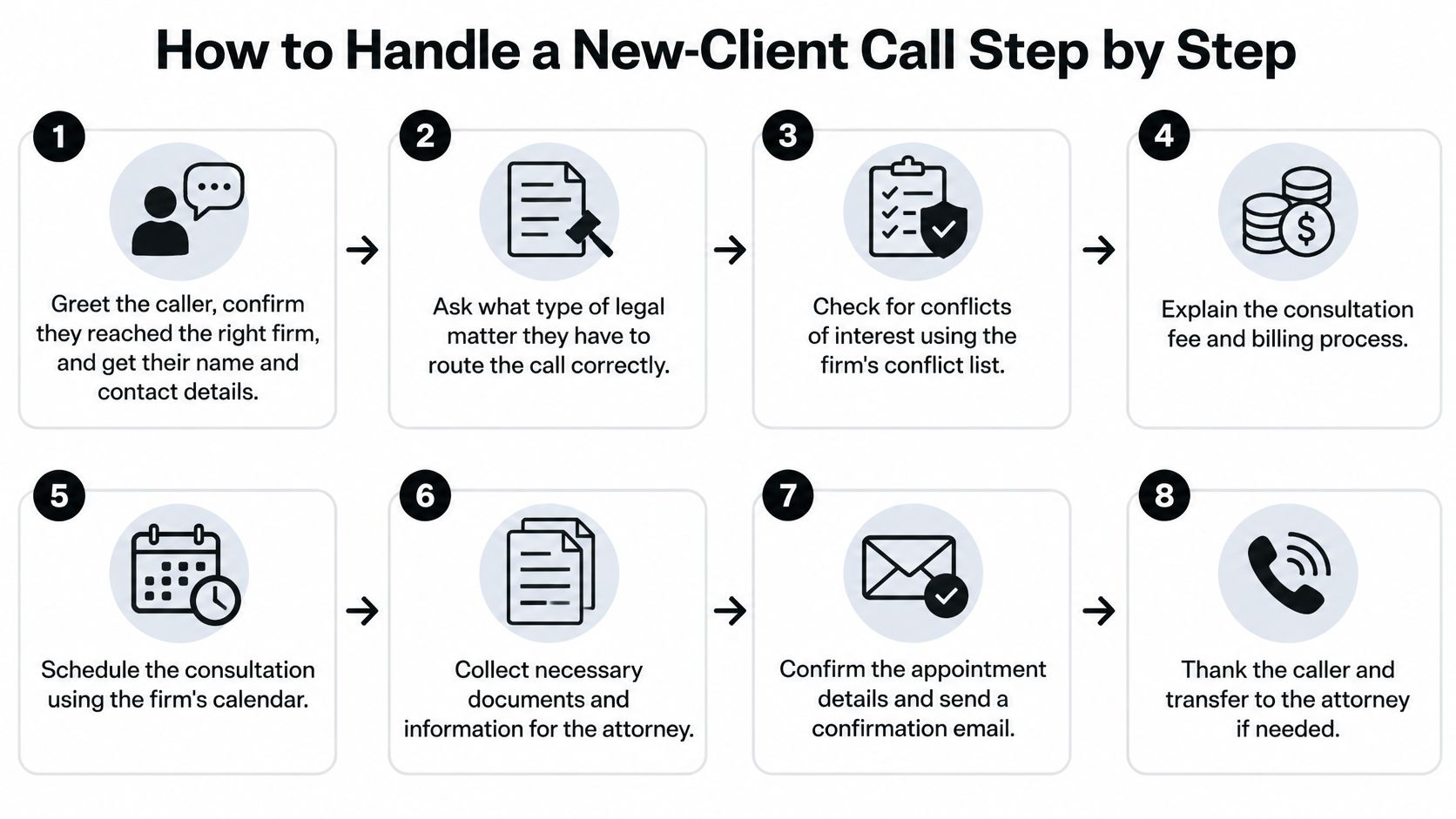
Greet the caller and secure contact details. Confirm the firm's name, then record the caller's name and callback number. This protects the handoff if the call disconnects.
Identify the caller's relationship to the firm. Ask whether the person is a prospective client, existing client, opposing party, court representative, or vendor. Each category needs a different route, so this question prevents a general intake script from being used on the wrong caller.
Record a short matter category. Use the firm's approved categories, such as family, injury, estate, or business dispute. A category helps assign the inquiry without inviting sensitive facts.
Ask about urgent dates. Record any hearing, filing, or other stated deadline and escalate immediately when the firm's urgency rule applies. The receptionist records the date as reported, rather than deciding its legal significance.
Collect opposing-party names. Write down the names the caller provides and confirm spelling for the conflict-check form. Accurate names help the designated reviewer conduct the screening.
Pause the factual narrative. Explain that an attorney will review the preliminary information before detailed facts are collected. This keeps a well-meant request for the full story from creating unnecessary exposure.
Confirm the next contact. Record the preferred contact method and the callback window the assigned team can meet, then read back the limited summary. This catches wrong numbers and prevents vague promises.
Finish the log. Record the call time, captured details, destination, and any information deliberately deferred. That gives the next staff member a clear starting point without requiring another unrestricted interview.
Keep preparation separate from screening
The firm's approved sequence should control any visual checklist. Consultation fees, document requests, and scheduling should follow the firm's authorization rules rather than bypass preliminary screening.
A useful pause line is:
Detailed case facts can wait until the firm completes its preliminary review. The attorney will receive the contact information, matter category, opposing-party names, and any stated deadline.
A completed intake record should also include referral source and follow-up consent, alongside the contact details, category, dates, and opposing names. Sensitive documents shouldn't be requested through an improvised channel.
After screening, a prospective family-law client may benefit from the Miles Hansford Law Firm consultation tips when preparing questions for an attorney meeting. That preparation belongs after the firm has established the appropriate next step.
For offices documenting an automated first pass, SkipCalls intake for small law firms provides a relevant starting point for planning the phone workflow. Attorney approval still determines what the intake script may ask and where it must stop.
Routing Each Call Type to the Right Person
Routing rules by call type
These are proposed office response standards, not universal legal deadlines. The firm should assign the people and backups before putting the sheet into use.
| Call type | First action | Who takes it next | Response time |
|---|---|---|---|
| New prospective client | Collect name, callback number and matter category | Intake coordinator, then attorney after conflict check | Same business day |
| Existing client | Verify identity, then take a message or transfer | Assigned paralegal or attorney | Same business day |
| Court or opposing counsel | Take name, firm, callback number and case reference | Attorney or docketing staff | Immediately |
| Hearing or filing deadline | Record the date and escalate | Attorney on duty | Immediately |
| Vendor, process server or records request | Take name, company and purpose | Office manager | Routine |
| Sales pitch or unrelated call | Politely decline and note the caller | Office manager | Routine |
The new-prospect row is the default for an ordinary inquiry. A stated hearing or filing date changes the order of work: the receptionist alerts the attorney on duty rather than leaving the call in a general queue.
Court and opposing-counsel calls need immediate internal routing because their purpose may affect an active matter. Immediate routing doesn't mean an attorney must abandon another proceeding; it means designated staff receive the message without ordinary intake delay.
Transfer when the handoff can succeed
A transfer connects the caller to an available attorney or paralegal. A message records the caller's name, number, reason, urgency, destination, and promised next step when nobody can take the call.
Before transferring, the receptionist should give the receiving person a brief introduction. If the transfer fails, someone must retain responsibility for the callback instead of assuming another team member received it.
A sample response to a request for legal advice is:
The receptionist can't provide legal advice. An attorney will receive the message the same business day.
That wording should be used only when the firm can meet the stated standard. It promises delivery of the message, not a legal answer or acceptance of the case.
The office manager should also define what “routine” means locally, including a review point for unclaimed messages. A process server reporting time-sensitive service shouldn't remain in an ordinary vendor queue because of the caller's category.
A written approach to sort inbound calls by urgency helps separate who is calling from what requires action. The final task is to post a routing sheet at the front desk with a named recipient, backup, and response standard for every row.
Comparing an AI Receptionist With a Human Front Desk
Human and AI reception compared
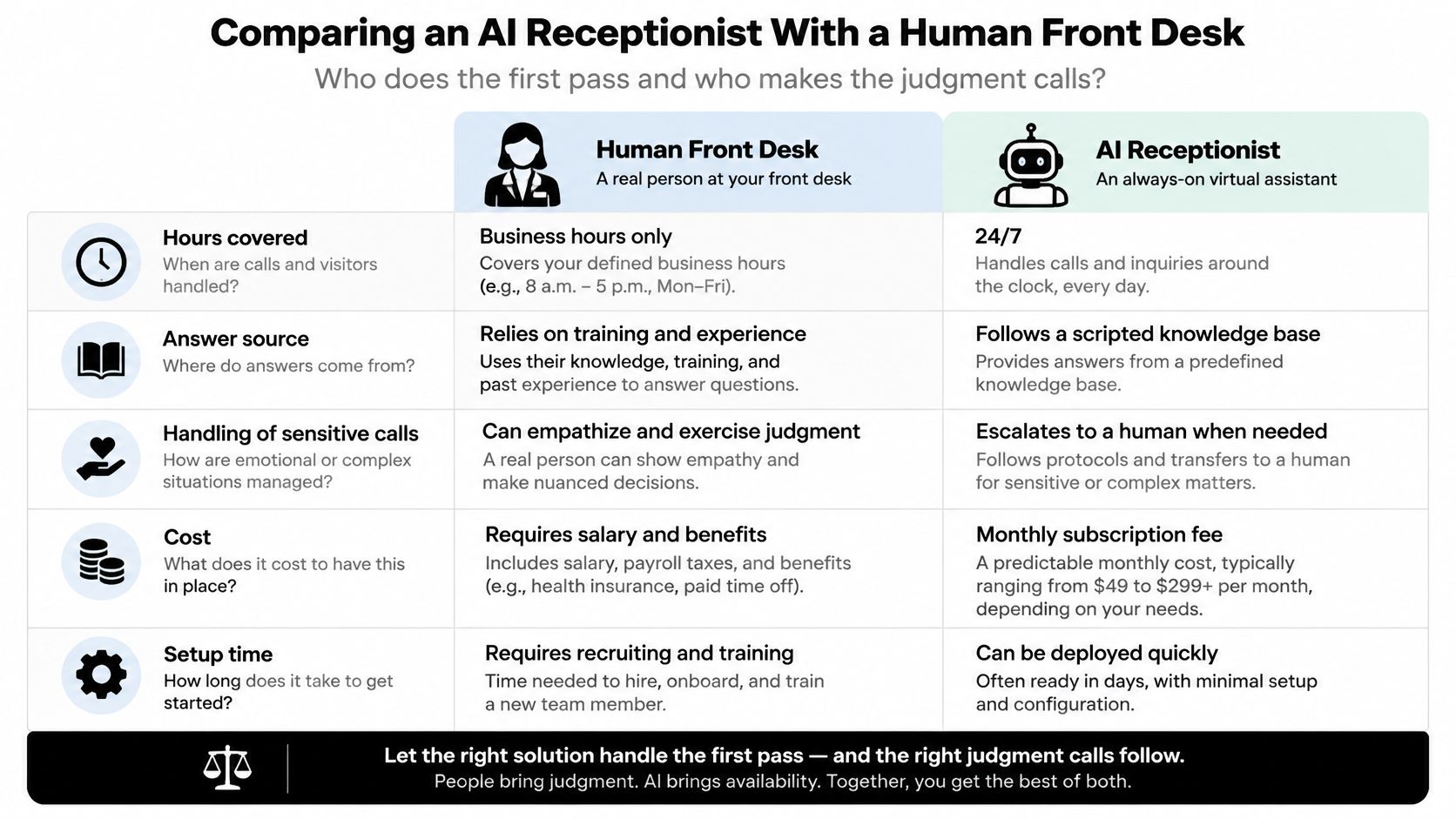
The choice concerns who handles the first pass and who makes judgment calls. Attorney responsibility stays with the firm either way.
| Factor | Human receptionist | AI receptionist |
|---|---|---|
| Hours covered | Set by staffing schedule | Answers forwarded calls 24/7 |
| Answer source | Training, approved materials, and the person's judgment | Answers from information the firm provides |
| Facts held back before a conflict check | Can stop politely when answers run past the approved fields | Collects only the intake fields the firm configures |
| Sensitive or emotional calls | Can provide empathy and exercise human judgment | Needs clear escalation rules to a person |
| Legal advice | Never given; attorney decides | Never given; attorney decides |
| Cost structure | Salary, payroll taxes, benefits and paid leave | Software subscription; see current plans |
SkipCalls is an AI receptionist for small businesses that answers the firm's forwarded calls 24/7 on its existing number, captures caller details, answers questions from the firm's own information, books appointments, blocks spam, transfers urgent callers, and texts the owner a summary of every call. The firm sets the intake questions, approved answers, and transfer rules, so the intake boundary stays where the conflict-check policy puts it.
Match coverage to the actual calls
An AI answering service fits predictable first-pass work: calls missed while staff are busy, after-hours inquiries, repeated questions about location or opening hours, and a fixed intake questionnaire.
The same boundary that protects a human receptionist applies here. If the firm limits intake to name, contact details, and matter type until a conflict check clears, the system collects that and nothing more. A caller who insists on telling the whole story gets routed to a person.
A human remains important for distressed callers, unusual requests, complex transfers, and in-person visitors. Someone must also review uncertain urgency rather than expecting a script to anticipate every situation.
A useful division of work looks like this:
- Predictable questions: Approved office information can be handled without interrupting the case team.
- Emotional conversations: A person should take over when the caller needs reassurance or a flexible discussion.
- Unclear requests: The call should reach designated staff when the caller's answers don't fit the approved path.
- Physical reception: Visitors, deliveries, meeting rooms, and private waiting areas still need an on-site owner.
Setup deserves as much attention as coverage. The firm should test unavailable recipients, incorrect names, incomplete answers, and callers who insist on discussing sensitive facts before a conflict check runs.
The practical verdict: A firm with frequent missed calls and repeatable inquiries has a strong reason to add a first-pass system. A firm with complex walk-in needs should retain a human front desk, even if it adds separate phone coverage.
Setting Up and Measuring Intake at a Small Firm
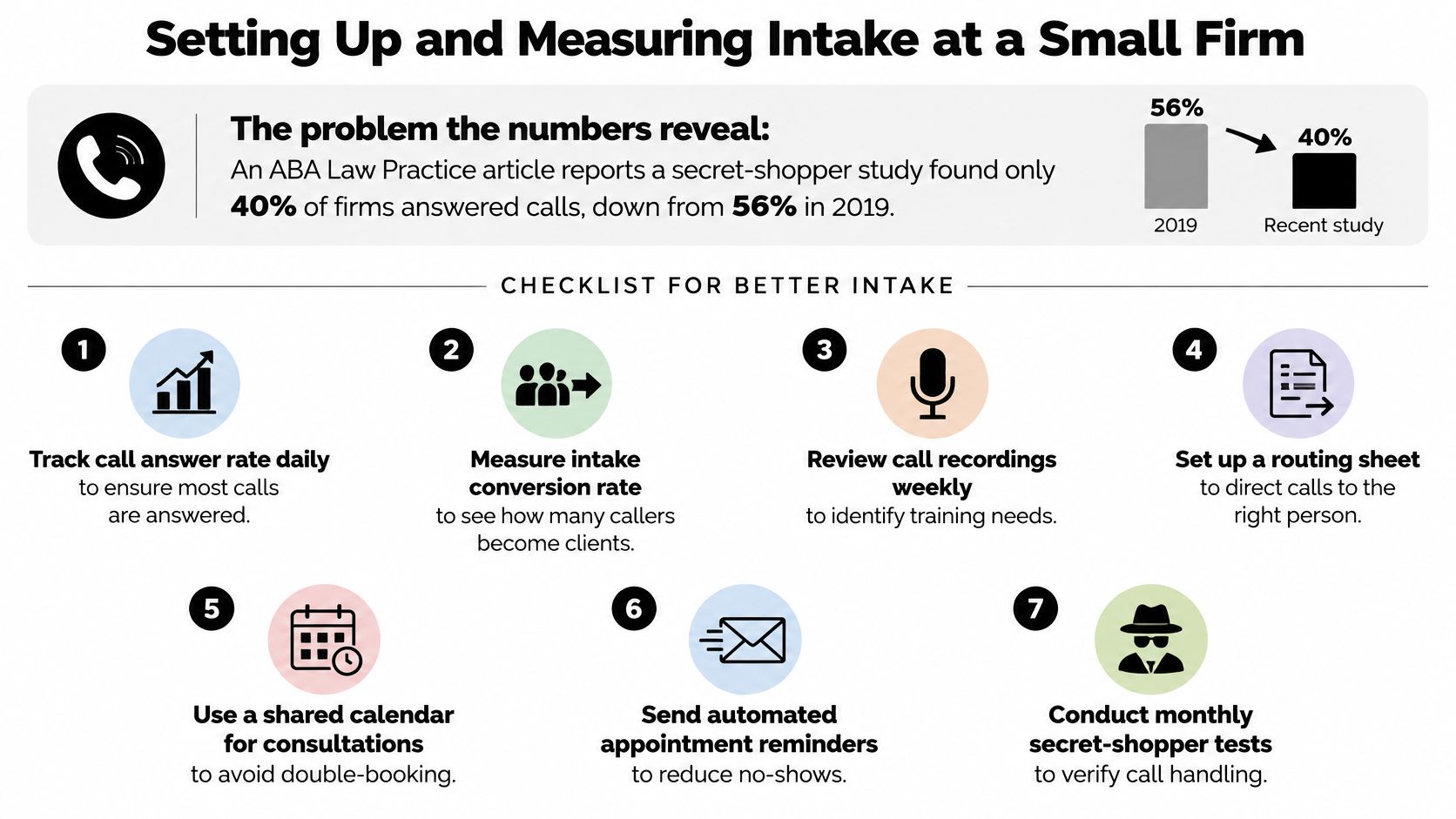
An ABA Law Practice article reports that a secret-shopper study found only 40% of firms answered calls, down from 56% in 2019; it also cites the MIT Lead Response Management Study's finding that contact odds fall 100-fold when response occurs 30 minutes after an inquiry rather than within five minutes. The lead-response finding isn't a law-firm-specific conversion guarantee, but it supports treating callback delay as an operational issue.
Put ownership into the setup
The office manager can use this launch checklist:
- Forward the main number. Test the intended busy, unanswered, and after-hours paths from an outside phone.
- Assign urgent-call recipients. Route stated deadlines to the attorney on duty and name a backup for failed transfers.
- Require the intake fields. Use the approved record rather than allowing free-form messages to replace essential contact information.
- Post the routing sheet. Give every person handling calls the same destinations and escalation instructions.
- Define after-hours triage. Capture the approved fields and transfer deadlines to an on-call attorney when the firm has one. Otherwise, record a next-business-day callback time without implying that waiting is legally safe.
- Own every callback. Attach each promise to a named person and a visible task.
An after-hours answering service should support a defined coverage policy, not an assumption that every lawyer is permanently available. The firm must decide what happens when no attorney can accept an urgent transfer.
Measure completed handoffs
A small dashboard should distinguish an answered call from a useful next step:
- Answer rate: Calls answered out of incoming calls.
- Abandonment rate: Callers who disconnect before the intended handling point.
- Time to human response: Elapsed time before designated staff respond.
- Complete-intake rate: Intake records containing the required fields.
- Qualified-consultation rate: Inquiries reaching a consultation after the firm's screening.
- Prompt missed-call returns: The share of missed calls returned within the five-minute benchmark.
For a practical audit, the office manager can review ten call logs each week as an internal quality-control routine. That's a suggested workload, not an industry benchmark.
The reviewer should check whether staff followed the script, stopped at the intake boundary, reached the correct recipient, and fulfilled callback promises. The purpose isn't to increase bookings: the receptionist gathers and routes information, while the lawyer determines eligibility, conflicts, and representation.
Confirm Your Intake Script Before the Next Busy Week
A phone workflow isn't ready merely because someone answers. It's ready when staff know what to ask, when to stop, and who owns the next action.
- Approve the script. The office manager should turn the call sequence into a working form, attach the prohibited-statement list, and obtain attorney approval. Counsel should also confirm recording, retention, access, and intake rules before launch.
- Complete the routing sheet. Every call category needs a named person, backup, and response time. Nobody should have to guess which attorney is available for an urgent handoff.
- Test the entire path. A staff member should call the firm's line as an unfamiliar caller, try an ordinary inquiry and an urgent scenario, then compare the resulting log with the checklist. A successful greeting doesn't excuse an incomplete message or a failed transfer.
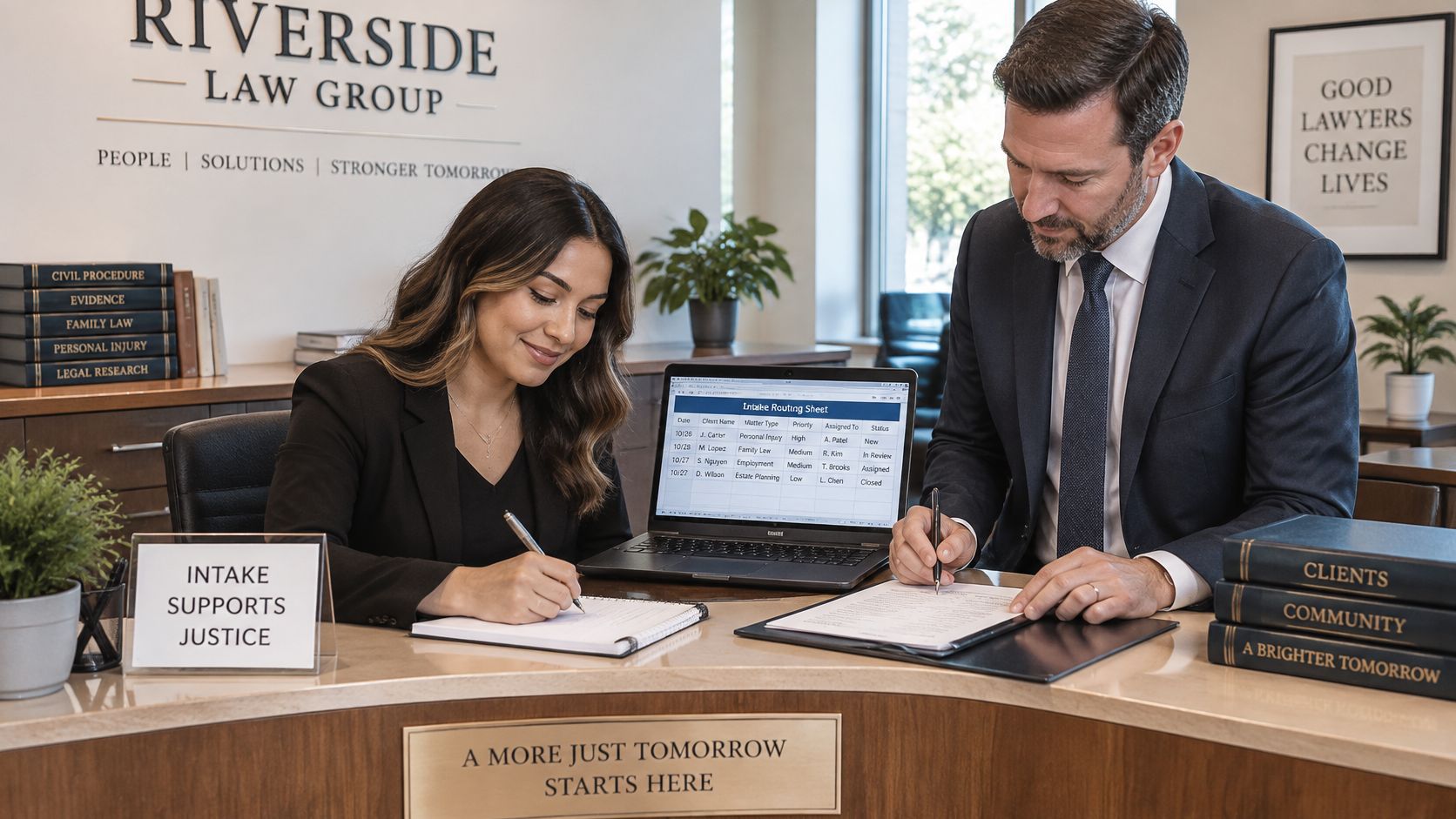
The final review should focus on exceptions: a caller who won't stop sharing details, a recipient who doesn't answer, or a message without a safe callback method. Those situations need approved handling before the next busy period.
A controlled intake process is more useful than a polished greeting alone. The firm's goal is a dependable handoff that preserves confidentiality and gives each caller an honest next step.
SkipCalls offers 24/7 answering with customizable scripts and firm-provided information, helping a law office handle initial calls within attorney-approved boundaries. The free live AI receptionist demo at +1 (888) 884-9511 needs no signup and lets callers speak for as long as they want. To get started, visit SkipCalls after counsel has approved the firm's intake and escalation rules.