
Lead Capture Process: A 2026 Guide to Sales Handoff
Optimize your lead capture process with proven strategies to turn first-click visitors into qualified sales leads ready for handoff.
A lot of small businesses don't have a lead problem. They have an intake problem.
The phone rings while you're on a job. A form comes in after hours. A chat starts while your office manager is helping a walk-in. The prospect did their part. They raised a hand. Then your process stalled somewhere between capture and follow-up.
That's why I don't treat the lead capture process as a marketing widget. I treat it like an operations pipeline. If the pipeline is tight, average traffic can still produce booked work. If the pipeline leaks, more traffic just gives you more missed opportunities to explain away.
The Missed Call That Cost You the Job
At 4:50 p.m., a solo HVAC contractor finishes a service call, gets back in the truck, and finally checks voicemail. There's a homeowner asking for a quote on a failing system. The message came in earlier, while the contractor was inside an attic and couldn't answer.
He calls back at 7:15 a.m. the next day. No answer. Later he learns the homeowner already booked another company, not because that company had better branding or a sharper offer, but because somebody answered on the second ring.
That's the part too many businesses miss. The lead was already there. The number was captured. Interest was real. The lead capture process failed anyway, because the response stage broke.
Where the leak actually happens
When owners talk about lead gen, they usually jump straight to ads, landing pages, SEO, and reviews. Those matter. But for local service businesses, the bigger operational question is usually simpler: what happens when someone contacts you and you can't respond live?
A missed call isn't just a missed conversation. It creates a chain reaction:
- Speed drops: the customer moves on while you're still finishing the job in front of you.
- Qualification gets delayed: you don't learn whether it's urgent, in-area, or even a fit until later.
- Channel choice starts working against you: the prospect picked phone because they wanted immediate help, not a voicemail box.
- Handoff never occurs: nobody gets enough context to turn that inquiry into a booked appointment.
Practical rule: If your business depends on calls, your lead capture process has to work when you're unavailable, not only when you happen to be free.
A lot of owners underestimate the cost of this because the loss is invisible. You don't see a line item in your P&L labeled “jobs lost to callbacks that happened too late.” But it's real, and the true cost of missed business calls usually shows up as low close rates, erratic schedules, and the feeling that leads are “bad” when the issue is broken intake.
The fix starts when you stop treating lead capture like a form on a website and start treating it like a pipeline you can debug.
What the Lead Capture Process Actually Is
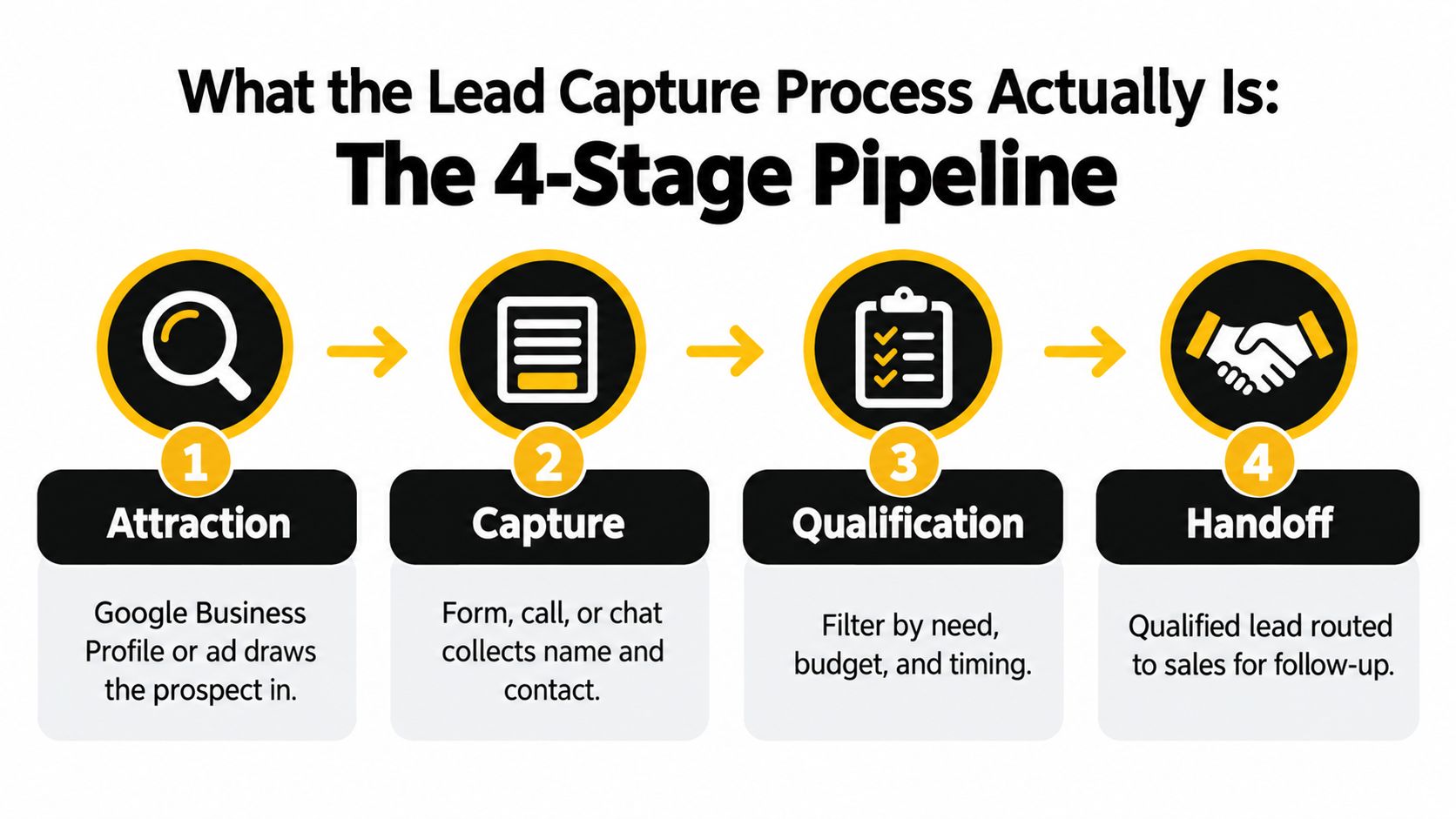
In practice, a lead capture process is a four-stage pipeline: attraction, capture, qualification, and handoff. If any stage is weak, good leads leak out before someone capable of closing ever sees them.
The four stages in plain language
Attraction is how the prospect finds you. For a local roofer, that might be a Google Business Profile. For a B2B company, it might be paid search or outbound targeting. If you want a solid strategic overview for the front end, this guide to B2B lead generation best practices is useful because it connects targeting and channel choice to downstream sales realities.
Capture is the moment contact information gets collected. That could be a submitted form, an answered call, a chat transcript, or a text exchange. Industry reporting summarized by Sender notes that in 2025, 66% of people who start a form complete it, while only 45% of visitors who reach a form end up converting successfully, and average pop-up lead capture conversion reached 4.65%, up from 4.01% in 2024 (Sender lead generation statistics).
Qualification is where you separate a real buyer from loose curiosity. A homeowner asking about emergency water damage tonight is different from someone “just comparing prices” with no timeline. The qualification step decides who gets immediate human attention, who gets nurtured, and who should be filtered out.
Handoff is the transfer of context, not just contact details. The rep, owner, or office manager taking over needs the name, source, reason for inquiry, urgency, service area, and next action. Without that, every follow-up starts cold.
Why most businesses over-focus on attraction
Teams often spend most of their budget and energy on top-of-funnel activity. Then they improvise the rest. One person checks voicemails when they can. Another person follows up from a personal cell. CRM fields are optional. Notes live in memory.
That setup creates avoidable leakage. Multiple 2026 industry summaries report that roughly 79 to 80% of marketing leads never become customers, meaning only about 20 to 21% convert into sales. The same benchmark roundup also reports a median B2B cost per lead of $213 in 2026, up from $198 in 2025, and an average lead-to-customer conversion of 0.94%, or about 1 closed-won customer per 106 captured leads (Saleshandy lead generation statistics).
Good lead capture isn't about collecting more names. It's about making sure the right person gets the right lead with enough context to act fast.
That's why routing rules, intake questions, and CRM structure matter more than many think. A dedicated lead capture software setup is useful only if it supports the full pipeline instead of just collecting submissions.
Choosing the Right Capture Channels
The best channel depends less on trend and more on buyer behavior. People don't behave the same way when they're pricing a long-term B2B platform as when their furnace dies on a winter weekend.
That's why channel selection should start with use case. Not hype.
Rank channels by the job they need to do
Web forms work well for considered purchases. If somebody is researching office renovation quotes or shopping for business insurance, they'll often tolerate a short form because the decision cycle is slower and they expect a later conversation.
Landing pages are better when message match matters. If you're sending paid traffic to a specific offer, a focused page can outperform a general website because it narrows distraction. Benchmark summaries reported by Prospeo say inline forms typically convert at about 1 to 3%, popups or exit-intent at roughly 2 to 6%, dedicated landing pages at 3 to 10%, and form-plus-scheduling flows at about 66.7% of qualified submissions booking an appointment (Prospeo lead capture benchmarks).
Phone calls beat forms in high-urgency categories. Plumbing, HVAC, urgent legal intake, medical scheduling, roadside help, dealership appointments. In those moments, people want an answer, not a form field. Dealership data reported for April 2025 showed phone leads converted to appointments at 74%, compared with a 40% set rate for internet leads (dealership appointment data).
Lead Capture Channels Compared
| Channel | Response Speed | Qualification Depth | Best For | Automation Fit |
|---|---|---|---|---|
| Web form | Moderate | Moderate | Considered purchases, non-urgent service requests | Strong |
| Landing page | Moderate | Moderate | Paid traffic with a specific offer | Strong |
| Phone | Fastest when answered live | Deep | Urgent local services, legal, medical, appointment-driven businesses | Strong with call handling tools |
| Live chat | Fast | Light to moderate | Mid-funnel questions, browsing prospects | Strong |
| SMS | Fast after first touch | Moderate | After-hours follow-up, missed-call recovery, appointment booking | Strong |
For PPC-heavy teams, the front-end media strategy still matters. If you're trying to reduce waste before leads hit intake, Come Together Media LLC's agency alternative is a useful read because it looks at paid lead generation through the lens of tighter execution rather than agency bulk.
A simple channel rule that holds up
Use forms when the buyer is willing to wait.
Use phone and SMS first when the buyer needs help now.
If the prospect has urgency, route them toward the channel with the shortest distance between intent and conversation.
This matters more after hours than during the day. A missed call followed by a quick text often keeps the lead alive. A form that sits untouched until morning usually doesn't. That's why a practical multi-channel messaging approach works better than forcing every inquiry into the same intake path.
Writing Qualification Rules That Filter Real Buyers
Most small businesses either under-qualify or overdo it.
Under-qualify, and your team spends time on bad-fit leads, spam, price shoppers outside your service area, and people asking for work you don't even offer. Over-qualify, and you scare off real buyers by interrogating them on the first interaction.
The fix is a short first-touch rubric that a human or system can apply in about a minute.
Start with BANT-lite, not a full interrogation
For most service businesses, you don't need a long discovery call at intake. You need a few signals that predict whether this lead deserves immediate attention.
Use a trimmed version of BANT-lite:
- Need: What problem are they trying to solve?
- Timeline: Is this urgent, near-term, or someday?
- Fit: Are they in your service area and asking for the kind of work you do?
- Authority or seriousness: Are they the person making the decision, or at least the one gathering quotes for a real project?
Budget can help, but it's often the wrong first question for local services. A homeowner with a leak may not answer cleanly. They will answer whether the issue is urgent, what kind of property it is, and when they need help.
Lead Scoring Rubric for First-Touch Qualification
| Criterion | 1 Point | 3 Points | 5 Points | Route To |
|---|---|---|---|---|
| Need | Vague inquiry or research | Clear service category | Specific problem you solve now | Human if total score is high |
| Timeline | Someday | This month | Today or this week | Fast response queue |
| Service area fit | Outside target area | Borderline area | Core service area | Local rep or scheduler |
| Decision readiness | Not decision-maker | Gathering quotes | Decision-maker ready to talk | Sales owner or estimator |
| Project type fit | Wrong service type | Related but unclear | Strong fit for your offer | Best-fit team member |
Add negative triggers early
Some leads should be filtered quickly, even if they sound active.
- Service area mismatch: Don't keep chasing leads you won't serve.
- Wrong project type: If you do residential only, commercial requests should route elsewhere.
- Competitor or vendor inquiries: Not every caller asking questions is a buyer.
- Incomplete contact path: If there's no workable callback number or reply channel, mark it for limited follow-up.
A clean set of lead qualification questions helps standardize this, especially if multiple people answer phones or handle inboxes.
Field note: The first touch should filter obvious junk and surface urgency. It shouldn't try to close the deal before trust exists.
The point of qualification isn't to make intake feel smart. It's to help a new hire, office manager, or automation layer make the same routing decision every time.
Speed to Lead and the Follow Up Window
Lead response time is the most controllable part of the pipeline, and most businesses are slower than they think.
Recent benchmarks summarized by Growth Centr report that the median inbound-lead response time is 42 hours, about 35% of leads wait more than 24 hours for any response, and leads contacted within five minutes are 21 times more likely to qualify than those contacted after 30 minutes (Growth Centr lead generation statistics).
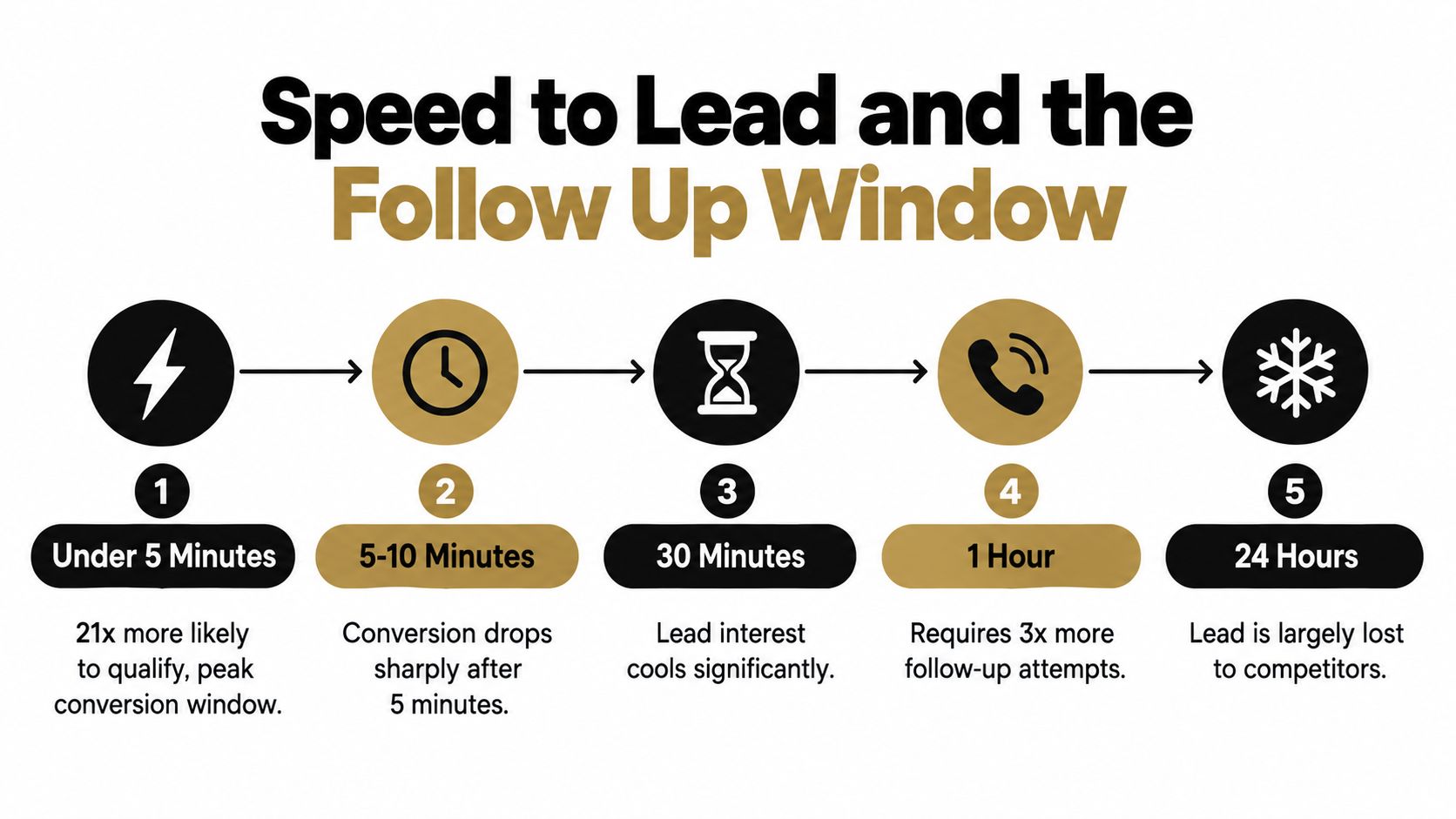
That's the operational gap right there. Teams obsess over generating more leads while letting existing leads cool off in voicemail, inboxes, and unassigned CRM records.
What fast follow-up changes
InsideSales summarized a large lead-response study showing that contact rates were 28.4% higher in the 9:00 to 10:00 a.m. window than the full-day average, 27.2% higher from 6 to 11 a.m. than noon to 6 p.m., and conversion rates were 8 times higher when follow-up happened within 5 minutes versus 6 or more minutes (InsideSales lead response infographic).
For a service business, that means volume doesn't rescue a slow process. If three solid inquiries come in while nobody responds, buying more traffic only creates a bigger pile of neglected demand.
Here's a useful walkthrough on how these intake gaps show up in real businesses:
What to automate first
Don't start with fancy nurture logic. Start with the obvious failure points.
- Instant confirmation: Send a text right away so the lead knows you received the inquiry.
- Calendar link: If the request fits self-booking, offer the next step immediately.
- Auto-assignment: Route by territory, service line, or urgency so no lead sits ownerless.
- Untouched-lead reminder: Trigger a task if nobody has taken action within your response window.
A fast process still needs human escalation. Automation can acknowledge, collect details, and route. It can't be your excuse for making prospects argue with a bot when they need judgment, empathy, or a pricing conversation.
Where AI Receptionists Fit Into the Pipeline
AI receptionists earn their keep in the gaps humans leave open. Nights, weekends, on-site jobs, lunch breaks, and those stretches where everyone is already on another call.
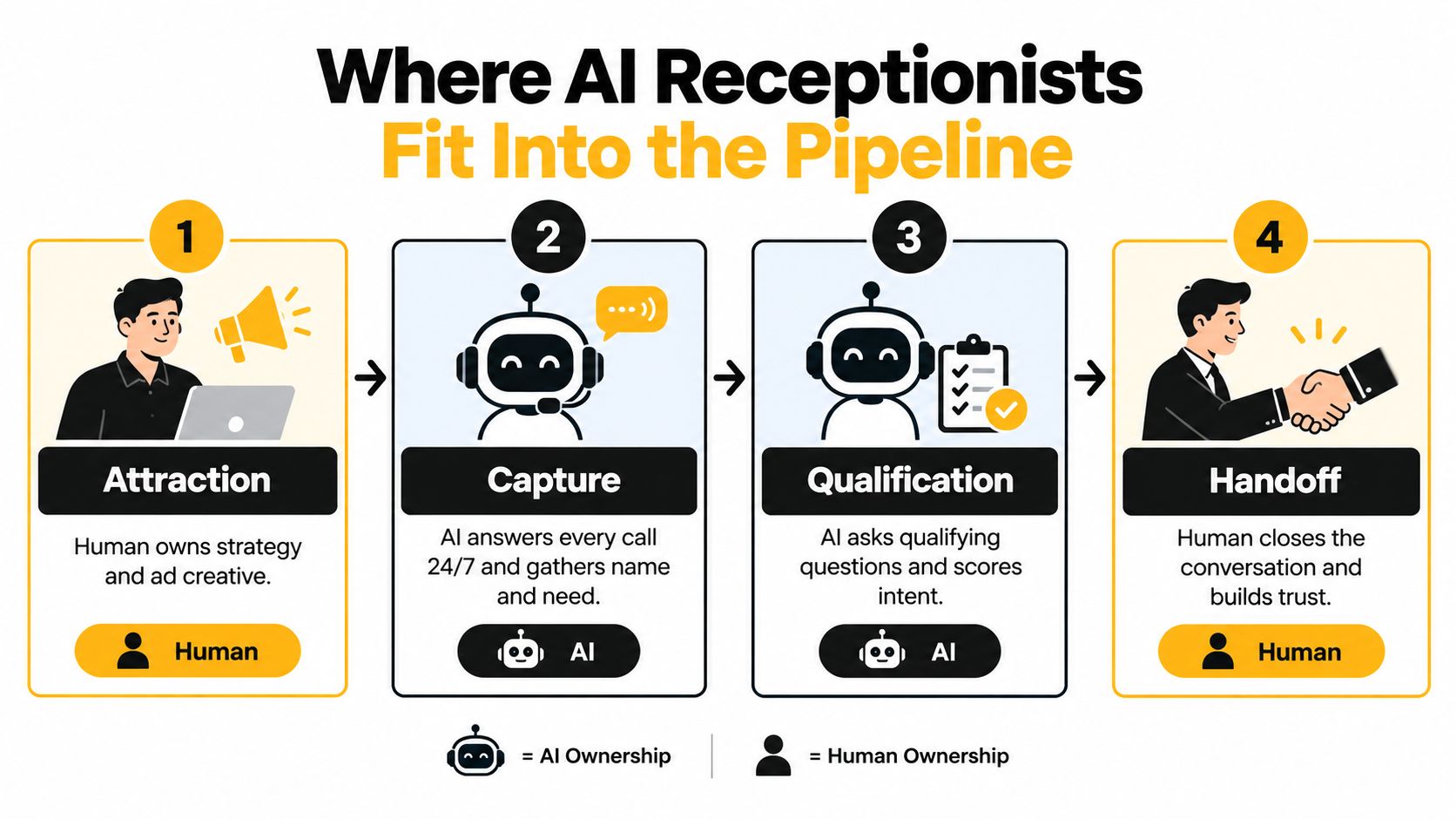
Used correctly, they support the lead capture process at capture, qualification, routing, and follow-up. Used poorly, they just create cleaner records for lost leads.
What AI should own
At the capture stage, AI can answer inbound calls in real time, collect caller details, and keep the conversation moving instead of dropping the person into voicemail. Industry guidance from OnceHub describes AI answering tools as systems that can qualify callers, book, reschedule, or cancel appointments on connected calendars, while syncing with platforms such as Google Calendar, Outlook, Salesforce, and HubSpot so records don't require manual entry (OnceHub AI answering guide).
For missed calls, text-back workflows also matter. Some systems support two-way SMS after the missed call so the conversation can continue over text, and one provider specifically notes these workflows can connect to calendars and CRM tools through Zapier, which it describes as supporting 6,000+ apps (AI front desk missed-call text-back).
What humans should still own
Humans should take over when the conversation requires judgment. Pricing nuance. Frustration. Exceptions. Negotiation. Requests for a specific person. Sensitive legal or insurance context. Edge cases are where trust gets built or lost.
The handoff trigger should be explicit. AI handles intake and scheduling. A person takes over when the caller needs advice, reassurance, or a decision.
This is also where tooling depth matters. Some business texting platforms sync calls and texts directly into CRM timelines, and one example specifically mentions HubSpot two-way sync with texts, calls, and AI summaries, plus Salesforce logging and real-time contact sync (Salesmessage platform details).
SkipCalls is a simple-to-set-up solution that works for any case, from customer support, lead qualification, appointment booking, and many more. It handles voice and text and does not require you to change your phone number to integrate into your workflow. It has many integrations with CRM and calendars.
The operational warning is simple. AI won't save a messy process. If your qualification rules are weak or your calendar logic is wrong, automation will apply those mistakes at full speed.
Your Weekly Lead Capture Audit
Most intake problems don't need a quarterly strategy retreat. They need a weekly review that catches leaks before they become habits.
Set aside 30 minutes. Pull your call log, form submissions, CRM tasks, and booked appointments. Then run four quick passes.
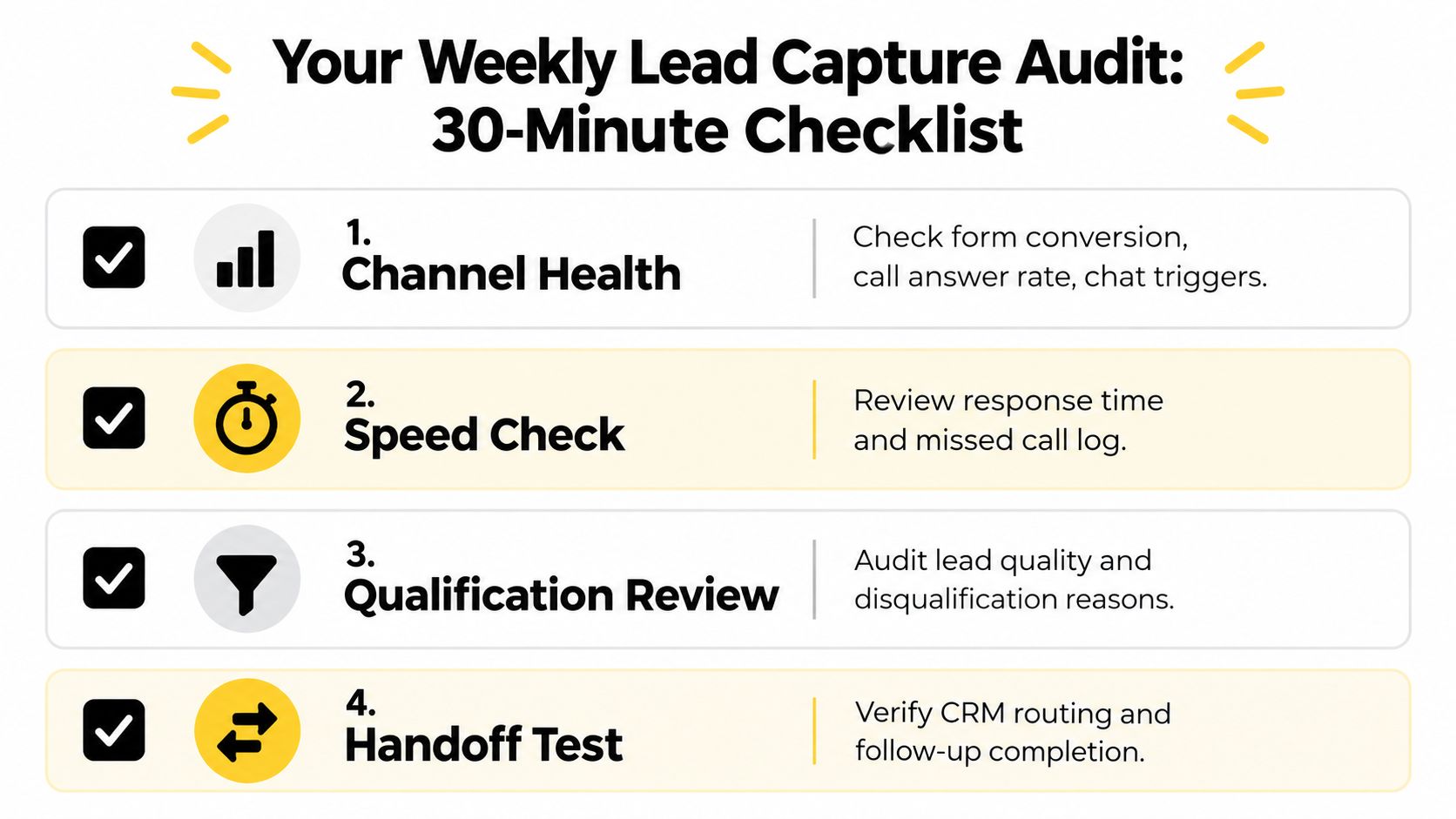
The four-pass review
Channel health. Check whether inquiries are entering the pipeline cleanly. Look at form completion quality, answered versus missed calls, chat transcripts, and whether after-hours contacts received a response path.
Data hygiene. Spot duplicate contacts, missing phone numbers, missing source tags, and notes that say almost nothing. Bad data doesn't just annoy your team. It breaks routing and follow-up.
Speed check. Review how long new leads sat untouched and whether warm leads got the required attempts. If someone had to guess who owned a lead, your handoff failed.
Pipeline leakage. Look at where prospects stalled. Did they never get contacted? Did they talk but never book? Did sales reject them as poor fit? Leakage has a stage. Find the stage before changing everything.
Five metrics worth watching every week
You don't need a huge dashboard. You need a handful of indicators that tell you where the process is slipping.
- Missed-call recovery: Are missed calls getting a live follow-up path or just sitting in voicemail?
- First-response discipline: Are new inquiries acknowledged quickly enough to keep the conversation alive?
- Qualification consistency: Are similar leads being scored and routed the same way?
- Booking conversion: Are qualified inquiries turning into appointments, not just callbacks?
- Handoff completeness: Does the closer receive context, or a bare phone number and guesswork?
Troubleshooting matrix
| Problem you see | Most likely broken stage | First fix to try |
|---|---|---|
| Low contact rate | Capture or speed | Add instant text-back and clearer ownership |
| Slow response time | Handoff | Auto-assign leads and set untouched-lead alerts |
| Too many junk leads | Qualification | Tighten first-touch questions and disqualifiers |
| Good conversations, few bookings | Handoff or channel fit | Add direct scheduling or live transfer |
| Reps complain leads are “bad” | Qualification or data hygiene | Audit notes, source tags, and scoring consistency |
Audit the ugliest leak first. Don't redesign the whole funnel when one broken handoff is doing most of the damage.
A reliable lead capture process is operational muscle. Review it weekly, fix one constraint at a time, and only revisit channel mix after the intake and handoff basics are stable.
If your business depends on calls, the biggest leak is usually what happens when nobody can answer right away. SkipCalls helps cover that gap by answering calls, capturing details, handling texts, and booking appointments so leads don't die in voicemail. If you want your lead capture process to work after hours, during jobs, and without hiring a full front desk, it's worth a look.




