Why "Missed Call Text Back" Is Costing You High-Value Jobs
Think automated texts are saving your missed calls? Think again. Discover why high-value leads prefer voice and how AI receptionists capture the jobs texts miss.
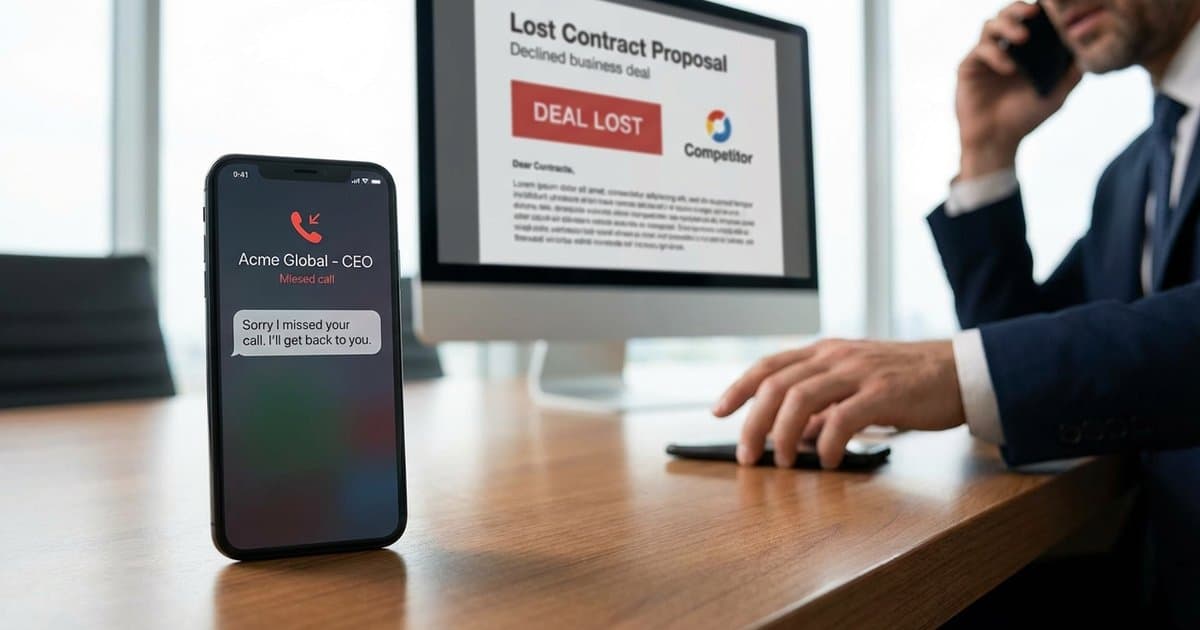
It’s 2:00 PM on a Tuesday. You’re under a sink, wrestling with a corroded pipe, or maybe you’re on a roof inspecting storm damage. Your phone buzzes in your pocket. You ignore it—you have to.
Seconds later, your automated software kicks in. Ping! The caller gets a text:
"Sorry I missed you! How can I help?"
You breathe a sigh of relief. You have a system. You didn't "miss" the lead... or did you?
For the last few years, "Missed Call Text Back" has been the gold standard for busy contractors. It’s certainly better than a black hole of silence. But in 2025, homeowner expectations have shifted again.
If you are in a high-urgency trade—like plumbing, HVAC, or electrical—that automated text message might be costing you your best jobs. Here is why the text-back safety net is full of holes, and why voice is making a comeback.
The Psychology of Urgency: Why Texts Fail
Put yourself in the shoes of a homeowner.
It’s 95 degrees out, and the AC just died. Or worse, there is water rapidly pooling in the basement. They are panic-scrolling Google for a plumber. They call the first number with 5 stars.
No answer.
Then, a text message pops up: "Sorry I missed you..."
Does that text stop the panic? No. Does it fix the problem? No. It just tells them you are busy.
While they are reading your generic text, they are already dialing the next number on the list. The contractor who answers the phone—even if it’s an AI—and says, "I can have someone there by 4 PM," wins the job.
Key Stat: 78% of customers buy from the first business that responds meaningfully. In an emergency, a text is an acknowledgement, not a response.
The "Commodity" Trap
When you rely on automated texts, you strip away your personality. You become just another faceless service provider.
High-value jobs—whole home repipes, system replacements, major renovations—are built on trust. Trust is hard to convey in 160 characters.
When a potential client hears a voice, even a synthetic one that sounds professional and capable, it triggers a different part of the brain. It signals competence. It signals that a system is in place.
If your competitor answers with a professional greeting and your business answers with a robot text, you are starting the race ten yards behind.
The "Phone Tag" Nightmare
Let’s say the customer does reply to your text. Now what?
Customer: "I have a leak under the sink." Auto-Text: "Great! When are you available?" Customer: "Now." You (2 hours later): "I can't do now, how about tomorrow?"
By the time you wash your hands and check your phone, that lead has gone cold. You end up playing phone tag for three hours to book a job that should have taken three minutes.
This friction kills conversion rates. Every back-and-forth text is an off-ramp where the customer can decide to go with someone else.
Are You Losing Jobs to 'Text Back'?
Question 1 of 2
Do you offer emergency or same-day services?
Are You Losing Jobs to 'Text Back'?
- Do you offer emergency or same-day services?
- What is your average job value?
The Solution: AI That Actually Talks
So, if you can't answer the phone because you're working, and text-back is losing you leads, what’s the middle ground?
Hiring a full-time receptionist costs $40,000+ a year. That’s out of reach for most solo operators or small crews.
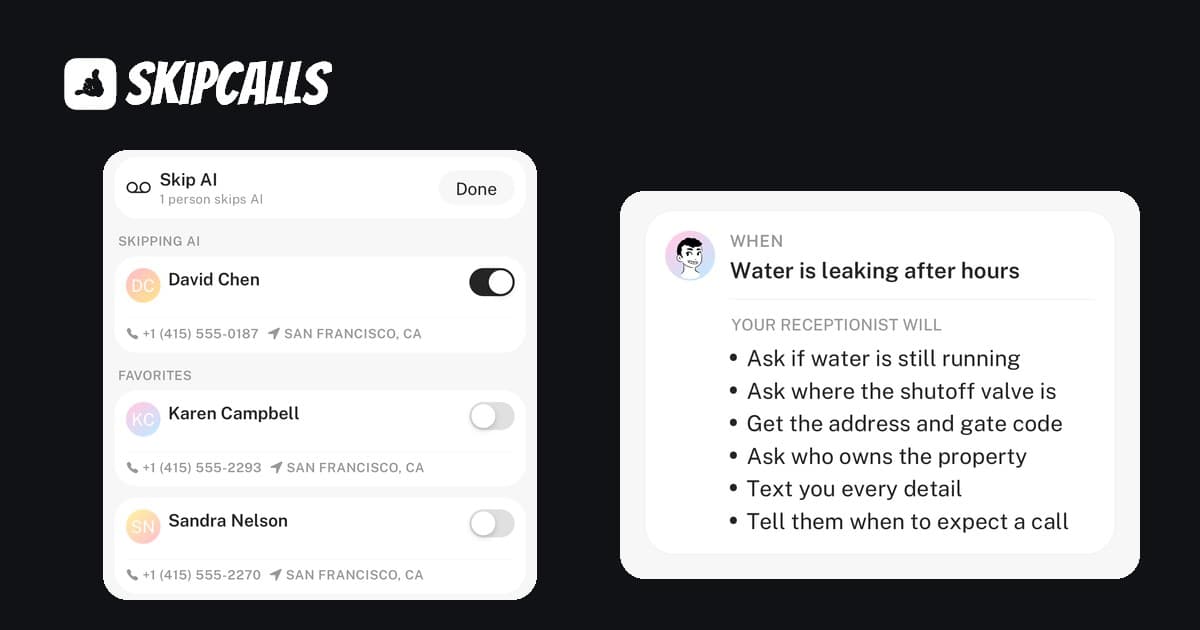
This is where AI Voice Receptionists like SkipCalls bridge the gap.
Instead of a text, your caller gets an answer.
- It sounds like you: Using voice cloning technology, the AI speaks with a natural, human tone.
- It handles the conversation: It asks what the problem is, checks your real-time availability, and books the appointment.
- It stops the shopping: Once a customer has a confirmed slot on the calendar, they stop calling other plumbers.
Scenario A: The Old Way (Text Back)
- Customer calls -> No Answer.
- Customer gets text -> Replies "Need help."
- You reply 2 hours later -> Customer has already hired "Speedy Rooter."
Scenario B: The New Way (SkipCalls)
- Customer calls -> SkipCalls answers instantly.
- AI: "Thanks for calling BrightSpark Electric. I can see we have an opening at 2 PM. Should I book that for you?"
- Customer: "Yes, please."
- Job Booked. You get a notification. You never stopped working.
When to Use Text vs. When to Use Voice
We aren't saying text is dead. It has its place. Here is a quick breakdown of when to use which:
| Situation | Best Tool | Why? |
|---|---|---|
| Emergency / New Lead | Voice AI | Speed and trust are critical. Secure the job instantly. |
| Appointment Reminder | Text | Non-intrusive, helpful. |
| Asking for Reviews | Text | High open rates, easy to click links. |
| Complex Quote Questions | Voice | Too hard to explain technical details via text. |
How to Upgrade Your "Missed Call" Strategy
If you are ready to stop relying on a text message to save your business, here is how to get started:
- Audit your missed calls: Look at your call log from last week. How many unknown numbers didn't leave a voicemail? How many texts went unanswered?
- Calculate the loss: If just one of those missed calls was a $2,000 HVAC install, you’ve lost more money than an AI receptionist costs for ten years.
- Try Voice AI: You don't need to change your number. With SkipCalls, you just set up call forwarding. It takes 5 minutes.
Stop "Acknowledging" and Start "Booking"
Text messages are great for friends and appointment reminders. They are terrible for closing urgent business deals.
Don't let a $500 job slip through your fingers because you sent a robot text instead of a solution. Upgrade to an AI receptionist that works as hard as you do.
Ready to capture every lead? Try SkipCalls free for 7 days and see the difference a voice makes.